

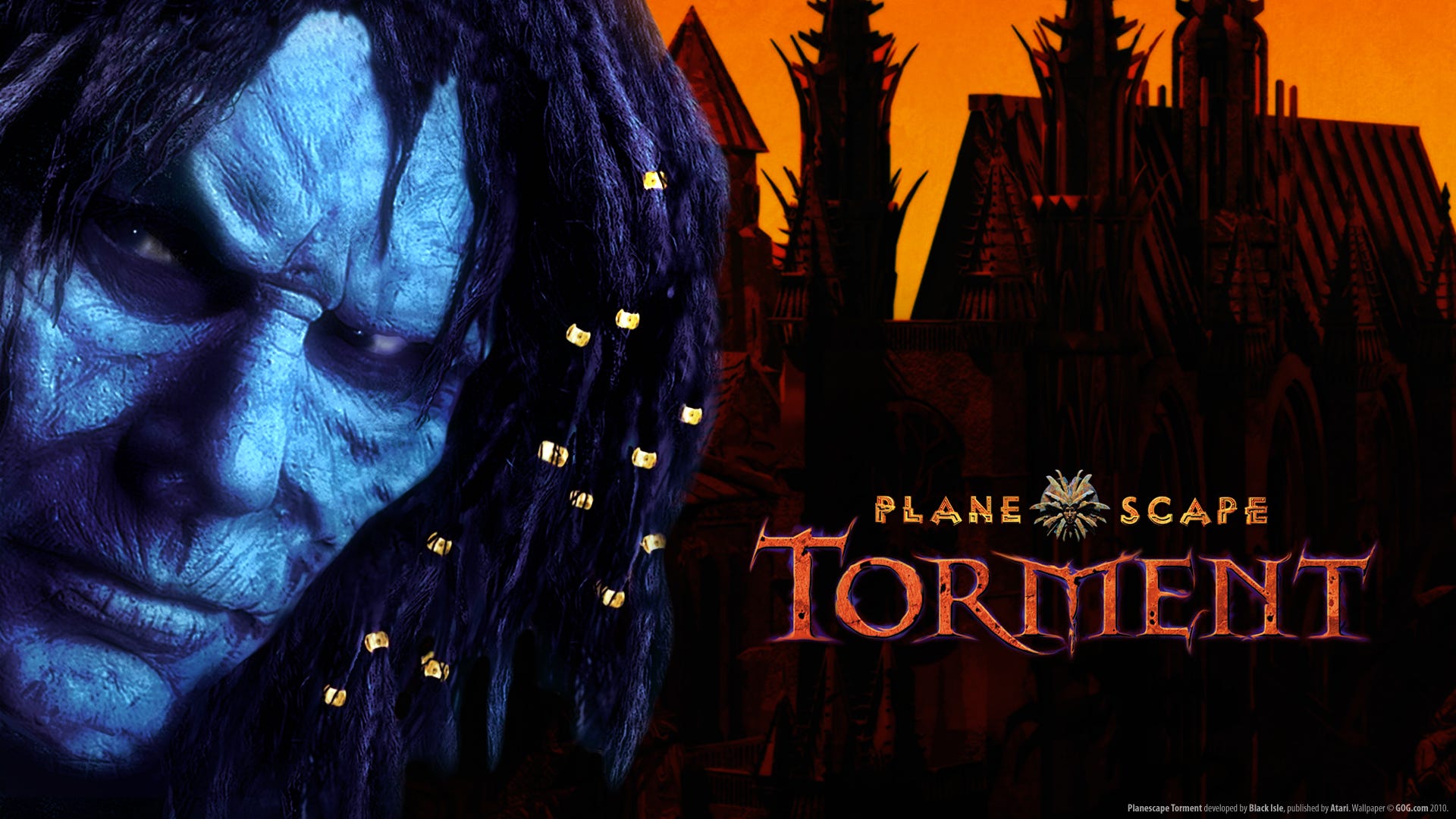
Today I have finally beaten Planescape: Torment. Over the course of my life I have undertaken this task approximately as many times as the Nameless One has been reborn from death. The furthest I ever got was in college, when it came out for iPad. I reached Ravel Puzzlewell’s maze and promptly lost interest.
This incarnation was far from my first. I made it partway through Sigil who-knows how many times in my childhood. Always my older brothers would assure me that Torment was the best cRPG and that I had to beat it. As I grew older, this sentiment seemed to be found everywhere online. Thus again and again I would try, and again and again I would fail.
As a child, my main objection was that the Nameless One wouldn’t put on a shirt. As I grew older, I started to hate the gameplay instead.
Despite all this I knew that if I just sat down to finish the game, I would enjoy it. I knew so many RPGers weren’t wrong. I knew Chris Avellone was a great writer. I just had to get it over with.

Now it’s done. And it seems that everyone was right. The final act of Planescape: Torment is brilliant and moving and is the best climax of any RPG ever made. You will find hundreds of video essays on YouTube explaining why. Avellone and his team paved the way for games that give actual characters for the player to inhabit, rather than empty sacks of meat, and in so doing set the stage for games like KotOR, Mass Effect, and finally The Witcher.
But although I loved it in the end, Torment was not easy for me to get through. I’m glad my time with it is over. My playthrough felt a lot like eating my vegetables. I knew I had to do it because it was good for me; and while I wanted to know how it ended, I was never especially engaged with the plot itself until the very last moment. The story is mostly just asking questions to a long line of NPCs, which I don’t find especially engaging. The dialogue trees themselves are very poorly constructed, and the text itself is enormously overwritten.
Originally I was going to compile examples of both of these sins. I thought that I should bitch about this game as old as I am like I usually do.
I won’t this time. I have no desire to nitpick this game, or explain why I found it hard to get through, because the reality is this: it’s old. It’s dated. It has a lot of problems. Everyone can see that. You can see that for yourself. But unlike with Fallout 2 or Diablo 2, the love Torment receives is no mystery. I have no desire to deconstruct it.
Torment is far from my favorite cRPG. I like it a lot less than Fallout 1, and about as much as Fallout 2 (2 and Torment are bad for many of the same reasons). I don’t think it’s as good as Torment: Tides of Numenera, and I think Avellone’s more recent examination of the same themes in Prey is far defter.
But I am glad to have played it. And I hope someday, as I flounder with my writing career, I can come up with something anywhere near as compelling as what Avellone manages in the final few hours of Torment. Like KotOR 2, here is a game that could desperately use a remake.
What can change the nature of a blogger?
For years, through all of high school and college, every time I watched a movie, read a book, or played a game, there ignited within me an unquenchable desire to analyze and deconstruct whatever I had just consumed. This fire was at its brightest after the shitshow launch of The Last of Us: Part II; it became so intensely hot, so blinding and destructive, that I had no choice but to launch this blog. Everyone had to know why that game was so terrible.
For a while, I felt similarly about everything I was exposed to. The result is the long catalogue of posts on theplayeristhething.com. I took far more joy in the analysis of a thing than in the thing itself.
In recent years, that joy has seriously waned. This blog has been maintained more out of a sense of obligation than desire. The energy that a review requires has seemed so much better spent on my fiction than on complaining about things on the Internet.
I’ve been contemplating this for a while now, but Torment has driven the point home. At first I had written out an entire essay bitching about the dialogue trees from this game released in 1999. But who fucking cares? Modern games have vastly improved that part of RPG design. It's not an issue that needs discussing. Obsidian innovated and figured out how to write games like this after Pillars. So who cares?
Not me. So it's not worth the time or effort. I don't really care, and neither do you (if you even exist). Creation is far nobler than deconstruction. I think I’ll do that instead.