


October, 2010. My parents are away for the weekend. My eldest brother has come home from college for babysitting duty. He shows me Evil Dead for the first time at midnight on Saturday. After a long discussion about the film, I'm ready to head to bed.
"Wait," he says, "it's not that late. Let's play a game."
He installs a client called BYOND on my PC and sets up his laptop on a nearby table. BYOND has a blue UI that looked ancient even then. Apparently this is a free platform for creating multiplayer games, but alongside every game--and there are thousands--is a playercount that reads 0.
"What are all these?" I ask.
"They're games," he says. "Scroll down to Space Station 13."
I find it in the list. Unlike the other games, it has sixty players online.
Stay alive inside Space Station 13
The story goes like this:
In 2003, a grad student named Exadv1 created a multiplayer atmospherics simulation. This was its sole purpose. You played one of a number of different roles onboard a space station, and as holes were blasted into walls, compartments were depressurized, and the oxygen in the station was replaced by methane or helium, the air composition at any point would be simulated.
Depending on whether or not the air was breathable, you'd start to choke. Depending on whether or not the air was flammable, a spark might start fires. And if there was no air at all, you'd choke and then freeze (unless you had a space suit).
Over time the simulation became more and more robust. By the time I started to play in late 2010, the game had diverged into a number of distinct servers, each with separate code and lore. All shared a few common features:
Medical Simulation
How much blood is within any player at a given time? Are any of his limbs broken? Have his organs sustained damage? Is he blind, and can he still breathe?
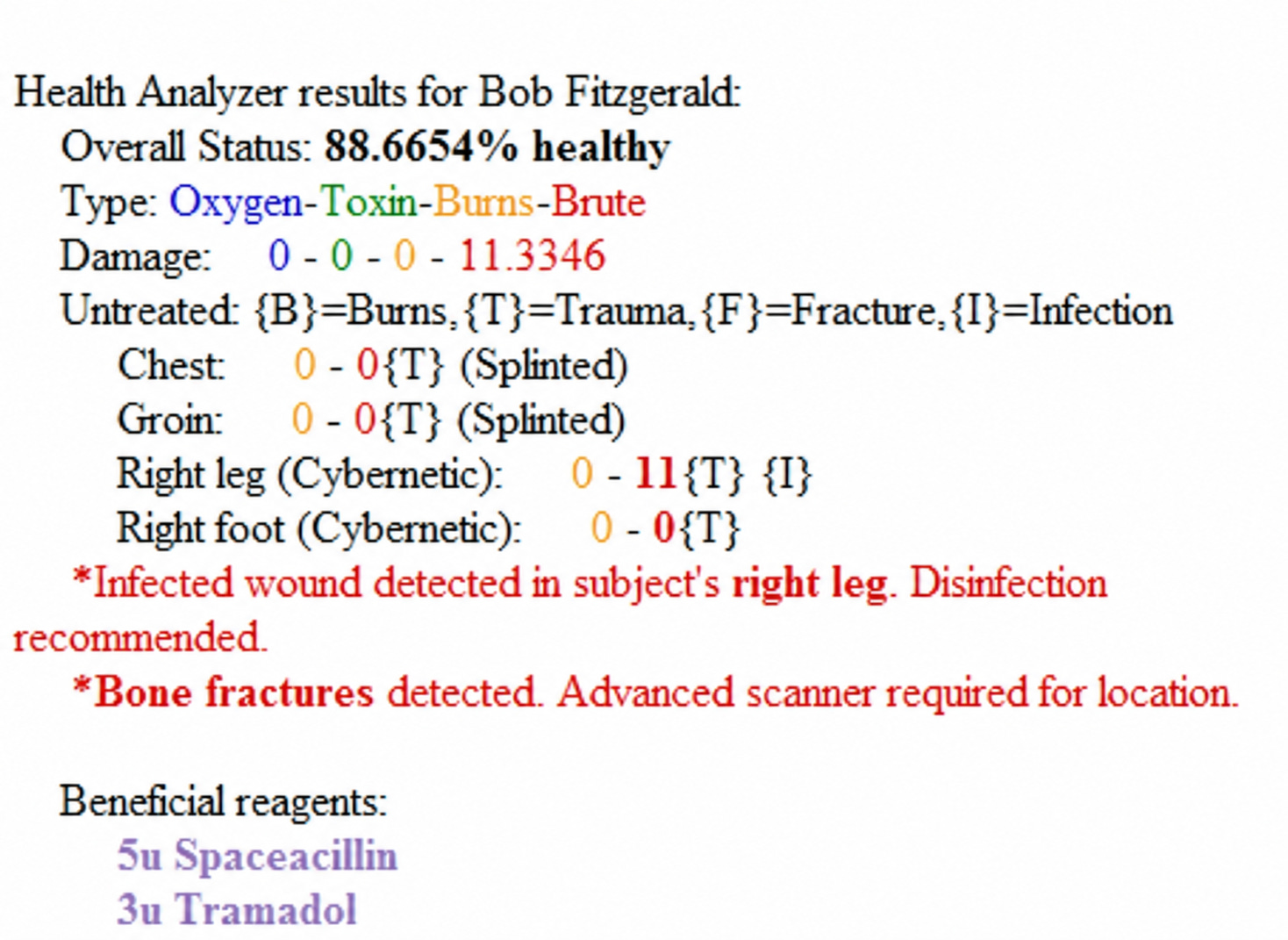
All of these questions are answered in SS13. The game individually simulates any aspect of your character's medical condition that you could ever want to know, from how well your liver is functioning to whether or not you've fractured your toes.
Hands Simulation
The primary gameplay in SS13 is acting as a puppeteer for your "2D spessman," as players like to put it. The core of this is the management of your hands.
You have two of them, ideally, although it's possible to lose one or the other (or both on a bad day). With your hands you will pick up objects and interact with everything else in the world. How good you are at manually swapping between your hands via X or MMB and then using them via Z is fundamental to determining how "robust" you are (the game’s term for how close a player is to reaching its incredibly high skill ceiling).
Hands and medical simulation are two of the main things that make SS13 so special. Although not exactly realistic, these allow server developers to implement systems that normal, more intuitively designed games could never hope to design. They permit the mechanization of things like reloading, which, in most games, are completely token. Not so here. Here, how good you are at reloading determines how good you are at the game as a whole.
Roleplaying Elements
Space Station 13 is a roleplaying game. Upon entry you create your character: give him a name, choose preferred roles, and select a haircut (this is vital, or else you will be called Bald).
Different servers have different levels of seriousness expected for roleplay, from "low RP" to "high RP." In general, no one tolerates "icky ooc"--in character knowledge being shared through out-of-character chat--and "oocky icky"--out of character knowledge being explained in a non-diegetic way through in-character chat.
Even high RP on SS13 tends to amount to little more than writing your dialogue in a funny accent, but this culture of roleplay does provide a framework for enabling truly gripping emergent narrative.

Don't Throw Away Your Shot
You have one life. If you die, you're out for the round. You'll have to wait for the next to join in once again. This has huge ramifications for player behavior.
Mayhem
This is what makes Space Station 13 worth discussing. Without central conflict, it's an interesting RP anomaly on a vast internet, fun to dick around with now and then but lacking anything worth holding onto.
But then come the traitors.
And the wizards.
And xenos.
And changelings.
And Syndicate.
On a traditional SS13 server, each round has some kind of hazard. A number of players are selected to be traitors, for example, and must work in secret to assassinate random targets, corrupt the AI, or destroy the station entirely via a nuclear device.
I stopped playing SS13 in 2013 because these elements weren't important enough. You'd be a traitor one out of every twenty or thirty rounds, and your odds of even interacting with a hazard before round-end were negligible.
That meant not enough conflict, and not enough conflict meant boredom.
I filed BYOND away and went on to other things.
Colonial Marines 13
In 2017, I started feeling nostalgic. So I redownloaded BYOND, expecting only to play a few rounds of Goonstation before going back to something else.
I was expecting a population of ~100. Instead, I saw 800. I recognized most of the servers, but the one at the top of the list stood out: it was called "Colonial Marines."
I love Aliens. I like it so much that I even beat Aliens: Colonial Marines. I clicked that server’s name very quickly. My life would never be the same again.
CM13: An Overview
In Colonial Marines 13, most players assume the role of marines investigating a distress beacon on a Weyland-Yutani colony, while the rest play either the xenomorph hordes or any remaining survivors. This playmode for SS13 preserves the game’s complexity while introducing formal deathmatch and competitive elements in a semi-structured “medium RP” environment.
This format gives SS13 what it always lacked: reliable conflict. That conflict facilitates endlessly engaging gameplay.
The Best Military Sim Ever Made
CM13 would not work if it was simply a deathmatch between marines and aliens. Instead, it is a combined arms military simulation, with a complex division of roles.
On the ship, players can control Command, Medical, Requisition, or Engineering staff, as well as the Military Police. Command helps coordinate marines; Medical fixes up their injuries; Requisition manages logistics, with Command’s help; Engineering keeps the USS Almayer operational; and the MPs grief players.
These roles together make sure the marines can do what they do. Any round of CM13 is a complex logistical dance between the soldiers on the ground and the officers in the sky.
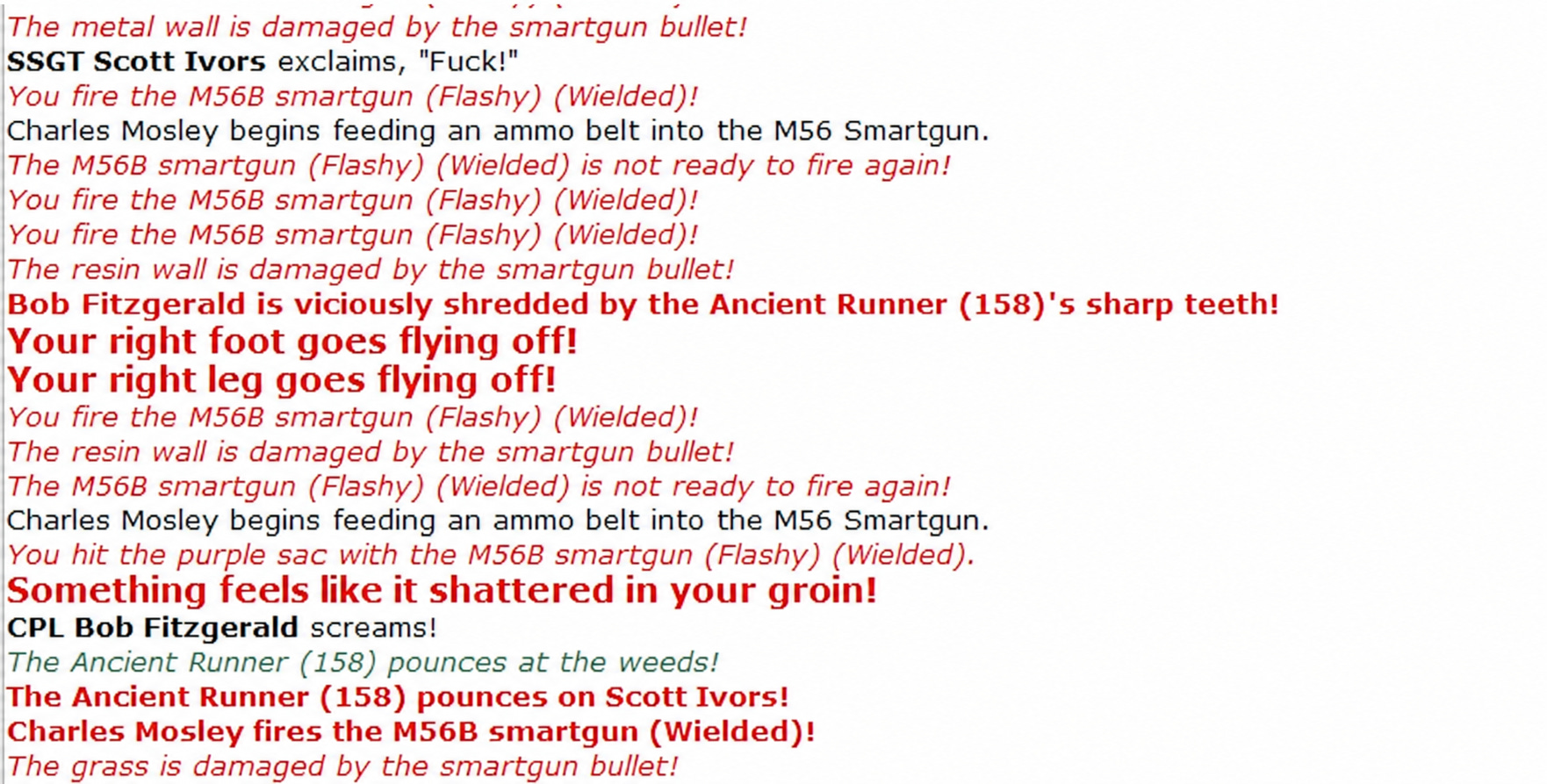
But these are only support. The real gameplay occurs on the ground. The rest of the players assume the roles of either xenos, or the members of one of the four main squads. Squadmembers can be Leaders, Weapon Specialists, Smartgunners, Engineers, Medics, or PFCs. Each is self-explanatory. There are also two Tank Crewmen who drive the APC (formerly, a tank: RIP).
I’ve never been very Robust, and I usually preferred Medic and Squad Leader. I have played thousands of hours of Medic over the years. I find patching up my friends more enjoyable than shooting aliens. But Squad Leader gets the best vantage over what makes CM13 most fascinating. It is his job to coordinate Close-Air-Support and Orbital Bombardments with command and relay information to the CIC. As an SL, you will truly feel the combined arms splendor of this game.
Combined Arms
A marine in CM13 feels like a soldier on a futuristic battlefield.
A gunship rushes overhead to strafe the enemy, as requested by you, the Squad Leader.
A tank rolls up to give backup.
A Scout Specialist lazes coordinates and sends them to the CO, requesting a cluster strike on the planet.
Unseen logisticians work to keep everyone supplied.
It's the versatility of the above mentioned systems that enables this sort of gameplay. Of course, these complex systems, all held together by little more than the duct tape of player engagement, can often backfire, like when your orbital bombardment is a few tiles off-center and hits the evacuating dropship instead of the overwhelmed landing zone:

But moments like these are exactly what players remember most. As Squad Leader I have fired Orbital Bombardments that won the game many times. I have also fucked up my coordinates and obliterated dozens of marines more than once. If it was not for the ability to fail, the success would not feel so sweet.
Emergent Narrative
I have only explained the game’s systems so far, because these systems work together to create emergent narrative. When we sit down to play CM13, there is no story. All we know is that we are soldiers in the employ of the USCMC in the year 2200; we are expected to act accordingly, but the plot that follows is determined by gameplay. Our only “script” is our objective.
But a three-act structure shall always emerge from each round.
The first takes place on the Almayer, as the marines get ready, the threat is assessed, and a plan is made.
The second takes place on the colony, as any survivors are rescued and the war against the xenos rages.
The third, given a xenomorph victory, takes place on the Almayer, as the hive attempts to board and hijack the ship.
Throughout these three acts, your friends will fall. You will make miraculous escapes through deadly terrain, evading xenos at every turn, only to survive because of one lucky twist. And if you make it to the end, you will have one hell of a story to tell.
You probably won't make it to the end.
That's the price you pay. Most rounds will end when you get shot in the back by the new PFC standing right behind you with his shotgun out, or because you walked onto a hidden facehugger trap, or because the CAS pilot accidentally nailed you with a Fatty bomb during his strafing run and blew you into gibs fifteen seconds after deployment. Like the Orbital Bombardment onto the Alamo dropship, the potential for disaster is what makes victory sweet. You cannot have the good in this kind of simulation without the horribly bad.
Your heart would not pound as you made your run for the escape pod if you knew it did not matter.
An Example
We're pinned down at the Forward Operating Base. I'm playing as Alpha Squad Smartgunner, which means that my bullets pass through friendlies. It's been a long round; I've participated in four or five xeno kills, which is a decent haul.
Our SL didn't make it. It's taken some coercing, but I've persuaded our lieutenant on overwatch duty to promote me to assigned Squad Leader (aSL). This gives me access to the Command radio channel and makes it my job to keep the Combat Information Center up-to-date with battlefield intelligence. The most important thing is to make sure we're ready to evacuate should the need arise.
I check all of the vulnerable spots over and over again. We don't want to get caught off guard. The xenos have back off on their assault, but I don't know if that's because we're winning or because we’re getting flanked.
I check telecomms. Tcomms is connected to caves in the back-end, which makes it a probable spot for a xeno flank. My motion detector scans the area.
Nothing.
I go to check the north caves next, and it's manned and secured. Just as I'm preparing to move back to tcomms, I see another aSL shouting over comms:
"QUEEN TCOMMS!!!11!!"
I issue a Move Order and run back ASAP. Through the barricades, past an autoturret, and where 30 seconds ago there were no xenos and no holes in the wall, the Queen stands with five Tier Three xenomorphs.
There is no winning this battle. They are slashing our barricades, and most of the marines are already dead. We are being overrun.
I don’t bother to stay and fight. I turn, and I run.
Our FOB is built at LZ1. But if I can make it to LZ2 via the south, I have a chance of being extracted.
But the front entrance to the FOB is overrun. I have no way out. I’m fucked.
"Hop in!" a voice calls over local chat.
The APC pulls up beside me. They had the same idea, and they’re about to make a break for LZ2.
I leap inside, and we tear out through the FOB. The last thing we hear before comms go down is that the Normandy is coming down to pick us up. A few xenos chase us, but they back off as we reach the LZ.
The Normandy touches down. The APC rolls inside, and all of the marines pile out.
"LAUNCH!" I cry. "GET US THE FUCK OUT OF HERE!"
My motion detector pings xenos all around us. At least a dozen of them, just outside of the walls.
"LAUNCH! THEY'RE ALMOST THROUGH!"
I hear a creak. The west doors are being pried open.
"We have fifteen seconds of cooldown,” the Pilot Officer says. “Can’t launch. Hold on.”
I have made it so far. I cannot stand the thought of dying here. I climb back inside the APC. Just then the dropship engines start to whirr. Looking through the porthole, I see a lone Lurker xeno leap through the doors, just as they close again. Its scythe arms decapitate a single marine as we take off.
Then we’re in the air. But the Lurker is now on-board the dropship with us, and it’s going for the Pilot.
I have to do something. I rush out of the APC and try to stop it. But it slips into the cockpit, and the door slams shut behind it.
I’m a Smartgunner. That means I don’t have DS cockpit access. On the other side I hear gunshots and slashing. Screaming. Death. I can't do anything to help. Then comes the dying roar of a xenomorph, and all is silent.
The ship lands itself.
The CO rushes to us and opens the cockpit door. The Pilot killed the Lurker at the cost of his life. He can still be revived; but the Alamo, our primary DS, has been captured. Now the xenos are on their way, 40+ of them, and we stand no chance. Only five or six marines are left.
Command decides it’s time for us to call evac.
I run as fast as I can toward the north pods. The door slides open just as the floor beneath me jolts. I trip inside, landing atop a cryopod, as I hear motion down the hall.
The lights have all shattered, but I have NVGs as a Smartgunner.
A xeno is running toward me down the hall.
I slam my fist against the launch button, and the pod takes off.
You have successfully left the USS Almayer. You may now ghost and observe the rest of the round.
Writers Leave
Sometimes the admins and developers of CM13 will run roleplay events, with scripts and pre-determined stories. These range from months in planning to a few fun adlibs to engage the shipside crew during marine victory.
It all sucks.
It doesn't matter how brilliant your script is. Nothing will compare to playing to find out what happens. Constructed narrative is never as compelling as the narrative that emerges naturally from systematic forces. I have, literally, thousands of stories like this one. I could fill a book with them. They are stories so exciting and improbable that no author would ever think to write them.
There is story in CM13. It is important, and it acts as a facilitator. Writing and systems should always work together: to give context to the world, to let us know how to talk and act. But the systems should tell the story.
A narrative has its own benefits, of course. Themes and characters and dynamic relationships are pretty cool. These things are important, and they are not likely to be found in CM13. But if what you want are thrilling stories, CM13 can generate them endlessly.
Takeaways
Perhaps I have made CM13 sound like the most amazing game ever. In some ways it is. Let me now lower your expectations and explain why you shouldn’t play it.
It is horribly laggy. When server pop is too high, it is unplayable. This is all the time.
The servers themselves are miserable to play on. CM13 has had tyrannical, insane, and anti-social moderators for generations at this point. It was better for a time, and now it is much worse. If you think that the server admins obey their own rules against metagaming, I have been in their servers, and I can tell you that they are all on Discord together while they play.
The server’s development is totally incoherent. Occasionally a brilliant and revolutionary update will drop with fantastic new content. More usually a baffling and untested change will be merged into the live server, and something no one wanted will be changed. The balance is a mess, and developers and moderators are rarely on the same page. Developers, moderators, and players make up the three estates of the Ancient regime. They are approximately just as dysfunctional.
Then there is the fact that everything good about CM13 is also something bad. Every round is a gigantic timesink. Most end in anticlimax. The playerbase is hostile and antisocial. Nearly every encounter you have with xenomorphs will make you want to vent on Github. Probably worst of all, the game is aggressively addictive. I played way too much CM13 in college; it is the only time I have been addicted to a video game, and it adversely affected my social life in a way that I am not proud of.
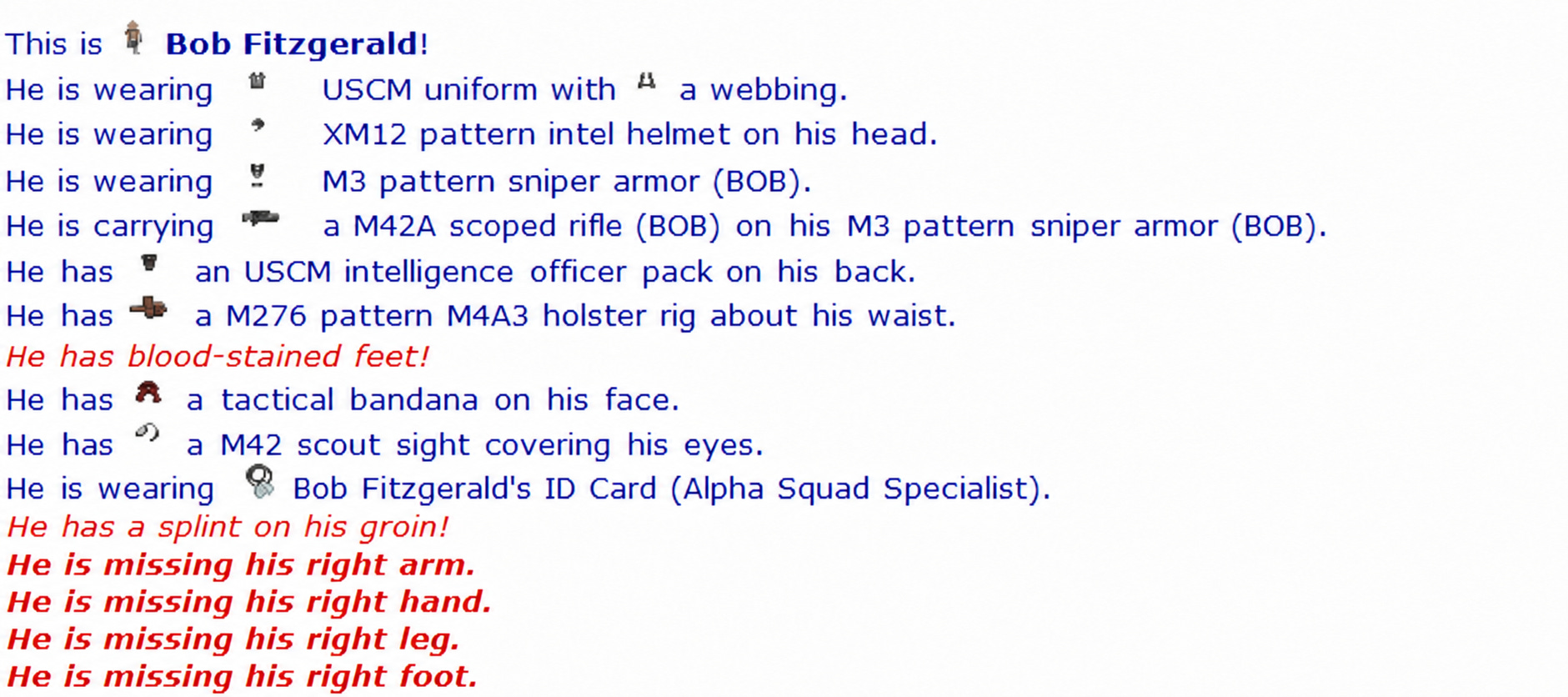
I often want to play CM13 again. I never will. Part of that is because we have outgrown each other. Part of that is because I cannot afford to get hooked again.
There is still a tremendously important lesson to learn from my time playing it. That is the primacy of systems. Games are games, and even narrative games must be systems-driven. The token roleplaying elements in SS13 sometimes create memorable moments, but they do so haphazardly and unreliably. The systems in CM13 create great stories again and again and again.