

Back to Raimi
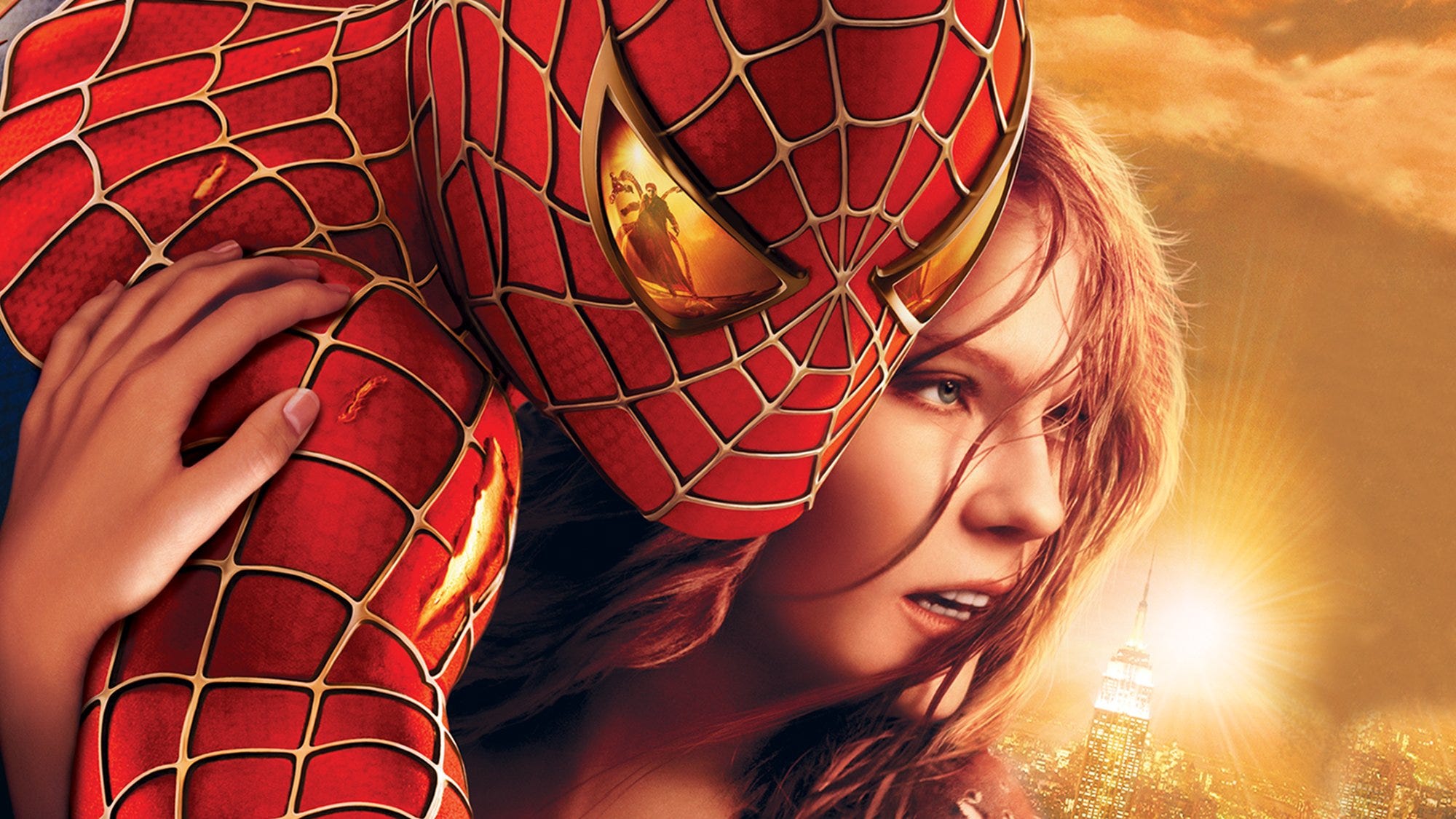
Superhero fiction does not interest me. But Sam Raimi is my favorite filmmaker, and his three Spider-Man films from the early 2000s remain exemplars in their over-crowded genre. All three of these have aged incredibly well in the corporate post-apocalyptic filmscape that is the MCU, but none so well as his best film, and one of the best films ever made: Spider-Man 2 (2004).
Raimi’s Spider-Men are obviously full of character and life and personality that later superhero films lack. But what really makes them interesting is that they demonstrate a completely different philosophy about what superheroes should be compared to the MCU as it crystallized with The Avengers (2012). Rewatching these films today, Raimi’s philosophy stands in dramatic contrast with what would follow, and it primarily is rooted in the fact that Raimi grounds his films in a believable world.
In the original comics, Peter Parker is a tech genius. His web-slinging is technological rather than biological, even though he has other biological powers. The more recent Tom Holland films restore this aspect of the character, and in doing so ruin what makes him interesting in the Raimiverse.
Turning Peter Parker into Tony Stark steals what makes him interesting. This character should not be about his gadgets. This character is about his relationships. Peter Parker is nerdy and intelligent, but if this is a world where any random nerd can invent pieces of high technology in his bedroom, the relationships lose their grounding, and the concept is spread needlessly thin.
Spider-Man needs to exist in a grounded world. This is fundamental to why Raimi’s Spider-Men are interesting, while the MCU’s aren’t. Spider-Man is a soap opera for teen boys. This is a character whose core dilemma is how he can balance his work, school, and relationships while also having superpowers and a secret identity. It is a fantasy for young men.
Spider-Man should not be about worlds that are going to be destroyed. It shouldn’t matter if aliens are invading or a billion lives are at stake. High-stakes villains might make for more interesting action sequences, but they do not pull on the strings that make Spider-Man fundamentally interesting. Those strings are relationships and Peter’s own psychology. The rest does not matter.
Spider-Man only needs generic villains to fight. They can be anyone. They can even be generic criminals without powers. So long as fighting them strains Peter’s relationship with Mary Jane and his aunt, or tests his ability to stay enrolled in school, they are doing their job.
This is why Spider-Man must stay grounded. He should be the only superhero in the world, or one of very few. If everyone is super in Spider-Man’s Manhattan, no one is, and he is no longer interesting.
Tobey Maguire’s Peter Parker is uncharismatic, weird, and kind of an asshole. He is rife with inner turmoil. Tom Holland is pretty and fun to be around, but his version of the character has no psychological depth. This is the difference between these series.
But what is most fundamentally important to Spider-Man is his “mask:” this character is about his secret identity and how he manages it. Peter Parker is an inhibited guy who doesn’t have many friends, who can’t break free from himself, who puts on a mask and reinvents himself. Becoming Spider-Man lets Peter realize his maximum potential—until becoming Peter again lets Spider-Man realize his.
I understand that some of the aspects I’ve emphasized here were elements that Raimi and his screenwriters invented or heavily emphasized over the original comics. It is nevertheless these elements that make their films so much better than what would follow them, particularly Spider-Man 2.
The fact that Spider-Man 2 is so much better than any other superhero film is what I actually want to discuss today.
Peter Parker Earns His Powers
Miles Morales does nothing to earn his powers in Insomniac’s new Spider-Man games. When a radioactive spider falls onto Mary Jane during one of her selfless acts of heroism, she is reduced to nothing but an arachnid taxi service. The spider stays on her for, presumably, several hours, at which point it decides to bite Miles for no reason instead.
This is morally outrageous. Mary Jane should have been Manhattan’s second Spider-Person, not Miles Morales. But I can accept the argument that superheroes are not really meant to earn their powers. They come from accident or natural genius. Peter certainly did not earn his powers in Raimi’s first Spider-Man (2002).
Spider-Man 2 is the exception. This film is a triumph of screenwriting, because over the course of its story, Peter Parker earns his powers and becomes worthy of his own heroism.
Who is Otto Octavius?
Doctor Octopus is the main antagonist of Spider-Man 2. He is memorable, and I had a Lego figure of him as a child. But he is also hardly in the film. The character we see instead is someone called Otto Octavius: not a supervillain, but a brilliant, over-ambitious scientist, doomed by his own dubious ethics. (An archetype that is startlingly common in Spider-Man comics.)
Peter’s relationship with Otto Octavius as he descends slowly into the madness caused by his invention forms the spine of the film’s plot. But the meat attached to the vertebrae is a story about Peter Parker losing his superpowers.
Peter loses his powers because he no longer deserves them. He has completely lost track of what heroism means. Fighting crime has become automatic. How could it not? Superheroes are not, actually, heroic at all. When nothing can harm you, when you are invulnerable and stronger than any human, what’s heroic about beating someone up? It is practically selfish not to fight crime with powers like these.
Thus to get his powers back, Peter has to remember what heroism costs. He has to become a hero, for real.
There is a scene in the first Raimi Spider-Man where Spider-Man rushes into a burning building to save a baby. This is certainly a selfless act. He could have been killed. But you could also be killed crossing the street. Why wouldn’t Spider-Man save a baby from a burning building? He’s practically immortal.
This scene is repeated in Spider-Man 2. This time, he does it as a normal, mortal human. He is not Spider-Man, but Peter Parker, and going into the billowing smoke genuinely risks his life. He does it without a costume. This moment is a true act of heroism. It is something you and I probably would or could not do.
In acting out this heroism, Peter becomes worthy of being super.
The best and most memorable scene of Spider-Man 2 appears near its end. Spider-Man must stop a speeding train using his own body as a brake. This almost kills him. It is not easy. It is something far beyond what even a superhero can be expected to do. It barely works, and it rips his mask away.
He is willing to do it anyway. And the scene that follows shows us what this heroism means. The people on the train recover his body and marvel at his youth, acknowledging his sacrifice, and show us what he saved: the lives of real civilians. For the first time, the people Spider-Man has saved can see his face. When his mask is returned to him, his identities begin to converge.
This scene shows us the humanity behind the carnage. This is what actually matters. There is more to heroism than simply having incredible powers; it costs something, and it gives something back.
You will never get the sense of this from a gigantic scene where space aliens blow up all of Manhattan and we never see a single human casualty. Because MCU films are too big, and too untethered from reality, and too busy focusing on cosmic threats to examine simple moments between one man and a crowd.
The Relationships
Spider-Man 2 is about Peter’s psychological journey toward recovering his powers. It’s also about relationships. What matters in the end is not who can fight the best, but how Peter can navigate the complexity of his relationship with his mentor. The ties to MJ and Aunt May and Harry are what bind the story together. This is what makes the film work.
Stories have to be about people. Stories are not about set pieces.
Thus when all is at stake, when the whole of Manhattan might be destroyed, the resolution in Spider-Man 2 is not some gigantic action sequence. It is a denial of action. Spider-Man defeats Doc Ock through persuading Otto that he can overcome the machines controlling his mind. Here the convergence completes. Peter Parker is wearing a costume that is now meaningless. There is no longer a separate Spider-Man that he needs a mask to conceal. And so the villain can be defeated without any powers at all.
Because Peter Parker is the one who defeats Doc Ock. He uses his relationship with the man who was once Otto Octavius, the man we have spent most of this film learning to know, to stop the disaster.
Peter does not need to be a superhero in the end. He needs to be a good man and a loyal student. That is all heroism ever requires.
This is slightly more thematically compelling than the Hulk smashing Loki a bunch of times.
Conclusion
There are some good MCU films. I have no doubt that there are many reasons why they have proved enduringly popular. I don’t care if you like The Avengers. I’ve never seen Endgame, and it’s entirely possible that it does exactly what Spider-Man 2 did.
What I do care about is that stories prefer people to set pieces. Very few films do this better than Spider-Man 2—even though it is a superhero blockbuster at its core. A superhero blockbuster can still tell a memorable, intimate story.