

The Beginning
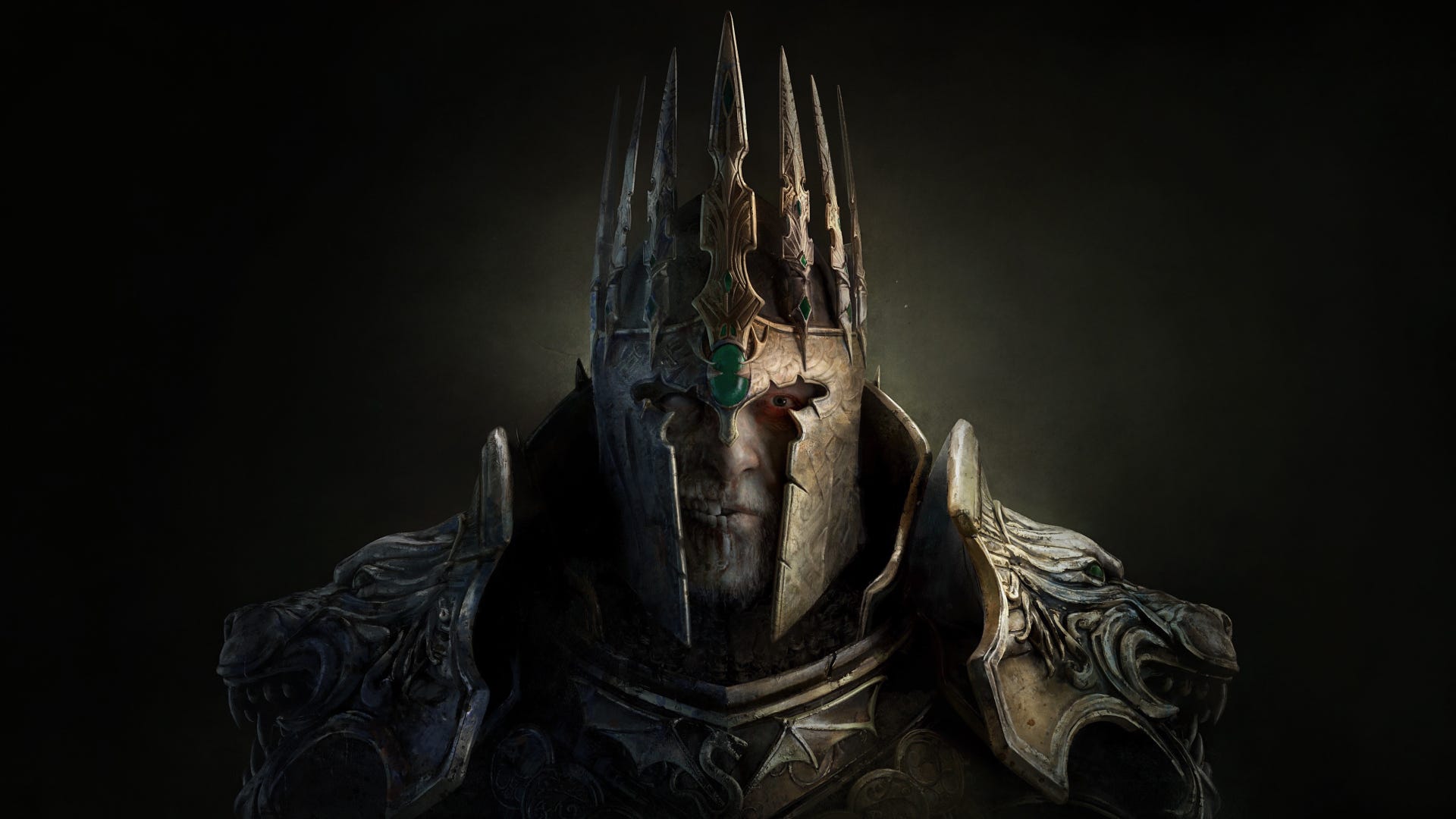
In King Arthur: Knight's Tale, you play Mordred, Arthur's arch-nemesis from classical Arthuriana. Immediately after dying, Mordred wakes up in a dank dungeon on the Isle of Avalon, upon which the Kingdom of Britannia has been mirrored in a perverted afterlife-like form. With Arthur mysteriously missing, Mordred declares himself king of the New Camelot and sets about recruiting a neo-Round Table, with new knights inspired by characters from across all Arthurian legend.

You do not play as King Arthur in King Arthur: Knight’s Tale. You also do not play as a knight, but a king. In fact this game has almost nothing at all to do with Arthurian tradition beyond its flavor. It looks a lot more like a Dragon Age dark fantasy world. To the designers’ credit, this is how it’s advertised.
Roleplaying Game?
This is a roleplaying game. As Mordred proclaims himself King of Camelot, he is given his first decision: is he a Good (“Rightful”), or is he Bad (“Tyrant")? These decisions are signaled to us by little icons so we always know which is which. You will be grateful for this feature, because the sentiments expressed between Good and Bad are most often identical. But one is Good, and one is Bad.
You can also choose to be Pagan or Christian. That means the game has a four-way morality axis, like so:

Mordred is a famous villain, so I decided to be Bad. I had also selected the Bad Guy option in the first dialogue by mistake, so my costs were sunk straight away.
These choices are not cosmetic. Morality thresholds give powerful rewards, including unique companions and special gameplay mechanics. A Tyrant Pagan, for example, will unlock Sir Dagonet. I chose to be Pagan for Morgana le Fay, who seemed like a considerably better prospective companion than Sir Galahad. In addition to special unlocks, each companion has his own morality, and your decisions will affect his loyalty and performance in battle.
I don't regret my paganism, but sticking to Tyrant was a mistake. Bad Guy Mordred gets the Red Knight and the Black Knight. Neither of these are well-known or well-defined characters from Arthurian legend. To the extent they are characters at all, it's as archetypes, or general epithets used by a number of different personalities. Neither the Red Knight nor the Black Knight proved remotely interesting.
Good Guy Mordred gets SIR LANCELOT.
My moral blunder aside, this is a good system. It adds replayability and a feeling of consequence to your decisions. The narrative itself doesn’t seem to branch, but your morality does make a big difference to mission availability: an entire end-game sidequest chain for me was about tracking down and killing Lancelot. Presumably this would not have been available had Lancelot been in my party. (Although you never know.)
The writing itself is not as good as the mechanistic implementation. Bad Guy Mordred is Pointless Hitler, while Good Guy is Flawless Jesus. But almost every game with a system like this is written that way.

The larger problem with the game’s writing is that your individual decisions in dialogue and event trees do not matter at all. Another event: a wall of text appears with four options. One gives Good Guy, one gives Bad Guy, one gives Pagan, one gives nothing. I need Pagan to get to Morgana faster; ergo, I choose Pagan, regardless of text.
Not only do I lack an incentive to read and engage with the text, but in fact I have a disincentive, because it doesn't actually matter what I would want to do as a player. My conclusion is foregone by gameplay needs.
There is simply way too much dialogue in this game. The characters never stop talking. And the talking they do is not good.
Dialogue Disaster
King Arthur: Knight's Tale is a dark fantasy game, but the characters do not seem to know it. Your companions do not speak like chivalric knights from the Middle Ages, but like modern people having casual conversations. Rather than adhere to a formal register, King Mordred says “also” and “anyway.” I thought it was incredibly inappropriate when he told Morgana he was working on getting “swole” and that her Fey enchantments had him “crunked up.”
This is a common problem in modern fantasy. We are losing our ability to capture archaic speech. But the problem is amplified by the Hungarian origins of NeocoreGames, and their writers’ seeming inability to recognize what is appropriately modern and formal in English. Whether this was the real issue, or the problem lies in localization, the dialogue in Knight’s Tale is very badly written.

Knight’s Tale ends with the following line:
The fight for Avalon is over, but the battle has just begun.
This is a cliché. You shouldn’t end your story on a cliché. But they didn’t even get the cliché right. "Fight" and "battle" are near perfect synonyms, and our conquest of Avalon involved countless battles. What they mean is “war.” They should have written:
The battle for Avalon is over, but the war has just begun.
Even this makes no sense. Avalon is completely self-contained, so if the battle for Avalon is truly over, then so too must be the war. It may be that the intention is more along the lines of: the war with King Arthur may be concluded, but there are many battles yet to come. That would make more sense, given the ending's foreshadowing.
I can only assume this all makes much more sense in Hungarian.
The Isle of Avalon
Rather than a spaceship or military facility, Mordred's home base is Camelot. There you'll train, equip, and treat the Round Table that you've gathered from across the realm. Four knights go out at a time, and while Mordred is required for story missions, you can send anyone out in any combination otherwise. Each quest you complete earns Gold and the evocatively named Building Resources, both of which are used in renovations.
Every knight must be individually placed in training, individually told to set his broken arm, individually told to heal his Vitality pool, etc. I nevertheless found this to be an engaging base mechanic. The upgrades make significant enough differences in the tactical gameplay to create ambivalent decisions, and resources are scarce enough to make those decisions matter. You won't have everything, even after the credits roll.

From the overworld you select one main mission at a time, or, if feeling underleveled, from a slew of side missions. These side missions are not optional, as I was nearly underleveled by the end despite sending the same four knights on every side quest as soon as it was available. Focusing purely on the main story would result in being massively underpowered and almost certainly make the game impossible.
Events occur every few missions. These involve either sending a single knight out on a quest of his own or resolving some morality decision.
You'll want to earn the loyalty of your companions for powerful bonuses. Take their traits under consideration while you're deciding if you're a Good Guy or Bad Guy. Then sort through your loot and gear them up for the next quest, presuming they haven't sustained any injuries that need healing.
Be careful that they haven't. If Vitality reaches zero, the hero in question is permanently killed--and Vitality damage doesn't heal except through time spent at Hospice.
I like the overworld in Knight's Tale. It could be deeper, but for fulfilling the fantasy of Arthurian roundtable management, it does what it needs to do. You feel like a king as you make decisions, gather retainers, and renovate your keep. You feel powerful. Regular returns to the overworld are where Knight's Tale is strongest, where the interplay between tactics and strategy matters most.
Turn-Based Tactics
King Arthur: Knight's Tale is a melee-focused turn-based tactics game. There are four classes: the Defender, the Champion, the Sage, and the Arcanist, which might be analogized as the Protection Paladin, the Arms Warrior, the Battle Mage, and the Mage Mage, but the reality in-play is more complicated. Every character on your roster is a hero who must be recruited--a distinctive, voice-acted personality from Arthurian legend, from Mordred to Sir Lancelot to Morgawse and Guinevere. While each will fit into one of the four main class archetypes, their skills are shuffled around, and they all feel individuated.
On the ground, your characters have a number of action points depending on their equipment and how heavy their armor is. Spend these on abilities, movement, and attacks. Balance your Armor and Hit points, and make sure your Vitality never gets too low: if it does, you'll begin to sustain injuries, and if it reaches zero, you'll die--forever.

Early on there isn't much to do but reserve AP and wait until the enemy approaches. Later, though, Mordred becomes Zeus, unlocking the power of thunder and lightning. His mother Morgawse proved to be my favorite knight with her ability to conjure thunderstorms and smite people across the map with shards of ice. By the final battle with Arthur I was regaining AP left and right, casting mass AoE, teleporting between strikes with Sir Kay, dominating the battlefield.
Between fights but within each level, the maps are reminiscent of Dragon Age: Origins. The graphics are excellent: dark and full of leaves caught in whirlwinds, flickering fires, and trees quivering in the wind. The whole game has the atmosphere of a chilly autumn day.
You will be overwhelmed by the sheer number of abilities at play. I restricted myself to the four knights seen above, as well as Boudica and Sir Ector when injury demanded. Remembering each active ability wasn't as challenging, but keeping the dozens of passive effects straight was impossible.
Each active ability has four potential passive skills, with many more passives on the tree. These range from minor to playstyle defining.

The trees themselves are good. But it isn't within my capacity to remember the entire skill trees of twelve different knights and all their passive abilities, and also their active abilities, over the course of a campaign. The glut of talents and abilities and the dearth of available XP would suggest that you are only meant to focus on four knights in any given playthrough.
Then why are there twelve knights at all? What’s the point of permadeath? This system appears incoherent. The whole game is about gathering a new Round Table when we are limited to only four knights at a time. This doesn’t quite make sense.
What Neocore has designed is good. But I can see where it could be better next time.
Difficulty Rating
King Arthur: Knight’s Tale is an excellent tactics game. But it is also very seriously flawed. Its pacing and level design detract badly from the overall experience. These are what led me to go from wondering why the game had such mediocre reviews, to thinking that I should go and give the game a thumbs down on Steam.
The game’s fundamental flaw is that the missions go on for way too fucking long.
Consider a level near the end of the game where the Lady of the Lake sends Mordred to close four portals in the woods. To get to the woods, you need to fight two major battles with eight to fourteen enemies each. These battles take between five and ten minutes. Then, to reach the first portal, you need to fight another battle of similar length. Then, at the first portal, there's another battle, this one the largest so far.
At this point you've been in the adventure for half an hour at least, and you feel like you're done. But you glance at your objectives and realize it says: Portals Closed (1/4).
So you head back out into the woods. You wander around for a while, stumbling into more battles, all of which are the same, until you finally clean up the remaining three portals.
By now it's been over an hour. Your brain is melting. You need the break of returning to the overworld. This quest has gone on for so long.
"But wait, Mordred!" cries the Lady of the Lake. "Hear me! You must now fight the Ultimate Portal Boss Monster!"
You are then teleported to the REAL final boss of the quest, and another ten or so minutes passes before you're finally set free.
Almost every mission in the game follows this structure. Countless battles, most of which are indistinguishable, in quests that go on interminably. More frequent returns to Camelot would do so much to break up the monotony of fighting identical Unseelie squads in identical woods. Without those returns, almost everything after the first act becomes a brutal slog. Two or three encounters per quest would have been sufficient. Eight? Nine? Fourteen? Forget it.

This was where I started skipping dialogue.
The problem is that every battle tests the same skills and nothing ever changes. I know how to do everything without taking damage, and I win without injury (almost) every time. The repetition is mind-numbing, even though the core systems are still “fun” in the purest sense.
The designers saw that their game’s repetition made it easy. Unfortunately, their only remedy was to ramp up the challenge by spawning enemies in waves, which only serve to drag out the levels even further. .
These are failings of level design. Fights needed objectives, like in XCOM 2 or The Banner Saga. But every encounter in Knight’s Tale is as simple as “kill everything.” For twenty-five hours straight, your one objective is to kill literally everything you see.
That is not enough for a game this long.
In Conclusion
Knight’s Tale is almost worth playing. Its first half is excellent. But its second half is tremendously frustrating, even when its core systems are good. Given its level of production value and its uniqueness in the market, I would recommend it on sale to anyone who likes turn-based tactics. Just expect that you might not make it to the end.
If you’re into Arthuriana or want an RPG with a good story, you can safely skip it.
I purchased a copy from Steam. Total playtime: about 30 hours.