

Halo is very important to me. Growing up in the early 2000s, it was all my friends and I ever talked about. We all wanted Halo action figures for our birthdays. When we were old enough we read Halo books. We always wanted a Halo movie. We loved Halo.
"Landfall" was our first taste of what Halo in cinema might look like. What proved to be a marketing video for Halo 3 was, we felt certain at the time, a pre-announcement for the forthcoming Halo film. Headlines assured us we were right. First Neil Blomkamp was involved, then Peter Jackson. "Landfall" was awesome. We needed more.
Nothing ever came of it.
Half a decade later, "Forward Unto Dawn" came out in pieces on YouTube for free. Now this was a real Halo series. I loved "FUD" at the time. In retrospect, it’s a big ad for Halo 4, but it isn’t terrible for what it is.
It isn’t a real Halo movie.
The next attempt came out along with The Master Chief Collection. It was called Halo: Nightfall. I stayed up until two in the morning watching it with my brother.
Nightfall is best forgotten.
For the next eight years, discussions of the next attempt to take Halo into cinema and TV have remained constant. At one point Steven Spielberg was involved. Who knows how many pilots and spec scripts have come and gone in that time.
This all leads to March 2022. Now, finally, Halo (properly italicized as a stand-alone series, rather than the franchise) has been properly adapted into television.
The first official trailer released in January. Every single thing looked wrong.
It later came out that the writers “didn't look at the game." They didn’t need to admit it. I could tell.
I told myself I wouldn’t watch the series. I don’t want to support people who hate the things I love.
Then I watched the first episode.
Let's Get This Over With
There are three levels to grade Halo on: as an adaptation of its source material; as a military sci-fi TV series; and as a piece of televisual narrative. It fails them all.
What I will say is that this episode could have been worse. There were a few hints that suggested somebody involved had played the games. For the most part, though, it seems like the content of the story has been changed for no reason except to irritate fans of the franchise.
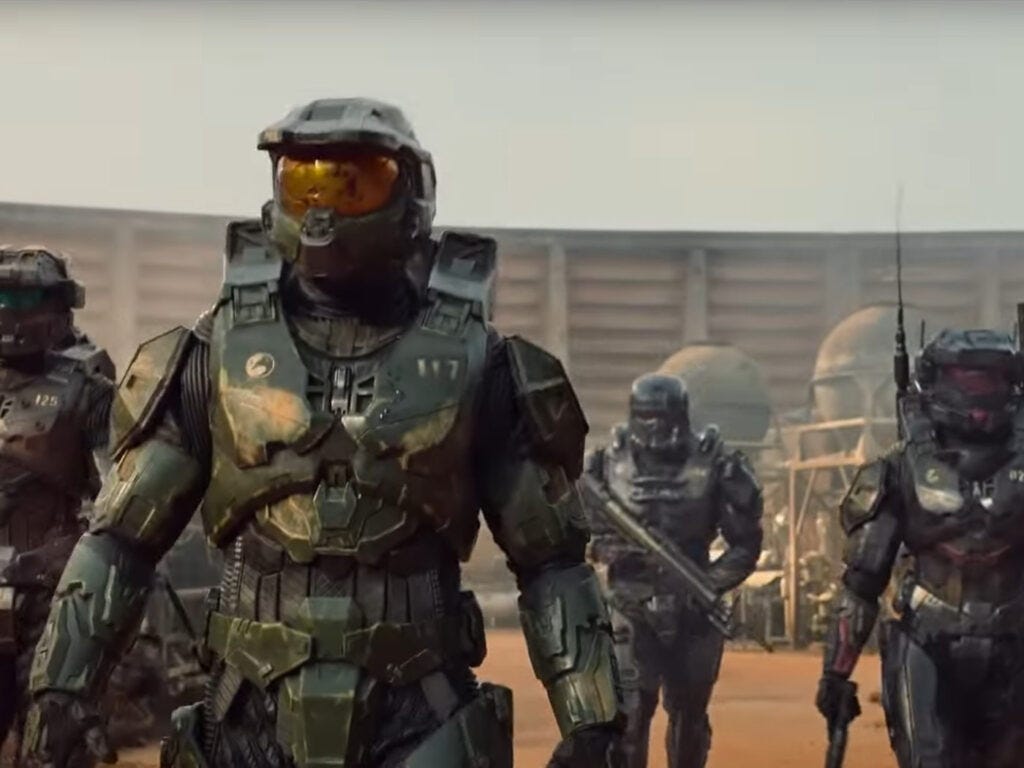
Consider the name of Master Chief's team. In the books (and Halo 5: Guardians), the Chief leads Blue Team. His subordinate Spartans are Kelly, Fred, and Linda. Here, their names are Vannak, Riz, and Kai. You may notice that Kelly, Fred, and Linda are mundane names; that is intentional irony on the part of the writers, given how extraordinary the Spartans are. You may also notice that Vannak, Riz, and Kai are not real names at all, but sound like noises made by a flaming coffee grinder.
These characters no longer form Blue Team, but Silver Team. Why Silver instead of Blue? There is no reason, except to aggravate fans of the franchise.
These writers want you to be annoyed. If you play Halo, you are the wrong kind of person.
Near the end of the first action sequence, an Elite has his head blown off. Halo fans who wasted their youths dumping magazines into dead Elites may notice something strange: the stump of his neck dumps gore out onto the ground, and it’s red.
Red blood. As in, normal, not-Elite blood.
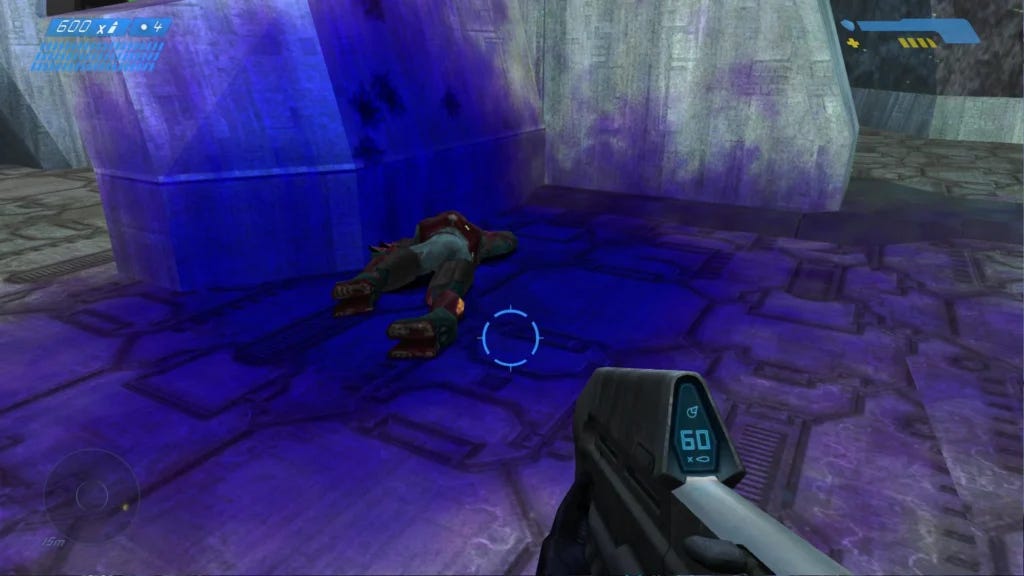
Elites have bluish-purple blood. Not red.
Why give Elites red blood? Either no one knew better, or the showrunners intentionally wanted to spite the game’s players.
They're Not Even Trying
The first third of Halo's pilot takes place on the "water extraction planet" Madrigal. Some aliens show up. Some kids get blown to pieces. Master Chief and Silver Team arrive and do a shit job of saving the day, leaving only one survivor. The fight goes on for ten or fifteen minutes.
A lot of Halo fans online are praising this sequence. They say it's cheesy but fun enough and appreciated touches like these first-person sequences.
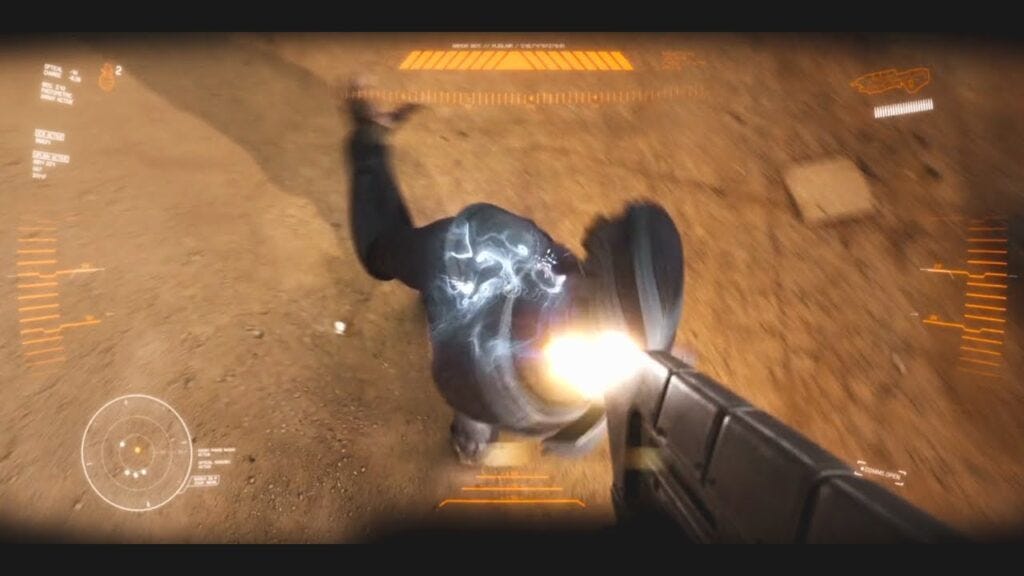
The visual effects artists clearly knew the games. The weapons look right. Sound effects from the games are used. We hear the right active camo noise. The Elites are wrong, and I'm not a fan of the new Spartan designs, but the feeling of Halo is present.
But this whole sequence has two minor problems: it’s terrible, and it makes no sense.
The Elites land outside of the open-air fortress. They then walk to town, knock down the gate, and storm inside on foot. Master Chief & Friends show up, drop down from a Pelican, and fight the Elites on the ground. Nowhere, at any point in this sequence, do we see:
Any air support;
Any ships in atmosphere;
Any artillery;
Any reinforcements;
Any vehicles;
Any non-Elite Covenant infantry (Grunts, Jackals, etc.).
This is a firefight between two hyper-advanced space navies and we never see a single plane, let alone a ship, in the air. In fact there are no ships anywhere in this series. They're all missing. When someone wants to travel across the galaxy, they hop into dropships and fly there. What? There is no Forward Unto Dawn, no Pillar of Autumn, and no Truth and Reconciliation. We do see High Charity, but there are no Covenant Corvettes anywhere around it. Later on, when we visit Reach, there isn't any kind of orbital defense network: the atmosphere is completely barren. There are no flying cars or ships in the atmosphere. Everything is empty. Compare this even to the much cheaper "Forward Unto Dawn," released for free in 2012, or any cutscene from any single one of the games, and you will see how phony this new series looks.
This is not science fiction. This may not be anything at all.
This opening action sequence is supremely lazy. The Elites barge through the front door. When normal humans shoot them, nothing happens. When the Master Chief shoots at them, they die instantly. I’m convinced that nothing about this fight was written into a teleplay; it was entirely created in post by a team of visual effects artists, desperately trying to tape something coherent together.
It isn’t their fault that they couldn’t do it. The screenwriters wanted them to do something literally impossible.
None of the writers knew anything about science fiction or Halo, it seems, and didn’t want to do any work. FTL communication is, apparently, completely free in Halo. No constraints at all. Anyone can talk to anyone else anywhere in the galaxy whenever they want. This makes no sense whatsoever and would ruin the plot of the first two games if it were true. What about the dynamic between secessionists, the UNSC, and the Covenant? Well, you'd think an existential genocidal crisis might pull people together, but actually the insurrectionist at the beginning says, "Oh my god, I thought the UNSC made the aliens up!"
You know. The aliens who've been destroying planets left and right? Yeah, they were just made up.
And why does Master Chief show up on Madrigal just in time? What was he doing there? Why was he saving insurrectionists? Why did the insurrectionists think Spartans were going to show up and kill them? Was that just a coincidence? And where are all of the space ships?
I have already spent more time on this review than the writers did on their script. This is not a good use of my life.
The Master Chief is Legolas
After their opening battle, Chief and Silver Team walk into a "cave" and retrieve a Forerunner artifact. Touching this artifact does something to the Master Chief and makes him more human, in a weird recreation of the start of Mass Effect.
Fifteen seconds later, when a directive from not-ONI comes for him to execute some random woman he just met, he decides he can’t do it. He goes rogue instead.
The Master Chief goes rogue 40 minutes into the new Halo series.
I watched this with my parents, neither of whom know anything about Halo, and if I hadn't been there to tell them that Spartans are genetically engineered super soldiers, they wouldn't have known. Chief behaves like a normal dude in power armor. We know nothing about Chief when he makes this decision. The first thing we see from this version of the character is insubordination. Our baseline for the Master Chief, before we've seen him do anything else in this series, is rebellion.
So where is he going to go? What is his arc?
A competent writer would have followed this exact same story structure, and then had Chief blow that woman’s brains out. Because the Master Chief is fundamentally a child soldier slave. His character is that he has no agency. He is a piece of military hardware.
But, over time, he could learn to think for himself. Cortana could teach him to be more human. It would be like Robocop. In other words, it would be an arc.
It would still be stupid. That’s not the arc that the Master Chief should have. But it would let him be a dynamic protagonist for a TV series.
From here on out, though, there is nothing to do. There is no room for Chief to grow.
But disaster was inevitable for this series. The Master Chief cannot be a protagonist for a television show. That is because the Master Chief is Legolas.
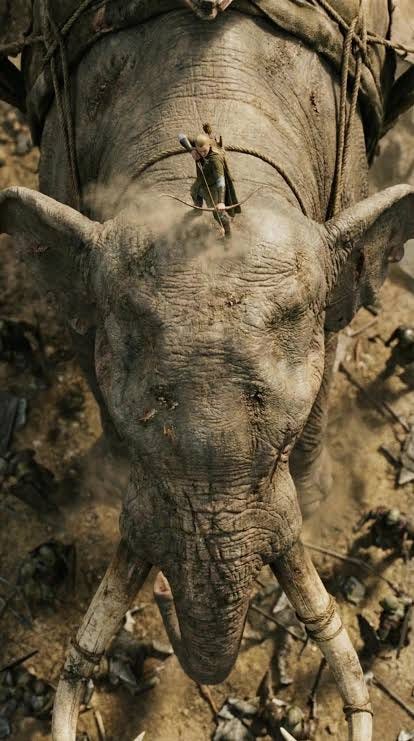
Consider the above scene in Return of the King. Legolas, who rarely says anything, takes the spotlight for ninety seconds and slays a mûmak. Then, like the support character he is, he fades back into the ensemble. Occasionally we see him murder an orc, but for the most part he remains in the background, trailing after Aragorn. We know he's there, but he is not the lead.
This is how he has to be written. Legolas is an elf who's 3,000 years old. He's hard for us to understand. He doesn't think like we do. He sees time differently. He's an interesting part of this world and, when the time is right, he's great to have around. He can make for a memorable action sequence. But he's not the lead character of The Lord of the Rings. He plays a supporting role.
There is a reason why Frodo is not a badass elf.
The Master Chief is Legolas. He's awesome. He kills shit. Consider the sequence in Halo 2 as a parallel to when Legolas slays the mûmak: the badass SPARTAN-II has singlehandedly boarded a Scarab tank. He has blasted his way through the bridge, cleared out the control room, and destroyed its engines. He emerges onto its roof, smirking behind his visor, surrounded by flames. Everyone stares at him in awe. The other characters know, diegetically, that this is not someone to fuck with.
In Halo 2, the rest of the cutscene in this sequence follows the actual protagonists of the game. We snap to Miranda and Sergeant Johnson and Cortana. These are the main characters of a TV show. We don’t see Chief again until we’re about to deploy to Delta Halo. That is because the Master Chief is Legolas. He is neither the main driver of the plot nor its emotional core.
There could be ways to humanize him. We could even see him out of his armor. Maybe he’s amazing at math and far smarter than any of the other officers. He’s a chess master. While they travel between star systems, he lifts weights and matches wits with Cortana. This is no different from how Legolas and Gimli are contrasted with the Rohirrim in The Two Towers.
But while he can be a fun side character, the Master Chief is not your perspective character. Do you get it? He's not the lead, not until literally everyone else is dead and there's no one else to follow.
The Master Chief is Legolas.
This is why the idea that we needed to see Chief’s face is so silly. I don’t care about knowing what he looks like, but the urge to turn him into a relatable character is incredibly misguided. You don’t need to show Chief’s face for the same reason that you don’t need to see Legolas without his bow.
Onward We March
This show will not get better. I suspect it will get worse. But I will be back next week anyway. Wish me luck.