
Deathloop Review: In Arkane's Oeuvre
Deathloop is a decent action-adventure game, but the most important question for me is how it compares to Arkane's previous titles. Does it hold up?

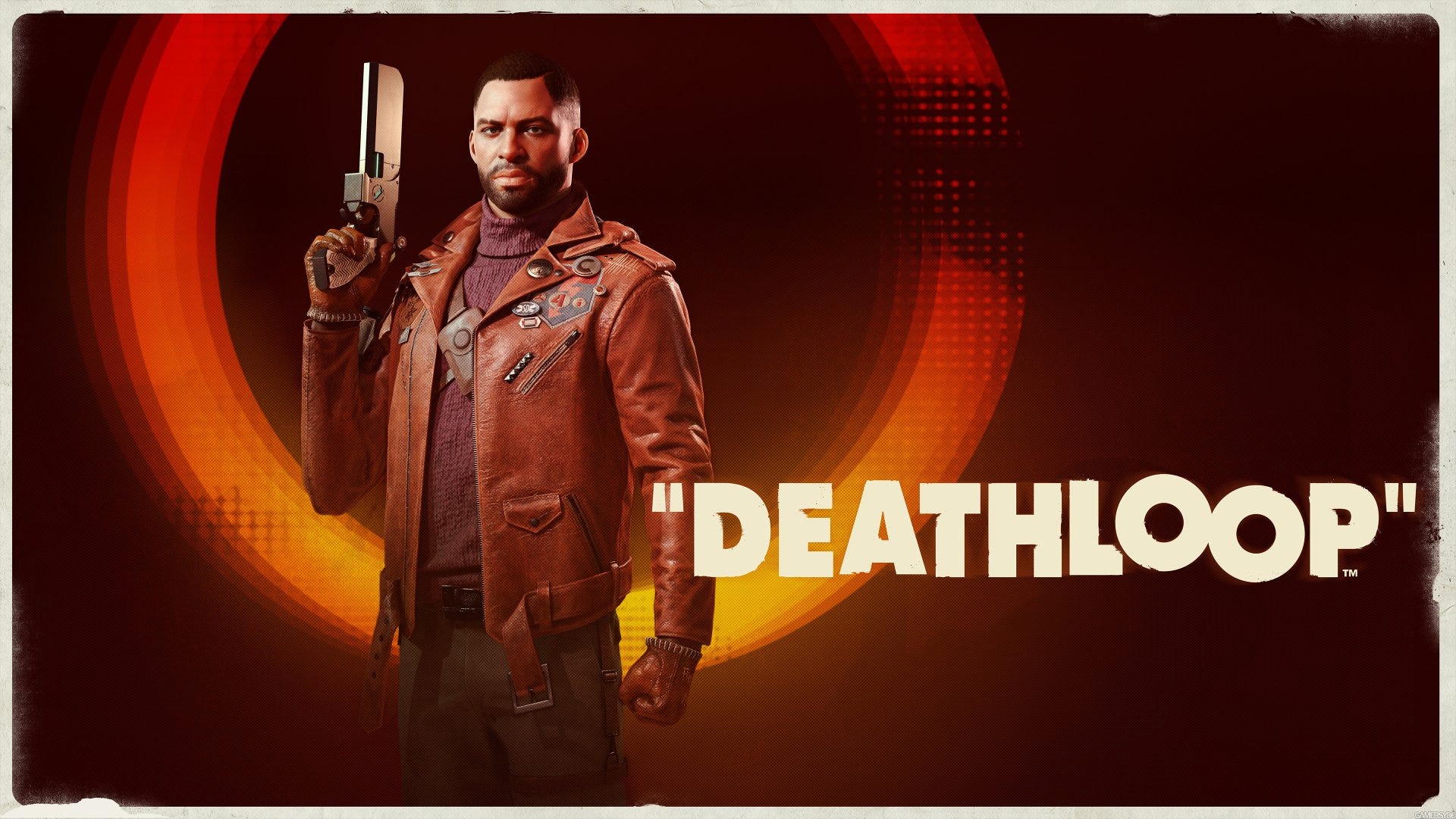
The key problem Deathloop had to surmount was, from the start, the unavoidable fact that it's made by Arkane. Arkane's last three games are among the best ever released, Prey above all. This creates expectations that are fantastically unrealistic. Bear that in mine as this review progresses.
Because of my love for this developer, much of this review will be spent contrasting Deathloop back to Dishonored and Prey. The uses for this are twofold: 1) the similarities are immense, and for purely evaluatory purposes comparisons may give you an idea about whether or not you'll enjoy this game; and 2) Deathloop is the first Arkane game developed without the lead of Raphael Colantonio, which I find an interesting facet to explore in and of itself for the purposes of examining Arkane's oeuvre (and for where the studio might go next).
Welcome to Death
In Deathloop you play as Colt, an assassin trapped in a Groundhog's Day-esq timeloop on a strange and enigmatic Arctic science facility. Your only hope for escape is to find some way to kill all seven "Visionaries," the program's architects and chief beneficiaries, within the course of a single twenty-four hour period. Work to build knowledge of your targets and collect an arsenal of weapons and supernatural powers with which to finally overcome the challenge--and break the loop.
There is no save function. Each death is part of the narrative; when you run out of lives, the clock resets.
If all this sounds like Dishonored meets Prey except Mooncrash, that's more or less right. There are some murmurings across the internet right now about how, despite the relative familiarity of its premise, Deathloop is original and like nothing else you've ever played. This may well be true if you've never played Mooncrash--but for those of us who have, one wonders if Arkane might have innovated a little bit more for their standalone looping game.
Live. Die. Repeat.
After the prologue, which is more of a first act, Deathloop opens up. You have four maps to explore, seven targets to kill, and four 'hours' to do it all. Each time you transition from map to map, an hour passes. Four hours make one day. One day resets your progress, except gear collected and 'infused' with a special currency received from killing bosses. Alternatively, die three times on any one map and the loop will reset. Any knowledge you've received, though, will stay. That means some narrative progress is always permanent.
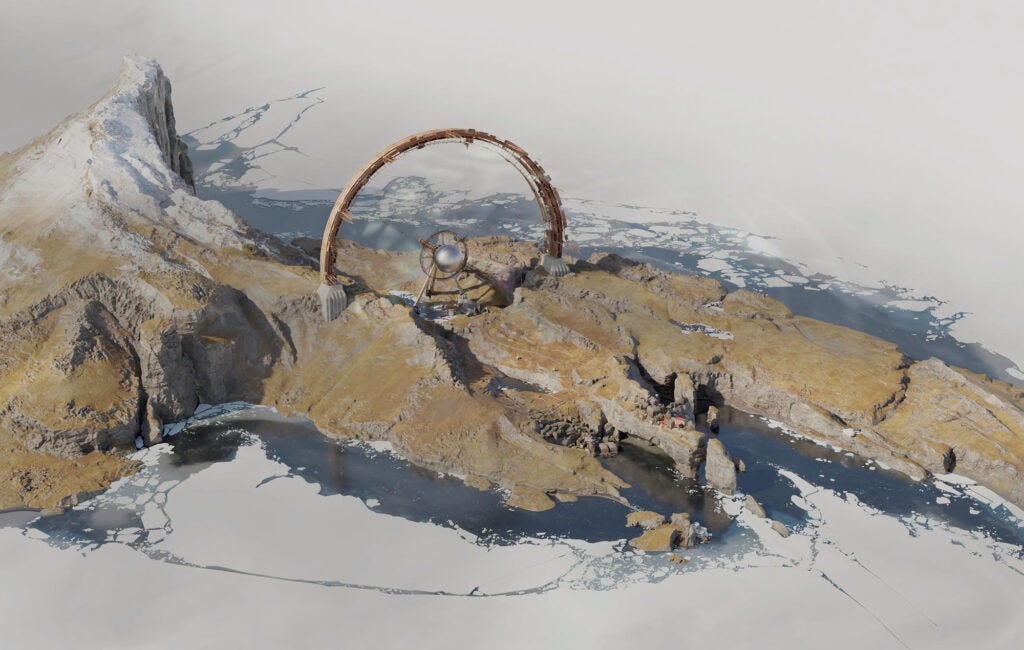
I very intentionally avoided all pre-release demos and interviews about this game, since I knew I would play it no matter what I saw. When it was first announced and pitched to me I had envisioned a single sandbox, like Talos I in Prey, where you had one life to assassinate seven targets--while being pursued by a player-controlled assassin (more on her later). This would be consonant with Mooncrash. In effect, the game would be the ultimate in systems-driven progression. A true immersive sim, where a good player who knows the map could beat the story in twenty minutes on his first try if he did everything right. No handholding, no real 'plot;' systems only would pilot the ship.
Deathloop is not that game.
Although the levels themselves are open-ended enough to 'play your way' to some extent, as has always been Arkane's philosophy, the overall thrust of Deathloop's narrative is more like Dishonored than Prey and Mooncrash. Unless I'm mistaken, you must hit the beats provided for you by the designers to progress the plot and reach the credits. The order is flexible, but the beats themselves are not.
I know, the horror. A linear game! What's the big deal?
The issue is not narrative per se. I'll write more on that later, but with the exception of the anticlimax, the narrative at large is well written. The characters are good across the board and the dialogue is fantastic. This game blows the Dishonoreds out of the water in terms of raw story.
...but games are not raw story. Games are, alas, games--and something is seriously off about the linearity of the narrative and the framework of the deathloop in Deathloop.
This Is Not An RPG
I refer to Arkane's previous immersive sims as 'pseudo-RPGs,' and I think the title remains apt. They are systems-driven roleplaying games. You don't choose dialogue, but you do make decisions that influence the outcome.
Your decisions do not influence the outcome in Deathloop. Your actions might make a difference at the very very end, I'm not sure, but I don't think so. The only real narrative control you have is how many times you die. This will be borne out in dialogue, but only in the most superficial ways. Beyond that there are no permanent stakes. There is no Chaos. You are not judged by a death panel of NPCs at the end of the game. Whether you sneak past guards or blow them to pieces, no one cares. It does not influence anything at all in the narrative.
There's something strange about a game that seems, at first, to be a sandbox, yet lacks these features. They seem more at home here than in Arkane's previous titles.
This does not ruin Deathloop, but it feeds into a larger issue:
This Is Not An Immersive Sim
It is not fair to compare any game to Prey, but I would like to take it as the epitome of the 'immersive sim' genre (and you know it's a great genre when I feel the need to put its name in single quotes). In Prey, the first weapon you find is the Gloo Gun. With the Gloo Gun and a bit of patience you can access anywhere you set your heart to on in the station. You can scale any wall. You can overcome any foe. The Gloo Gun is the immersive sim weaponized. It is a gun that uses your own creativity as ammunition.
This is the first of many tools the systems give you to overcome challenges your own way. Heavy furniture or debris blocking the path? You can ignore it and find another point of entrance; or you can find a recycler charge and turn it into spare parts, thus freeing up the route; or you could invest in bigger muscles and haul it to the side; or you can open the nearby door with your hacking skill; or you can use your telekinesis power to reach through the pane of glass and open that same door remotely from the other side; or you can shoot through a mail slit in the wall with a Styrofoam dart from your toy crossbow and hit the button to open the door that way.
You get the idea. 'Play your way' is an understatement.
It's telling that most of the environment in Deathloop is no longer interactive. Sinks don't work and mugs can't be picked up, in sharp contrast with Dishonored and Prey both. This was one of the first things I noticed about the game. This 'dumbing down' is reflected across the systems.
When confronted with a blocked path, your options here are to come back later or find some way around. There are no, or next to no, clever systems-driven ways around walls or through vents. There are no inventive ways to use powers, aside from murdering NPCs and jumping over things. In short, every time you do anything in Deathloop, you're doing it exactly the way the designers intended.
There's nothing wrong with that. Most games work this way. But between systems and story, each loop is playing Arkane's way, not yours. Often times you will be doing things just because the game tells you to. Not because you need to or understand their significance, but because they're next on the quest list.
The phrase that comes to mind is 'hand-holding.'
I have nothing against hand holding. I like holding hands at parties and on dates. But it gets weird when you're doing it in the public restroom.
Nothing exemplifies the departure from traditional ImSim structure more than the cutscenes which play between breaks in the main questline. These cutscenes are good, but they tend to be Colt narrating at you precisely what to do next. Sometimes, like right before the final loop to kill all seven Visionaries begins, he'll even tell you the exact order of operations to do it in--he basically beats the game for you!
Some of this is necessitated by the game's overall structure. The unfortunate reality is that there's so much going on, so much information to marshal and so many variables to track, that--unlike Mooncrash--it's nearly impossible to put it all together on your own, at least with the game's as-is journal (decent, but doesn't put relevant information in a single place and lacks a map).
But really, Colt? Did you need to walk me through step-by-step on how to beat the game? Why am I even playing at that point? Why don't you beat it for me? I had already thought the order of operations through and come to the correct answer on my own! You know, because I had been playing the game??
Similarly, the lack of map functionality necessitates leaving objective markers on. Objective pins ruin Prey and make Dishonored worse, but I cannot imagine beating Deathloop without them. It's simply too hard to know where to go. I did the first act with objectives disabled and it ruled, but good luck knowing which random room has which random piece of paper you need to pick up to progress the story without some sort of HUD marker telling you the general proximity.
Welcome to Murder
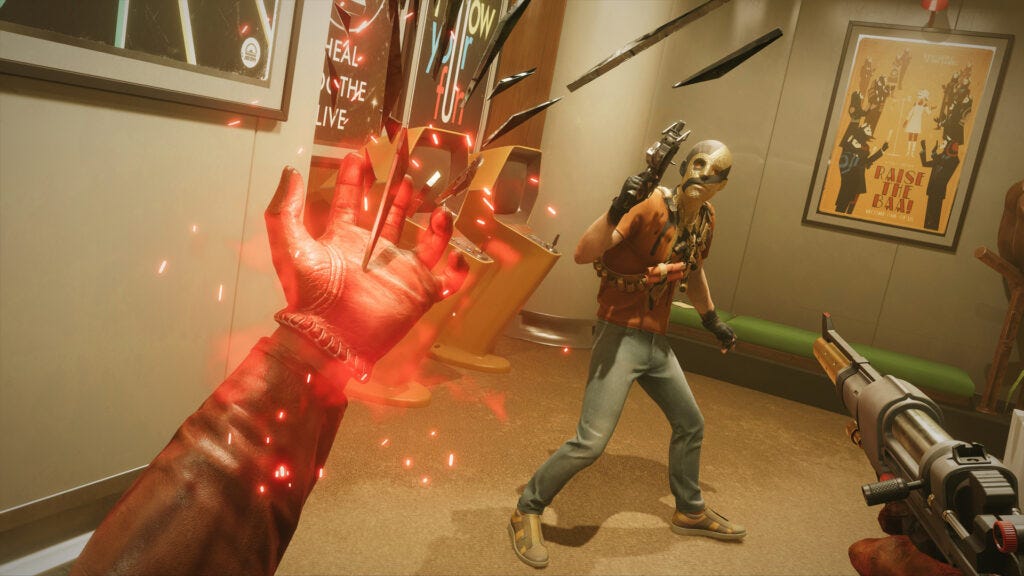
Deathloop, therefore, is an FPS with immersive sim elements, rather than the other way around. It bears the vestigial workings of a stealth system, but in practice you're visiting the same areas over and over again, and combat is so easy that the rewards for working stealthily are non-existent. Even if you aren't feeling bloodthirsty, you're better off simply running past enemies most of the time. This is because the AI is unbelievably bad.
AI
The only thing objectively bad about Deathloop is its NPC AI, which is some of the worst of any game I've ever played. "Eternalists," as they're called, seem to be completely deaf. You can run up behind them, assassinate their friend who is standing directly adjacent, and they still won't notice. Unlike in Dishonored, where an active alarm will attract every NPC on the map, the alert radius is pitifully small. Gunshots won't attract any Eternalist who's more than five feet away. Sometimes they'll be in line of sight as you slaughter their companions and they still won't activate. This all makes stealth itself trivially, pointlessly easy, but it makes slaughtering the map each day even easier.
This was the tactic I took.
Combat and Murdering
There is no non-lethal option in this game. I approve of this decision. Immersive sims have gone on for too long already as pacifism simulators. Mandating murder is fine and a step in the right direction. However, because there are no narrative penalties, or in fact mechanical penalties, to genocide in this game, and because it's so trivial due to bad AI and squishy opponents, clearing out a map before doing anything else is practically mandated. It's easy, it doesn't take that long, and it lets you explore in peace.
This is tolerable because Deathloop is basically just a shooter with magic powers. The gunplay itself is satisfying and fun; blowing heads off never goes out of style. But the levels aren't designed like a shooter's, and overall the primary gameplay loop is underwhelming. It was fun the first time I walked into Aleksis' party, holed up in a room with a shotgun, and killed the 100+ Eternalists as they piled in through the chokepoint; the next ten times were not nearly so enjoyable. That led to me eventually skipping most fighting, and turned the third act of this game into a parkour simulator rather than an FPS. Although parkouring with Blink is always fun, once I learned each map, it quickly became a test to see how quickly I could speedrun a zone, kill Julianna, get the objective, and get out without having to bother with the rest of the game's systems. Because quite honestly, the rest of the game's systems weren't very fun.
Although the gunplay is good, it bears mentioning how limited the arsenal is. There are two types of pistols, two types of shotguns, a single SMG, and a breech loading rifle. There are also a few legendary variants thereof which are effectively different weapons altogether. If Deathloop is an FPS, and I believe it must be, then this is really not sufficient. I used the same yellow pistol pair for well over half the game and almost never felt then need to try anything else.
Repeat. Repeat. Repeat.
None of Deathloop's maps are particularly big. They are tiny in comparison to the megamap I had envision when the game was announced, and I'd guess the total combined play area to be significantly lower either of the Dishonoreds. This is despite the fact that the game is at least twice as long as either Dishonored game overall.
The first trip to each of these four maps is thrilling, like you would except, but they get very, very repetitive. They change in minor ways as each day progresses, but they don't change between runs, at least not significantly. You will have to return to each numerous times, especially Updaam, which is the closest thing to a main hub.
By the third act, I knew every inch of Updaam to such an extent that I never wanted to visit it again. More than simply knowing its side tunnels and back exits, I knew how to navigate it expertly using Blink. Every single return to Updaam I would sprint through using the same path, Blinking the same direction, assassinating the same enemies. Even as my objectives on the map itself evolved, my techniques for traversal were as familiar as the blocking in a play.
In Mooncrash there are significant changes each run. This helps keep it fresh and prevents you from going through the motions, at least too much. But in Deathloop it's an inevitability. The maps needed to change more between visits and they needed to each be significantly larger. The unfortunate reality is that I was sprinting through each zone by the end of the game, because I knew what to expect and there were no interesting new challenges to face that might give me pause.
Deathloop's third act is a brutal slog, and the repetitive back-tracking of the level design is the number one culprit.
Inventory, Residuum, and Trinkets
The persistent gear system in Deathloop is clearly derived from Mooncrash, or was prototyped in therein. You accumulate points each day ('Residuum') and then spend them to lock weapons you've collected permanently in your inventory, although you can only take a limited number of weapons and items into any level.
Inventory consists of four trinkets, three weapons, three weapon trinkets per, and two powers. The powers are Shadow Form, Blink, Whirlwind, Semblance (Julianna only), and Domino, as well as a new and hideously overpowered berserk power called Havoc, which makes you invulnerable. If you can't tell I have intentionally referred to these powers by their names in Dishonored--in fact they all have new names, but the powers themselves are largely unchanged.
Beyond collecting these powers, the primary systemic progression is via trinkets. Trinkets are more or less like trinkets from Dishonored, except crossed partially with the passive ability enhancements you might buy with runes as well. The same goes for weapon trinkets.
This system works well to start. Just as in Mooncrash, though, you will eventually reach a tipping point. By about eight hours in I had literally no use for collecting gear or residuum anymore; I had everything I wanted or needed. There was no longer any need to engage in the inventory mechanics. I had infused all of the gear I could have possibly used, and significantly more.
In short, the progression systems stop progressing well before the end of the game--which took me about 14 hours to reach once-and-for-all.
As for powers, they're just as fun here as they are in Dishonored, except you're limited to only using two at once. This means creative multi-power combinations are now impossible, and it's ultimately pointless anyway because there's no reason to take anything other than Blink, and Havoc is by far the best of the remaining powers.
I mean seriously. Is someone really going to leave Blink at home? It's the most important power in these games, and it's also the most fun. It should have been default. Players can disagree over what's most competitive in the second spot, but Havoc is the only one that turns you into an invulnerable killing machine who can walk through the map effortlessly, which makes it, in my mind, similarly indispensable.
By the time I began the final loop I had eleven hundred identical trinkets in my inventory, multiple duplicate enhancements for each of my powers, pages and pages of duplicate weapon trinkets, and they were all purple in quality. The loot systems had completely broken down. Once again, the third act disintegrated underfoot.
Colt vs. Julianna
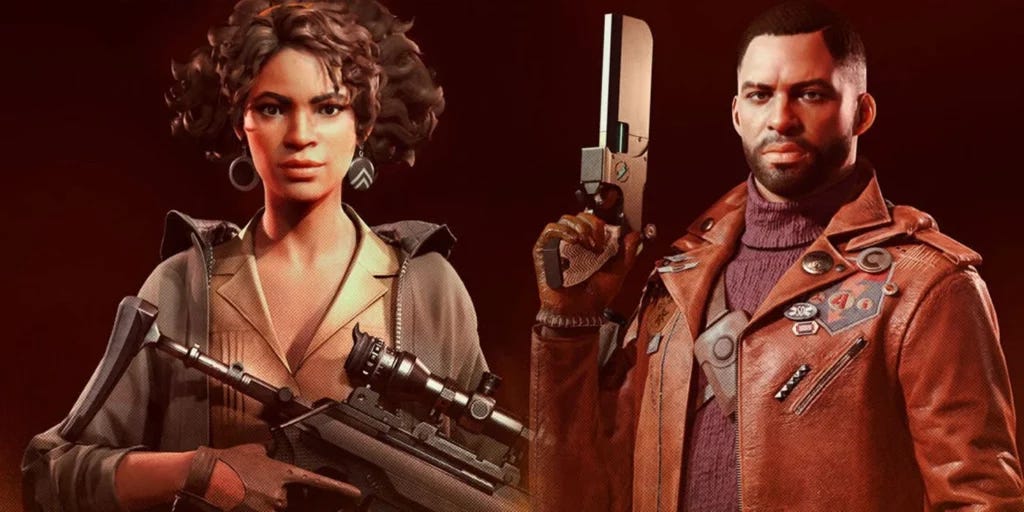
Probably the most distinctive feature of Deathloop is its much-touted PvP. In essence, while trying to break the loop as Colt, you can leave your game open to 'invasion' from players online. When invaded, a player takes on the role of the game's primary antagonist Julianna as she tries to track you down and blow your brains out (or otherwise make your life miserable).
PvP is the piece that completes the puzzle of Deathloop's gameplay. Without invasions, the game is trivially easy. NPCs pose no real threat to a decent player, especially once you've received purples in all slots and the hilariously OP Strelok Verso pistol-SMG-thingie.
With PvP, the early sections of the game become thrilling:
A red bar appears on the screen. 'You are being hunted.' You know this is a real person: Julianna will not be a pushover. Any death will mean lost progress and a reset day. Invasions were what made the early game for me. Going after objectives while simultaneously skirmishing with Julianna was absolutely, heart-poundingly fun.
...but, unsurprisingly, it's ruined by the players. 9/10 of every invader will simply go to the signal jammer, which Colt must disable in order to leave after an invasion has commenced, and camp there.
And camp.
And wait.
And then attack you when you get close.
This became so reliable for me, and I mean really like clockwork, that I would immediately proceed to the jammer after an invasion started, just to get the fight over with. Sure enough, I literally always found it there. Every time I looked.
Colt has three lives on any given map before his loop gets reset while invading Juliannas only have one, so the odds are in your favor. I killed about one third of my invaders without losing a life, another half after losing one life, and one or two after losing both. I was only permakilled by Julianna once, which was actually a double kill--we both killed each other at the same time.
Invasions keep you on edge. They're what excuses the terrible AI. They're where the real challenge is located in this game. But by the late game, while progressing through story missions and completing technical objectives, invasions become a nightmare. Every time someone joined my game I had to stop what I was doing--because if the battery I was carrying got shot, or my toy statue fell off a cliff, or the Visionary was alerted to my presence, then I would be boned and have to start the loop over (a huge pain in the ass). It was always better to report directly to the jammer, because I knew our duel there wouldn't have any loop-ending consequences (unless I really fucked up, which I never did).
Because you bounce between the four maps regularly while wrapping up loose ends, and each new map means a new chance at invasion, I had to turn off PvP in the last three or four hours. It stopped being fun and it never really was a challenge. Much like traversing each level, fighting off Julianna became little more than a chore. Having to face her back-to-back-to-back was exhausting. The game really could have used a one-invasion-per-loop limit.
I'm dead. So what?
My largest criticism of Deathloop hinges on the following point:
Who cares if Julianna kills you?
The worst thing failure ever means in this game is that you have to replay content, sometimes a significant amount of it. That content in and of itself isn't hard; the vast majority of my deaths came from stupid shit like falling off cliffs, or off buildings, or into water. The only time the gunplay poses a risk is when Julianna shows up.
In my imagined Deathloop, a dynamic sandbox with moving objectives, surviving for long periods would be the central challenge of the game as a whole. This is how it works in Mooncrash. But here, especially once you've reached max effective infusions, death costs you nothing but time. There are no narrative consequences. The ending doesn't change.
In other words, when Julianna kills you, it's annoying--but it doesn't matter. It forces you to replay content and literally nothing else. This effectively makes the deathlooping one big checkpoint system that just happens to be interwoven with the narrative.
That is a good thing, don't get me wrong, but to fulfill its premise, Arkane needed to do so much more with the game's roguelite elements. The fact is that death simply does not matter and simply is not interesting past the eight or so hour mark. This is, incidentally, the same point at which Deathloop stops being fun.
Sunshine and Snowses
It may seem like my take on Deathloop is very negative so far. Let me state now and for the record that I did like this game. It is a good game and I recommend you play it. With the exception of the AI and some fairly serious performance issues on PC, there isn't much 'wrong' in its design, if you take it as just another AAA action game.
The characters especially, and Colt in particular, are the strongest in Arkane's history and the best since Hades last year. Colt's conversations with Julianna are witty, funny, distinctive, and engaging. The setting is interesting and, by the end, I certainly was aligned with Colt psychologically: I just wanted the loop to end. The overall arch of the narrative is strong, and I thoroughly enjoyed the story despite its use of (more than a few) familiar video game tropes.
Finally, although the loop is messy in practice, turning the failure state into part of the narrative is an enormous accomplishment. It's what great games should try harder to do. The nature of the loop also rectifies one of the primary problems I have with Dishonored and Prey, which is that nothing is ever at stake if death only means reloading a quicksave you made ten milliseconds previously. Not so in Deathloop: here there are at least some consequences to failure, even if those consequences aren't what I would call fun in any real sense.
I must stress that it's mostly in the third act, and the end of the second, that my issues with Deathloop start. The first half of this game is almost as good as a Dishonored. Exploring the environments Arkane designs is always fun. Learning the weapons, gathering gear, fighting off Julianna, and meeting each Visionary is a blast. The only problem is that there isn't enough to keep you there for the duration the game wants.
Conclusion
Arkane's wires were crossed with Deathloop. Here is where I think Colantonio's departure makes itself apparent, because this game lacks a coherence that his projects always exemplified.
Deathloop has fundamental contradiction in premise: either this is a deathlooping roguelite sandbox built off of Dishonored's systems, or this is a plot-driven, mostly linear action game, where you're still afforded some degree of leeway in approach but are otherwise constrained.
The former is Mooncrash. The relative lack of environments is compensated with systems-driven narrative. Figuring out how to get each crewmember evacuated falls on your shoulders; you are not told what to do or where to go, outside of the most general and vague of instructions. In other words, the game does give you an objective, but it doesn't give you a plan. It is a sandbox.
The latter is Deathloop. You are given a plan as well as an objective. This is not a sandbox. This is not a roguelite. It doesn't make use of RNG. With the exception of a lack of saving features, it's basically just a normal shooter-adventure game, with an Arkane twist and a shitload of tedious backtracking.
It can't be both of these at once--but it's trying. The key point is that the deathloop itself doesn't benefit from this linearity. Where such a technique works is in a sandbox, like Mooncrash, where you're expected to think for yourself. It ultimately serves very little purpose in this type of game. This is why the third act in Deathloop drags so terribly. We aren't gaining anything from the timeloop gimmick anymore. It's just a narrative function. It could be replaced by quicksaving and nothing would be lost in gameplay terms.
That's fine. The loop does work well as a narrative function. I must stress again: I like this game and I think the story especially is good, up until the end. But this game is no Prey, and I think that's a shame. To be as good as it could have been, that's what Deathloop needed: more Arkane spirit, less new Wolfenstein: more Mooncrash, less Dishonored.
The End
In short, Deathloop is the best new game I've played this year. It's the best game currently available on PS5. If it had come from any other developer, I'd be singing paeans to the stars of its brilliance. But it's not a very good Arkane game. It's not much of an immersive sim. It has too little content to support its length, especially in terms of level design, and it falls apart at the end. Although I was engaged until credits rolled, I was not having anything remotely describable as fun in the lead up to the final loop. It's telling that the thought of going back to Updaam yet again makes me sick to my stomach. I'm so tired of these environments, and in a way that I'm not with Prey's Talos I even after nearly a hundred hours there.
In order to make revisiting the same locations interesting, Deathloop needed to be a sandbox. But it isn't. It's just a normal adventure game. This is the real point I'm trying to make. This is why the timelooping quickly becomes a bug instead of a feature. And it's a shame, because the content of the game comes very near achieving the brilliance of Arkane's previous titles. The story is good, the gameplay is fun, and the setting rules. It's just everything else that's lacking.
So there you have it. Pick Deathloop up on Steam or PS5 for $60. It's okay. It's good enough. And that's fine. Not every game needs to be Prey.
This review was done with a copy purchased from Steam on launch day. My final playtime was 13.3 hours. I haven't messed around as Julianna and have no desire to; I cannot stand to spend any more time in those four levels.