

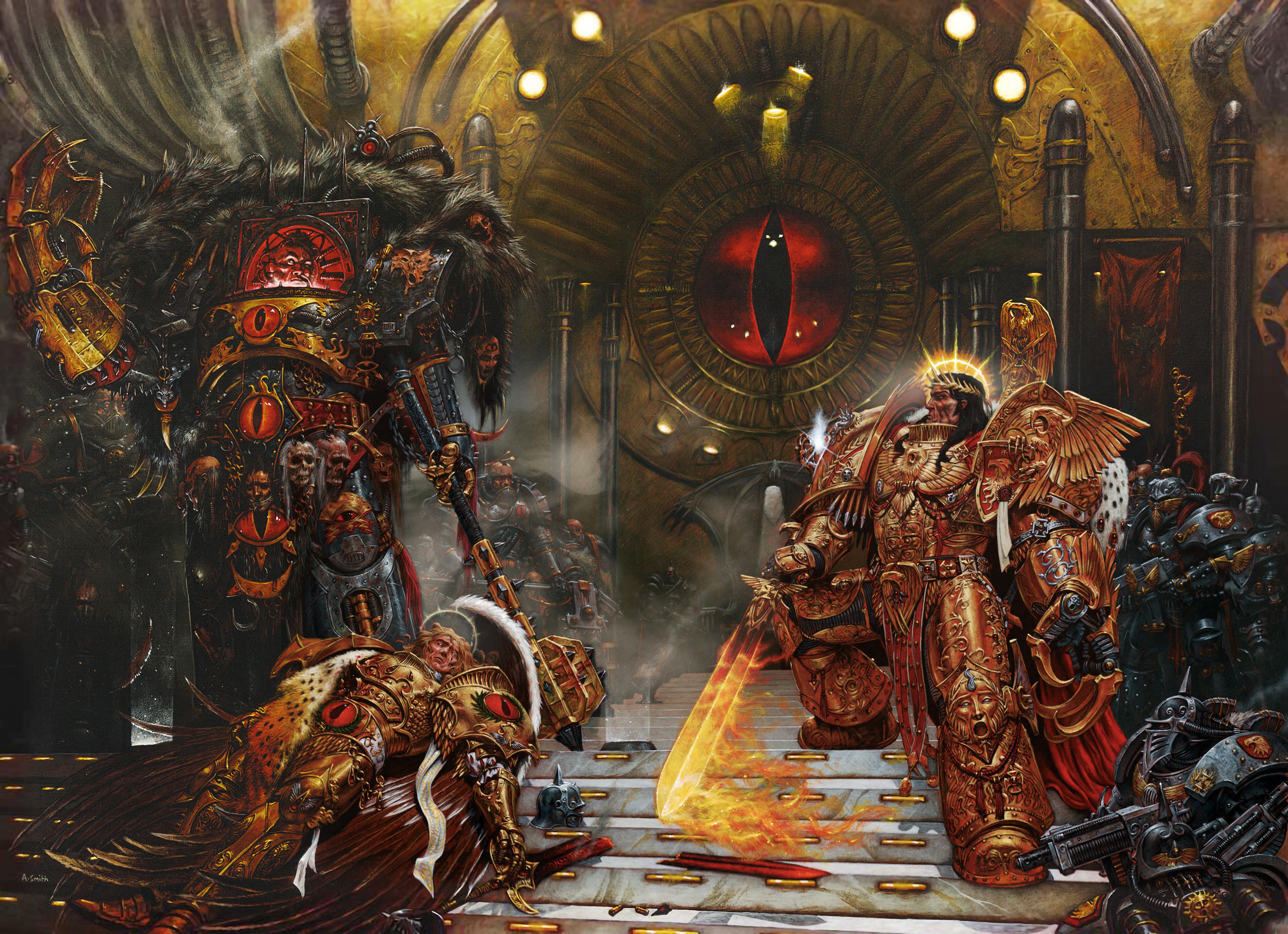
I wept the day our city’s hobby shop closed. In the early 2000s, Hardcastle was Tucson’s premier purveyor of miniature models. This underlit, badly air-conditioned store dwelled in the back-alley parking lot of a destitute strip mall on the West Side of town, almost a full hour’s drive from where my family lived. A less auspicious location to play games could hardly be imagined. In my memory there are black bags taped over the windows, and dust shimmers where burning rays of Arizona sun pierce between these makeshift blinds. A Mountain Dew aroma oozes from atop astroturfed tables, while Nirvana and Red Hot Chili Peppers thrum over tinny speakers.
Whether it was quite so dingy as that, I can’t say. But I do remember that it was a marvelous shop. Through its long entry corridor, towers held army after army. Long gunlines of brand-new Tau models welcomed every visitor. Necrons and Chaos Space Marines stood stalwart behind glass. At the counter within the shop, pre-built and painted models were sold, and along the opposite wall, stacks and stacks of Warhammer Fantasy Battles and Warhammer 40,000 miniatures hung.
It was, in retrospect, a perfectly average hobby shop. But it was the only one in Tucson at the time. Despite the distance, I went there with my family constantly around the era of 4th and 5th edition 40k. I shudder to think of the money my father wasted on expensive plastic spacemen for his sons who lacked the intellectual capacity to make use of them. He was happy to do it though; my father had no interest in miniature wargaming, but he had been obsessed with Warhammer since making the random purchase of second edition Space Hulk in 1996. I own the full contents of that box to this day, and he continues to read nearly every Black Library book that gets released—including every title in the Horus Heresy.
I was infatuated with the oddities Hardcastle sold. In this age, before resin and long prior to Primaris, white metal still reigned. I would always be drawn to the enormous range of metal figures in blister packs on the wall. There were countless strange, unique characters for sale in both Fantasy and 40k, and they fascinated me. Characters like Commander Dante seemed mythological. Their models were older than me. They made 40k seem like an institution, as firm and steadfast as the Earth we walked upon.
Would a boy getting into 40k would look at Guilliman the same way today? His model is almost ten years old. But I doubt it. The mystique of metal, in the dawning era of plastic, was part of the magic spell.
Learning more about Second Edition and the history of 40k today, it’s funny to realize that those miniatures really weren’t so old after all. Dante was released less than two years before I was born, and I was hardly eight. But two years is everything to an eight-year-old.
Hardcastle went out of business shortly after the financial crash. I remember the day I found out vividly. My childhood was very lonely and very troubled, cursed by never-ending medical problems, and there were few places I took comfort in. Though I had never learned 40k’s rules, never assembled an army or really painted anything approaching value, Hardcastle had been a place that mattered to me.
My father broke the news, and I ran to my bunk bed, literally weeping. I was prone to such outbursts. Where would I go to admire Commander Dante now? How would I get new Warhammer?
The answer was nowhere.
Over the coming years, I developed the habit of scrolling through the Games Workshop webstore, tabbing through their game systems, and gawking at the majesty of the old Forge World’s offerings with some regularity. It became a custom each Christmas for my father to buy me Space Marines. I came into possession of 5th edition Sanguinary Guard, Death Company, and Grey Hunters this way, all of which remained unbuilt (partially) until I scavenged them for parts this year.
I did occasionally try to paint. With a local hobby store, I might have kept with it. But without Hardcastle, there was no way to learn the games, no way to explore the model ranges, no magic left for me to find. I remember searching through Tucson with my dad for a replacement store, but there were none at that time, c. 2010-2012. These days there are at least three that carry GW products, and we even have our own official Warhammer store. But things were different back then.
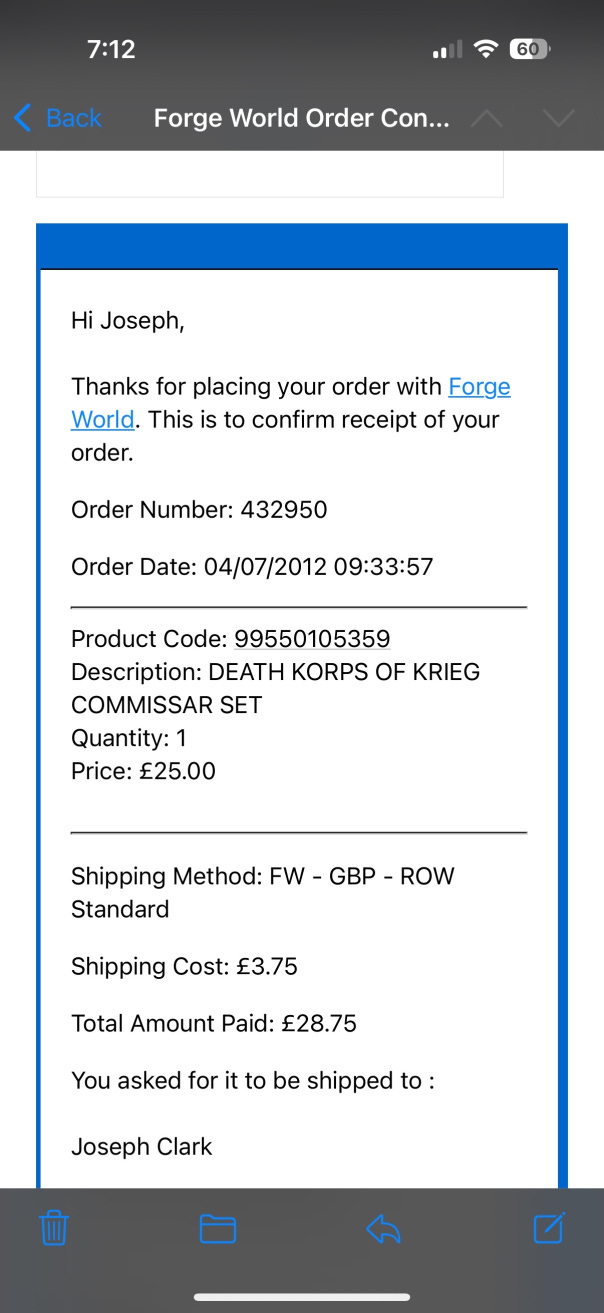
So I gave it up. The last miniature set I ever bought was the Forge World Krieg Commissar bundle. I lost them when I moved to college, and I deeply regret that (because they were expensive as hell for a fourteen-year-old: look at this!):
The Context
I am afflicted by something called a “non-verbal learning disorder.” This condition describes a severe visual-spatial incapacity. There is no word in English that can express my coordinational disability. I usually tell people I’m dyspraxic, but this really doesn’t go far enough. It took me many years to learn how to have even vaguely legible handwriting in school. I was sent to physical therapy as a child for no particular reason other than clumsiness, where I was deemed less athletic than the girl in a leg cast. I get along with sports like a Space Wolf with a Dark Angel. I have never drawn a straight line of any length or made a perfect circle.
Once, when I was in college, the guy at the desk behind me leaned over my shoulder and gestured at my notes:
“I just wanted you to know,” he said, “that you have the worst handwriting I’ve ever seen.”
I am fortunate to live in a digital era where I can spend most of my days pretending to be unburdened by the physical body that has never felt like it really belongs to me. I mention all this now, of course, because when a child whose visual-spatial skills are retarded to the level of an infant sets his mind to miniature painting, the results are predictably calamitous:
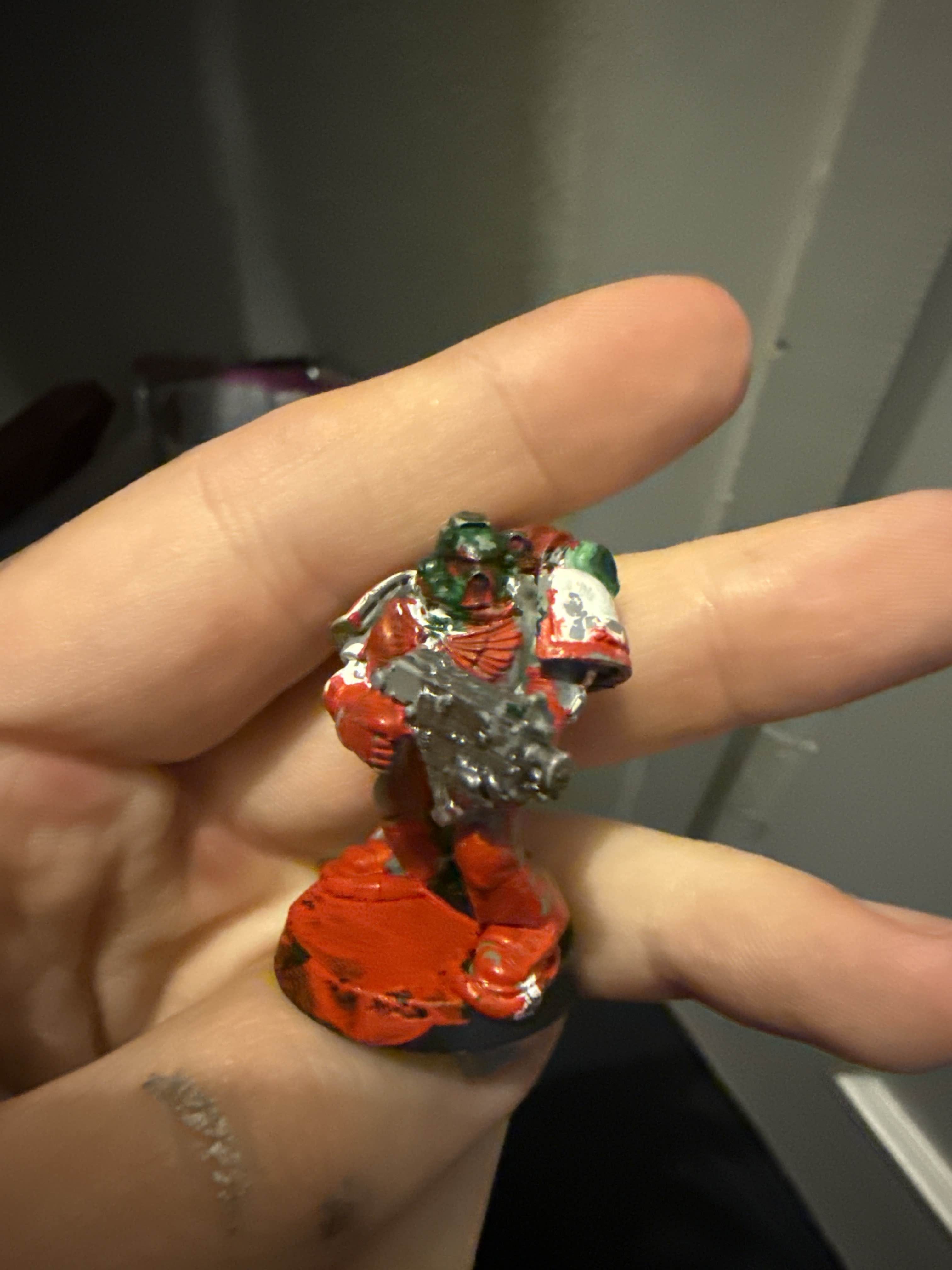

I must have been about eight when I “painted” the top marine. I might have been as old as ten when I defiled the Defiler. It was my brother’s model, and he was furious with me for choosing such a creative color scheme. As you can see, I didn’t know about priming (and he didn’t know about isopropyl alcohol). This caused a great deal of consternation when working with white metal minis.
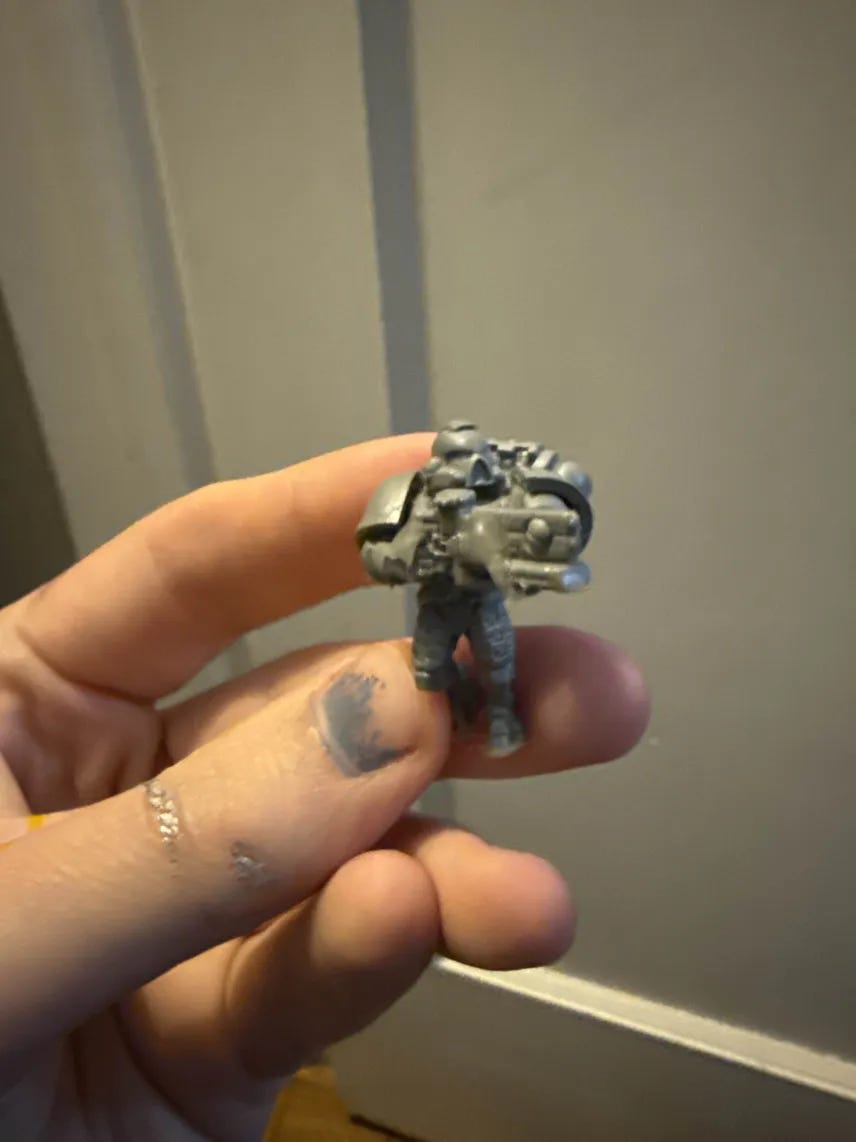
My particular obsession was with kitbashing Tau and Space Marine models together, for some reason, always using disastrous amounts of hot glue. I also had the habit of putting Space Marine shoulder pads on backward, which I did despite having access to codices that would have shown me otherwise. I guess I didn’t care.
For the sake of my own shame I will spare you any further horrors from within the bits box of my youth. There are many more.
This mishandling of expensive plastic miniatures continued well beyond the age it should have. For that I have no defense.
By the time I reached the enlightenment of puberty, I saw painting and Warhammer as an important part of my identity. I had begun reading the novels and often discussed the lore with my family. I played every game available and especially adored Dawn of War 2. But I had also become keenly aware of my utter inability as a painter. This was likewise before the mass availability of painting tutorials online, in YouTube’s earliest days.
It may not be possible for one to have less of an affinity for something than I do for miniature painting. It is like composing poetry in a language one cannot speak. Fine motor control is almost impossible for me. I cannot even comprehend how a person might imagine something and draw it. I can imagine something and describe it, in extreme detail. But the second I put a pencil to paper, nothing makes sense.
It is, according to some, an actual autism spectrum disorder.
So after 2012, I gave up. There was never a conscious decision to stop painting miniatures. There never really is. But it’s difficult to enjoy being so terrible at something, and I didn’t have a mind to improve. So I simply stopped.
I always thought that I’d come back, someday. I just didn’t know when. I missed Finecast. I missed the release of Knights. I completely missed Primaris. It all happened out of view, barely acknowledged. Lore updates were received around the dinner table. That was the extent of my engagement with Warhammer.
The Next Year
At the end of 2023, I was diagnosed with adult-onset type 1 diabetes. This diagnosis followed a lifetime of severe, rare medical disorders carried over from childhood and completely changed my life. It stole my love for gaming from me and killed this blog. In the year that followed, struggling badly to cope, I needed something to replace my lifelong passion.
For eight months, I had nothing. I started working out for the first time in my life. I hated it, but there was nothing else that I could stand to do. Games no longer held any joy. I couldn’t even write.
Then Space Marine II was released.
If I had done a good job maintaining this blog, readers would know that Space Marine II has been my obsession for the last year and a half. Instead I’ve never even mentioned it. Let me review it briefly now:
Space Marine II is very good. Together with Rogue Trader, it thoroughly reignited my passion for Warhammer 40,000. The week after SM2 came out, I went to the nearest hobby shop, picked up an Eldar Kill Team, and built my first miniatures in twelve years.
And the experience was so horrific that I gave up halfway.
This was not so dissimilar to what I had gone through utterly failing to get into Blood Bowl several years earlier. But it wasn’t what I remembered as a child. This time, unlike last, I refused to be deterred. I drove forty minutes back to the GW store and bought some Space Marines instead.
That first Primaris kit that I had ever seen or built was not a horrific experience. The models proved much more restrictive than I remember from the early 2000s, but they looked great put together, and my reservations over lore changes had mostly melted away after listening to a few newer audiobooks.
My first paintjob looked like I was eight years old again.
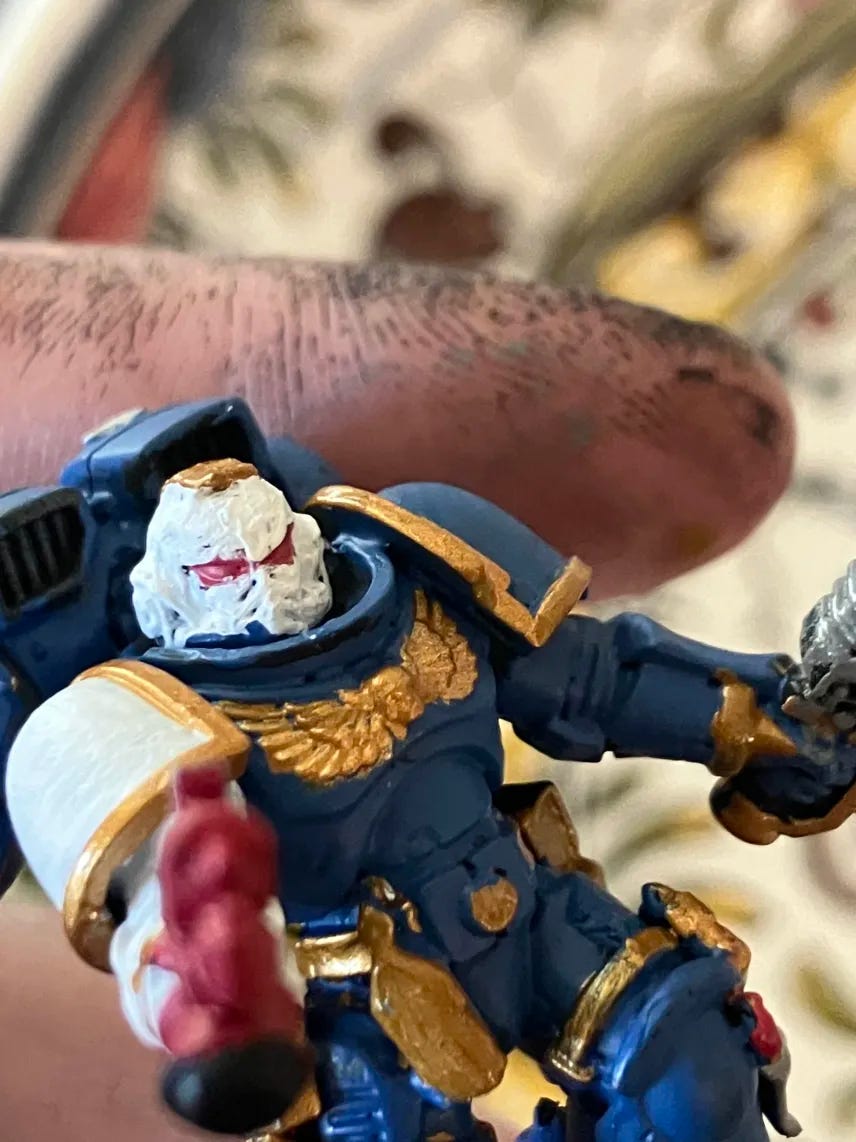
For a reason I can’t articulate now, I thought I knew what I was doing. I thought that I had experience. I quickly learned I was mistaken. I didn’t know about thinning my paints, had no understanding of how to pick out materials on the miniature, and had no brush control whatsoever.
And yet though it may seem a horror—I was actually impressed. This was better than I thought I would be able to do. I was expecting another Defiler.
Thus from this beginning, I decided to see how far I could push myself.
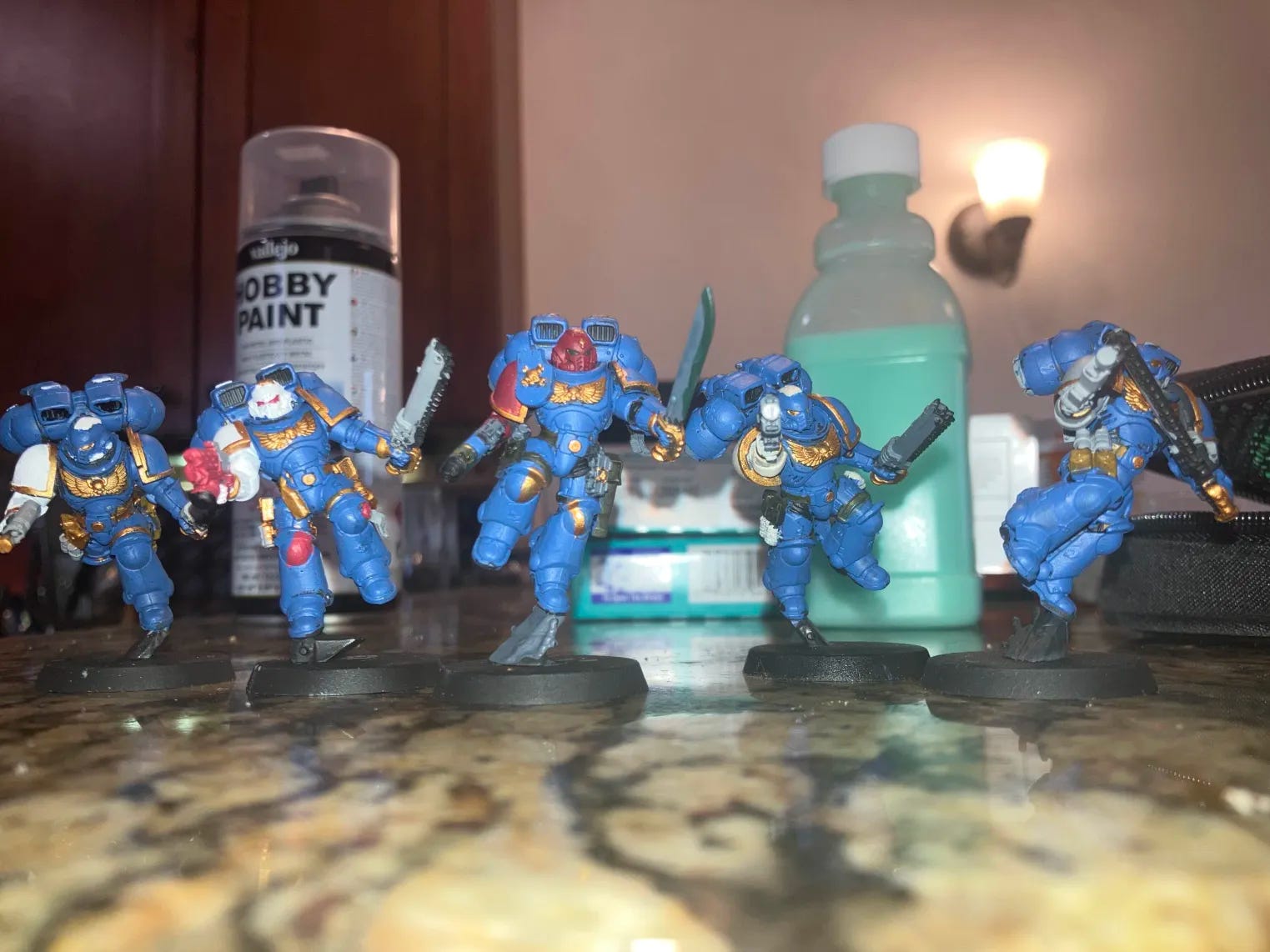
This is where I start. A dead-end paintjob on an Ultramarines successor chapter. I realized there was no chance I would ever try painting white again. More importantly, the Blood Angels, my favorite chapter as a kid, were getting a refresh. They were who I would play.
I stripped the models and tried again.
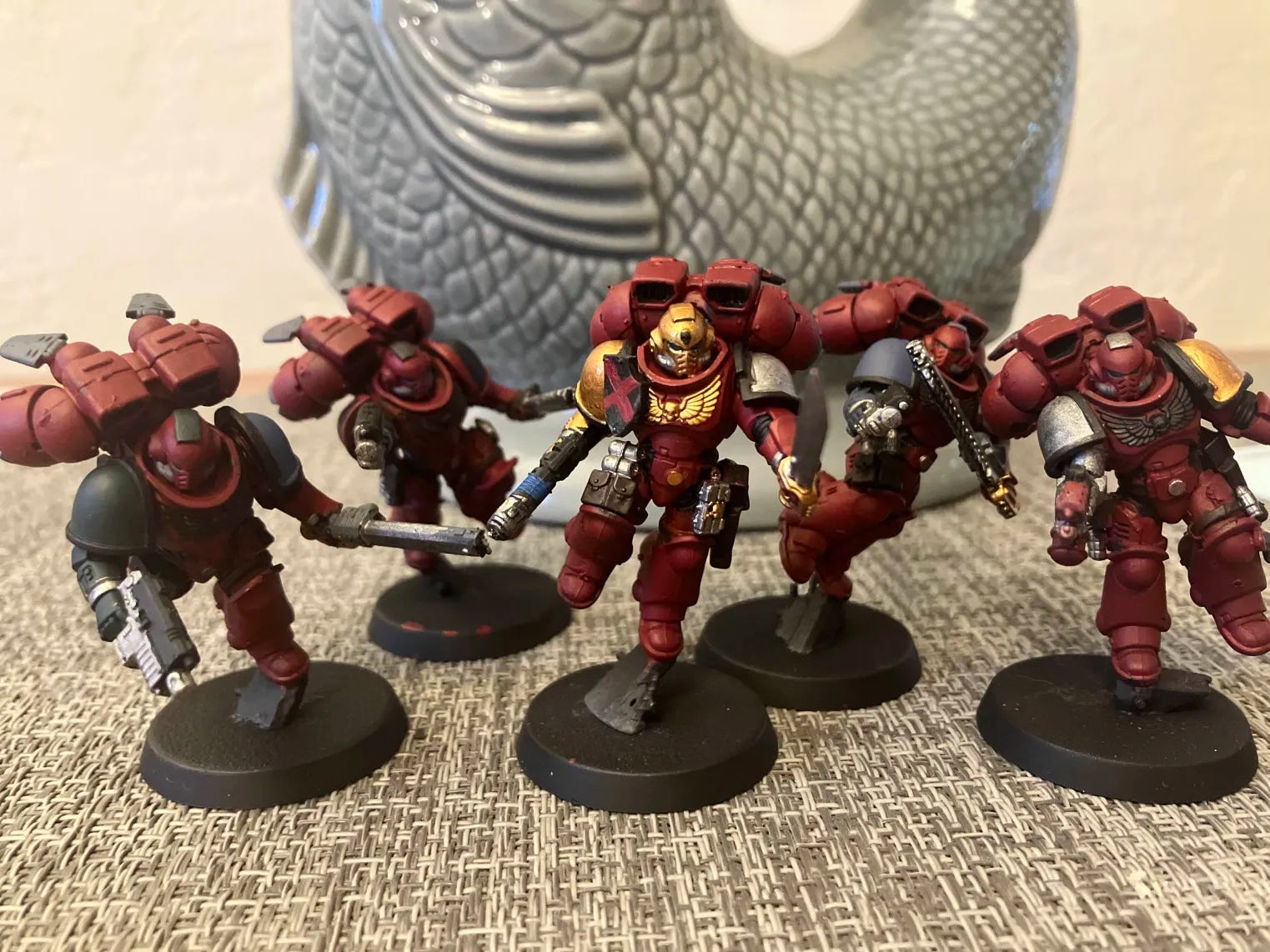
This was some improvement. I had spent hours watching videos. I still didn’t know what I was doing. Brush control felt impossible. Getting a smooth base coat was incredibly challenging for me.
But now I was infected. I was addicted to plastic crack. It was too late to get out.
Though it took a year to find them, my Blood Angels proved to be the thing I needed to replace gaming. They were the distraction from diabetes that I had been desperate for. I do not know what I would be doing or where I would be had I not found Warhammer again. But I’m glad I won’t need to find out.
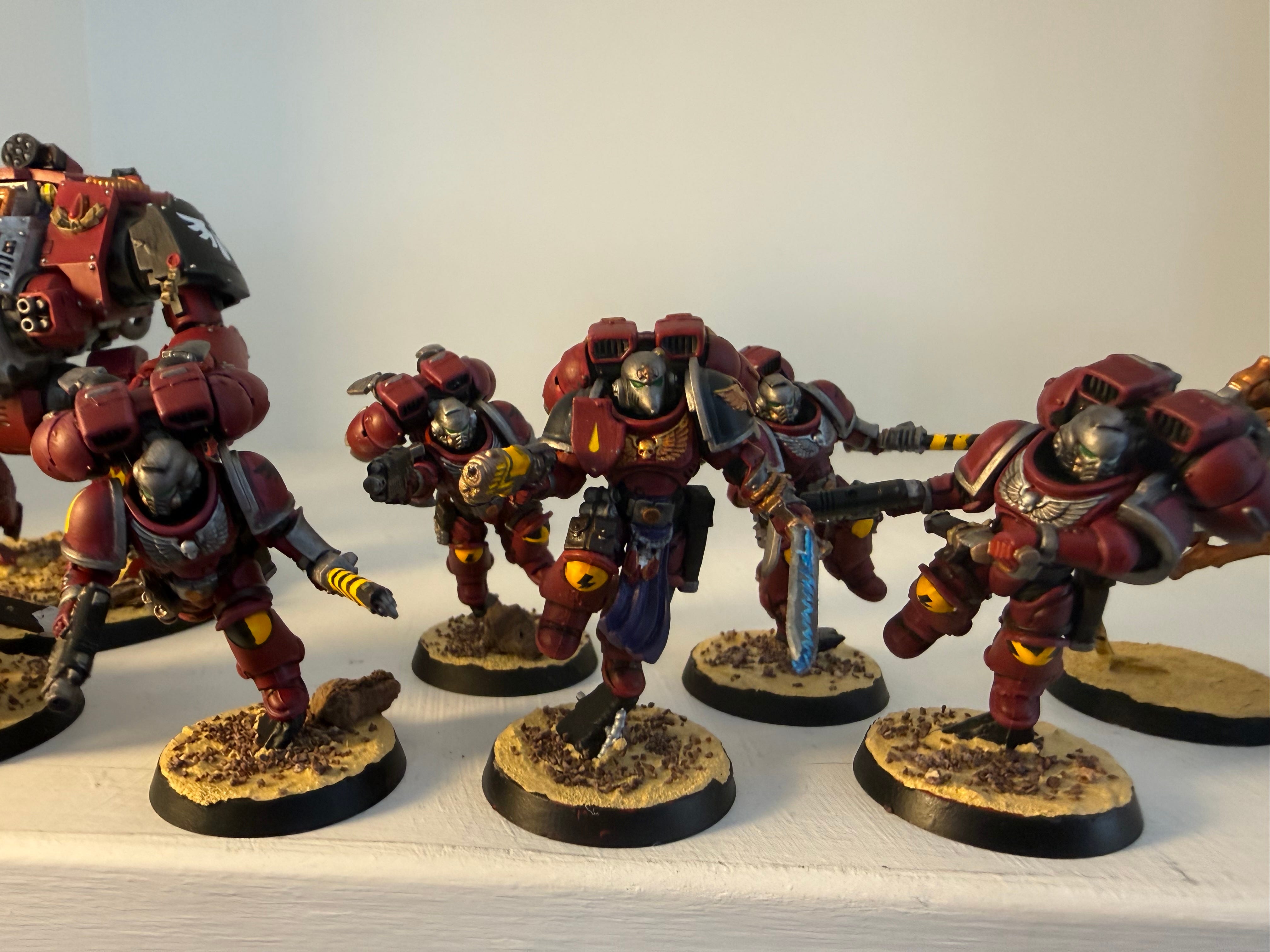
My life has looked like this for the last fourteen months. In that time, painting has supplanted all other forms of leisure. I have played only one new game this year. I have watched zero films, new or old. I have viewed one reality television series—Clarkson’s Farm—and nothing scripted. I have listened to over fifty books on audio. And I have painted, and painted, and painted.
I’ve played one thousand hours of Classic WoW since 2019. I’ve had a tremendous time with it, and every winter I feel the urge to play it again. But what do I have to show for that time? For seven hundred hours logged on my Fire mage? What evidence exists to prove that I was alive at all for those seven hundred hours?
I don’t even know where my mage lives anymore. I think she’s been swept along to a Classic Legion server. I won’t ever play her again. Her purples earned in Molten Core mean nothing. No one will ever care. I can’t even show them to anyone.
Seven hundred hours spent laboring over a hobby desk with paint and miniature have yielded me a vast army of Blood Angels. Anyone who comes to my house can see it. I could sell it. I can play games of Warhammer 40,000 10th Edition with it. Unless it is stolen or my house burns down, I will always have it. It isn’t going anywhere. My time invested is there, material, before my eyes.
Maybe little plastic soldiers don’t matter. But at least they’re real. This is what I’ve learned, paradoxically, now that every day living in reality is a hundred times harder than it ever was before. I spent all of my life hiding inside video games, and in all that time, I produced nothing real at all. What was the point?
This blog post isn’t about my experience with weight loss or becoming physically active, but the principle is much the same. It’s been two years since I first set foot in a gym. My progress isn’t amazing. But after a thousand hours or more lifting weights, I can see the difference. Anyone can.
What would a thousand more hours of Crusader Kings III have earned me?
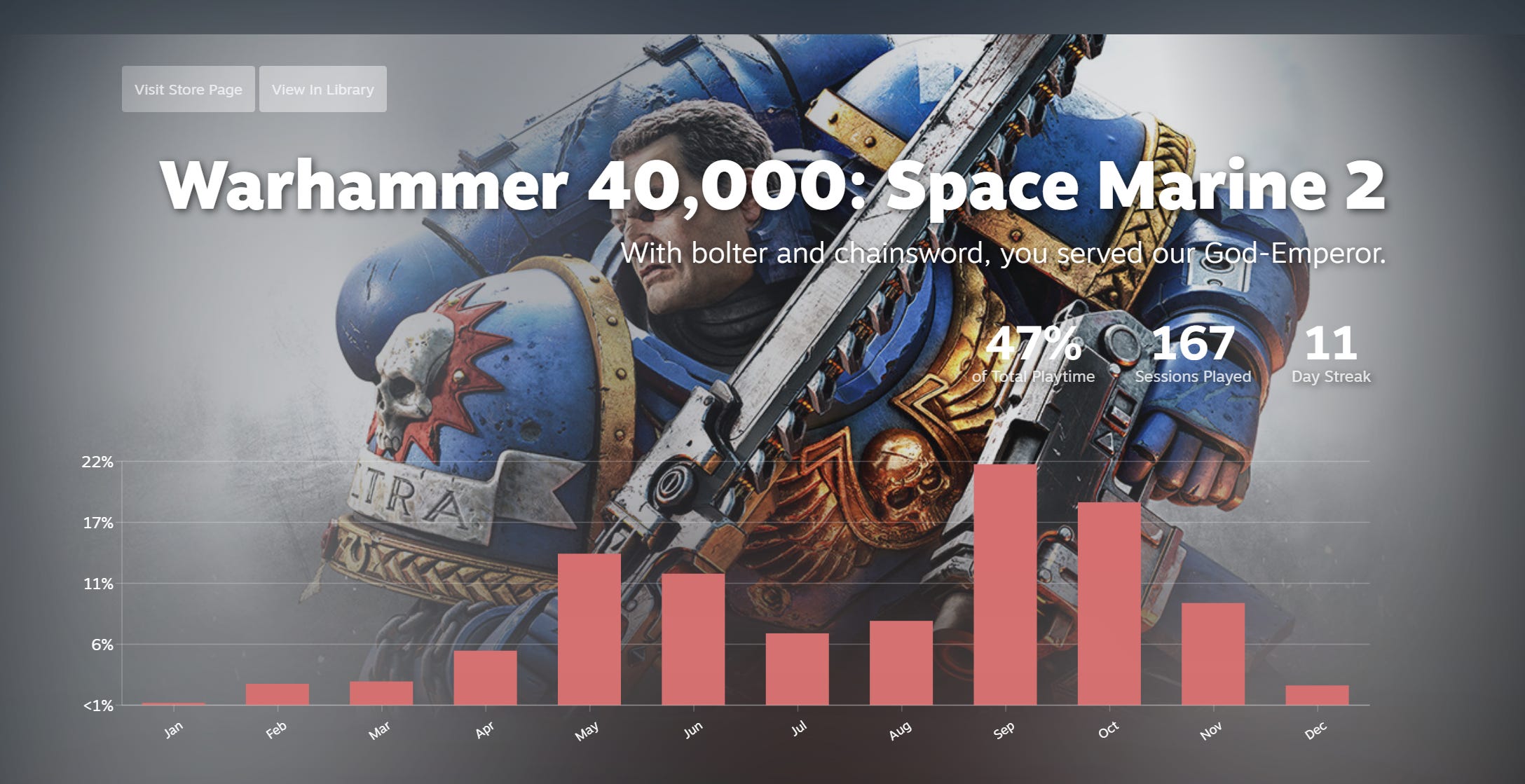
Not all time spent needs to be productive. An activity isn’t a waste just because it doesn’t scar the materium. I’ve still played some games this year. A bit of WoW. Quite a bit of Space Marine II. But nothing at all compared to last year. Kingdom Come: Deliverance 2 was the only new game I played all year, period, and though I meant to review it for this blog, I disliked it so much that I couldn’t be bothered. There were too many minis to paint instead.

Proof in the Materium
So here is the trace that my year of labor with a paintbrush has left in the physical realm. This is a gallery of every model I’ve worked on since I started my collection. I’ve been repainting miniatures steadily as I improve, going back and adding highlights, and so this won’t be a true indicator of progress. These miniatures are way too expensive to stand as living museum pieces. I don’t find any value in that.
Though I was confident in my choice of Legion, I knew early on that I wanted to diverge and make my own color scheme. I spent several months trying to settle on something that both worked and felt unique. It wasn’t until I was browsing the Horus Heresy catalogue and stumbled across the Angel’s Tears units that I had my revelation.
My successor chapter would be descendants of the Angel’s Tears destroyers, and they would be red, silver, and gold.


This is how they stand now. The First, Second, Third, Fourth, Fifth, and Tenth companies of the Angel’s Tears, who mostly use normal Blood Angels iconography. Though the challenge of building out a single company of Space Marines has always appealed to me, the scarcity of Blood Angels shoulder decals—and my utter inability to freehand them—meant that I really had no choice but to organize my forces this way. I like it, though. Each group has a different specialty.
No Blood Angels successor would be complete without its own Death Company, of course:

This is the whole of my army. It’s something like three thousand points in 10th Edition, though I’ve only ever played one 500-point game. Many of these models were painted at least twice. Some have been stripped three or more times, including the dreadnought.
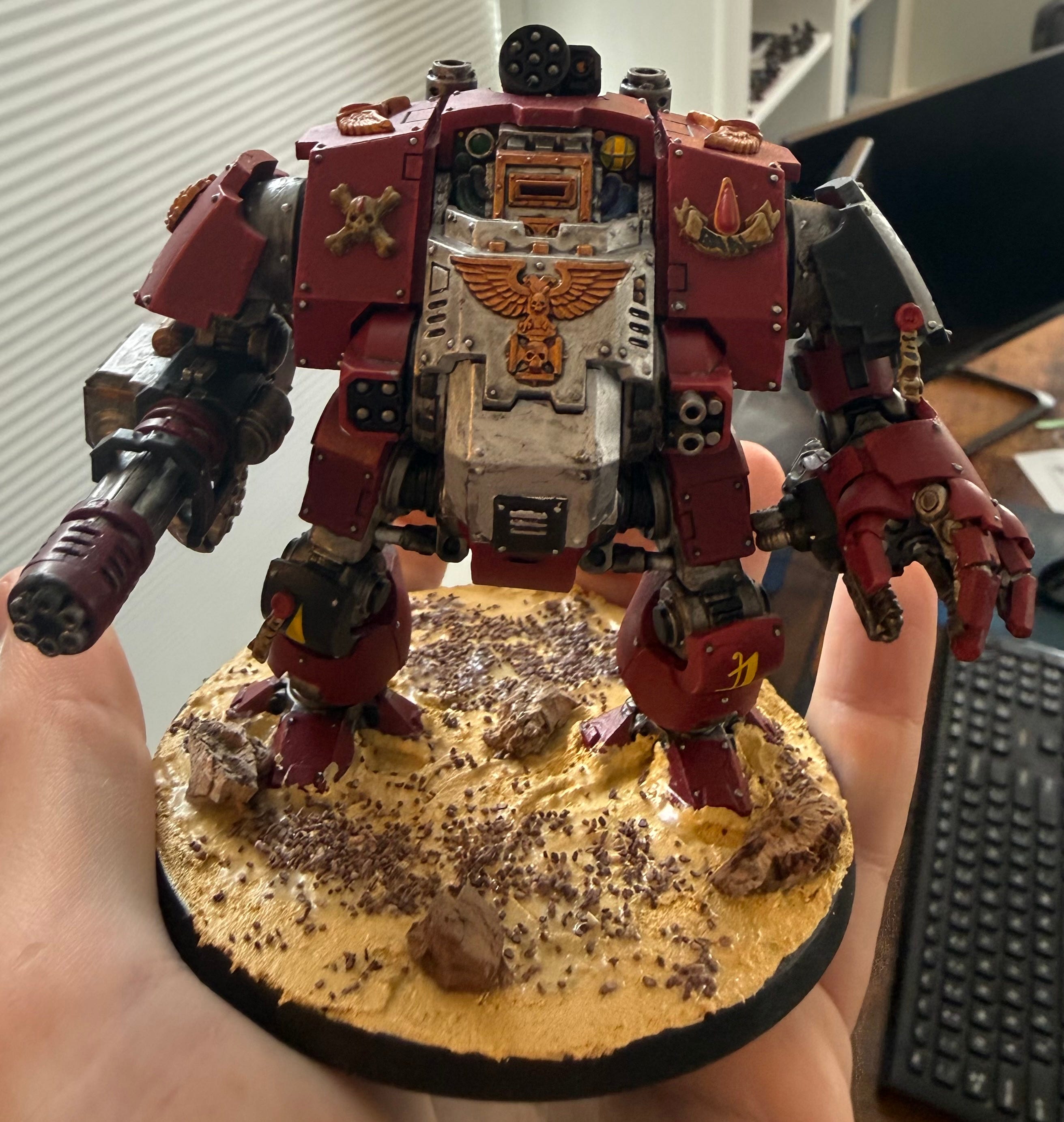
My first vehicle, he was a disaster. Building him was miserable, and I utterly failed to layer Khorne Red thin enough over black to build opacity smoothly. A horrible texture covered his armor panels, and I had no choice but to strip and start over.
Creating smooth base coats with Khorne Red then and still now proved my greatest struggle. Thin, watery layers flood the details and clog them up. Thick layers inevitably create tide marks, even when careful not to touch up areas already painted. But I decided to try moving over to a red primer, and the results were tremendous. I had an amazing time painting this model. My motor control issues felt basically non-existent when working with such a large sculpt, and for the first time, I had the confidence to try highlighting the edges.
The color I used was much too soft. But he still represents a huge step forward in my skill as a painter. I had thought that highlighting would simply be impossible for me. I didn’t even bother trying. Now I wondered if it was something worth practicing.
So I practiced. I went back to old models to clean up messy details and add edge highlights. I learned more about shading and discovered panel lining, mostly thanks to Duncan Rhodes, and started putting it into practice:
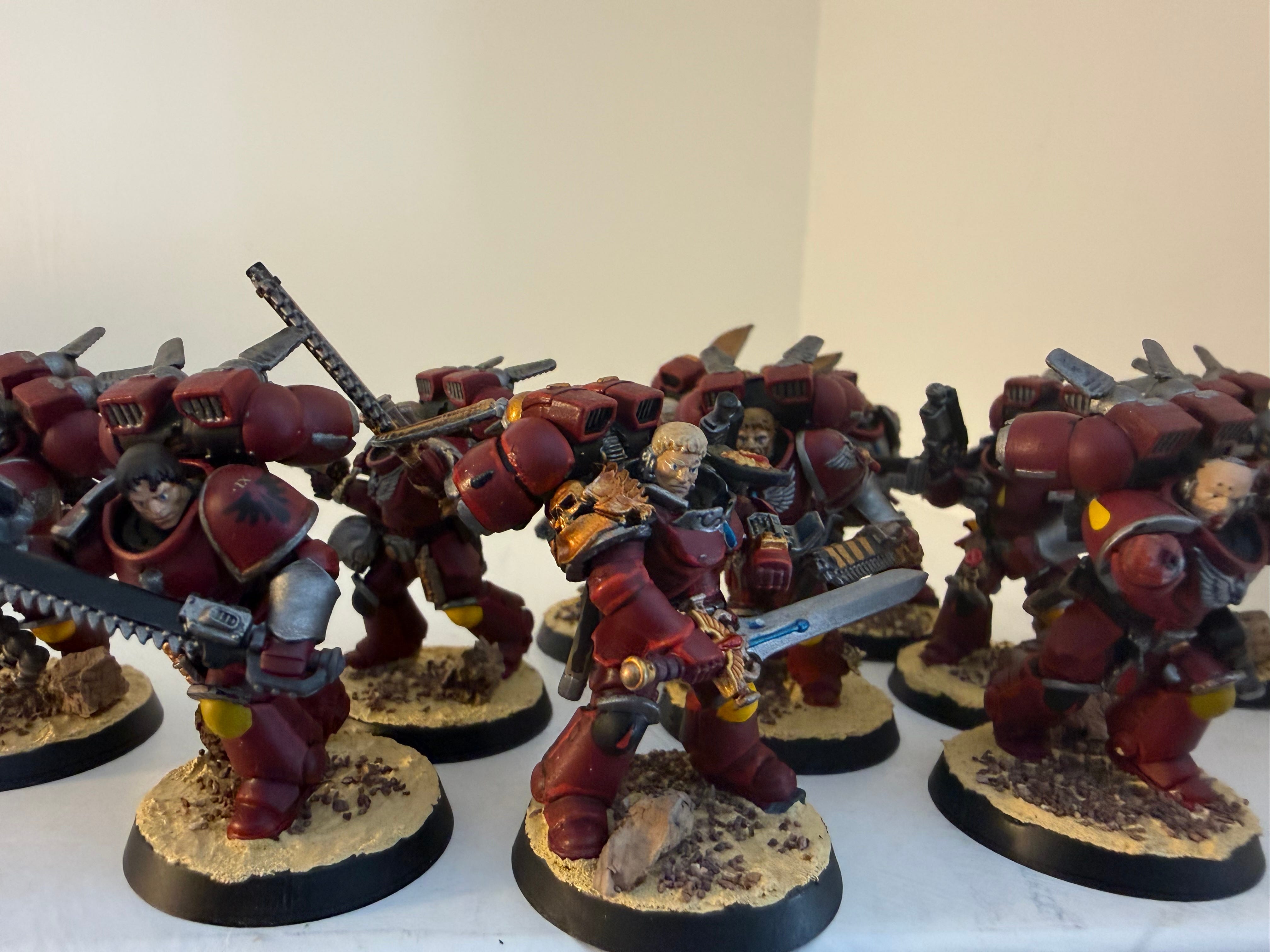
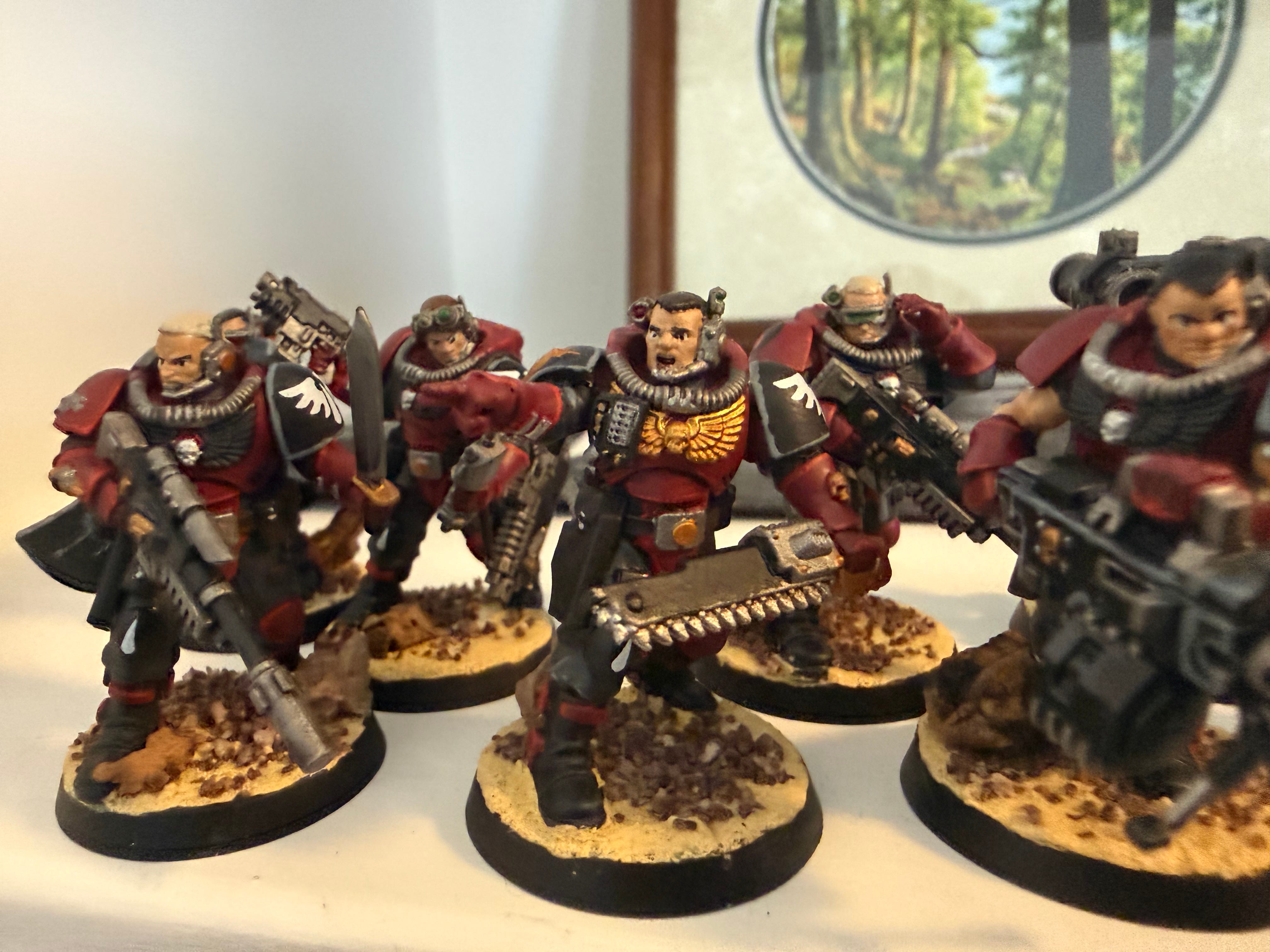
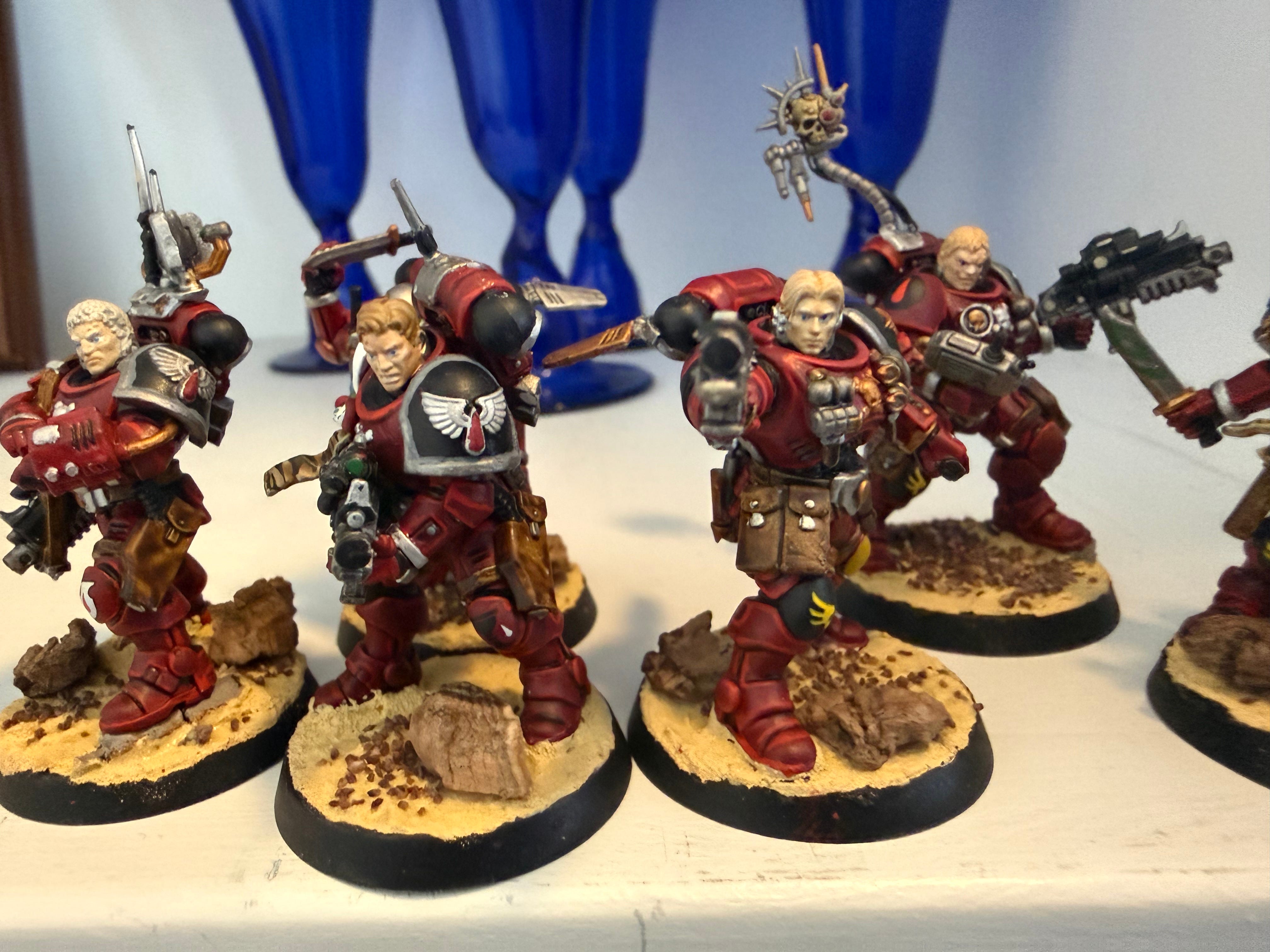
Working up to these fairly basic techniques took me about six months. I can barely write my own name. How could I highlight a miniature?
I quickly learned that it isn’t as hard as people make it out to be. With a good brush, acceptance that it might be a bit messy, and a willingness to spend huge amounts of time per mini, acceptable results are achievable by literally anyone. My highlights don’t look anything like what I see people post on Reddit. They’re way too thick and almost never neat enough. But they’re still good enough when you don’t have a camera blowing up the miniature to ten times its real size.
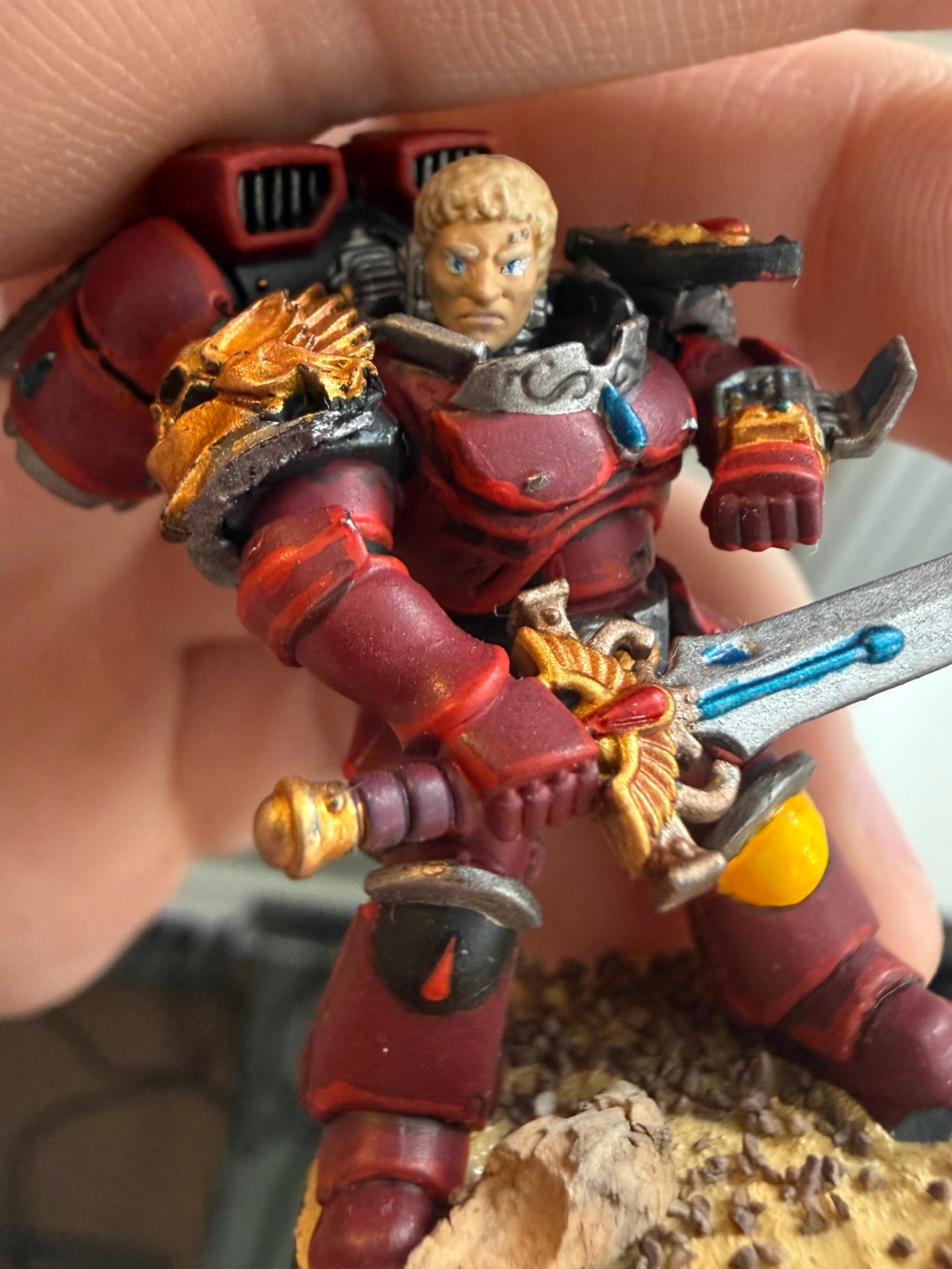
At thirteen, I never would have believed I could have painted to this level. At twenty-seven, I’m frustrated that I still struggle with so many basic principles. Where my collection does look relatively good, what can’t be seen are the countless visits to the isopropyl bath, and the endless hours spent fixing simple mistakes. For me, painting is an exercise in patience. I have to repaint any area five or six times per model. My hands slip constantly. More complicated techniques are effectively off-limits, because if I can’t touch an area up after moving on, there’s really no point. I’ve spent an unbelievable amount of time experimenting with contrast paints; I love them, but the truth is they’re basically impossible for me to use. Mistakes are too hard to correct, and I make too many mistakes.
But over time, I’ve found what works. And the results are good enough.
Along with basing, waterslide transfers were one of the biggest hurdles that I had to get over. I spent months avoiding them, because I remembered being utterly baffled by this strange technology as a child. By the time I dared to try, I used hard Arizona tap water, and the results were terrible.
With Microset and Microsol, it became trivially easy.
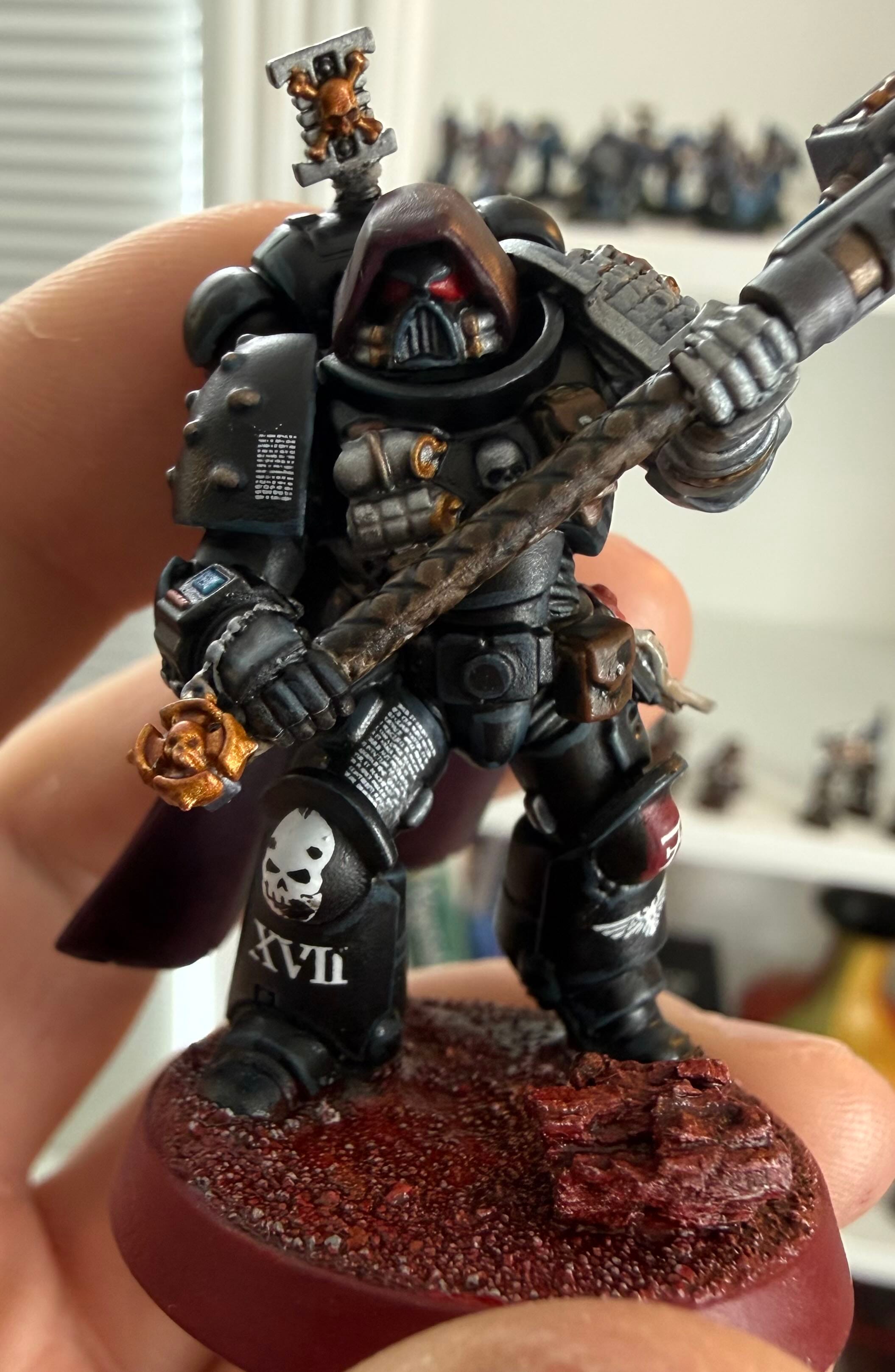
Decals are amazing. I abuse them now. My models are festooned with stickers. I will never be able to freehand an aquila, or a skull, or even draw a numeral to an acceptable standard. Transfers allow me to add that level of verisimilitude to my figures anyway.
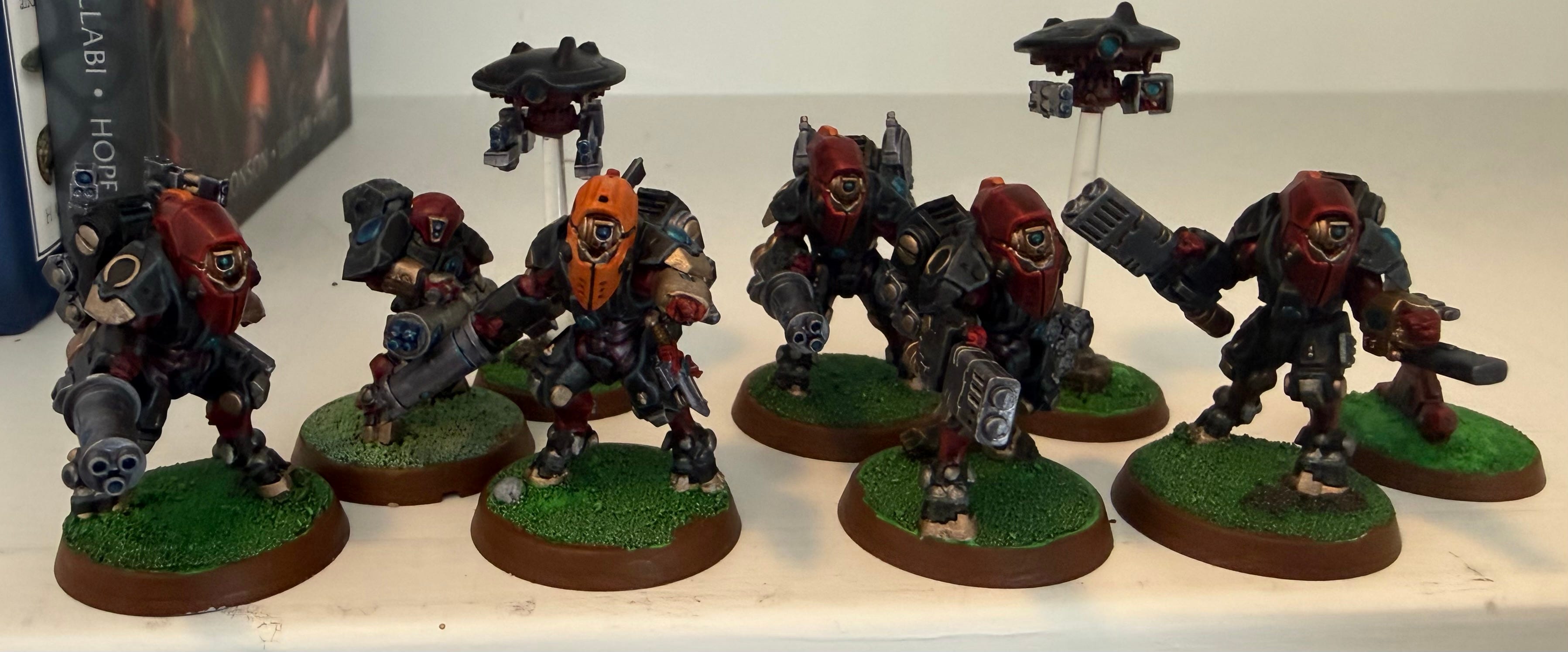
My love isn’t just for Space Marines. When I returned to the hobby, it certainly wasn’t foregone that I would be basic enough to collect Primaris marines. I’ve done some experimenting. I finished the new Stealth Suit kill team earlier this month:
I’ve always particularly loved the Guard. Had it not been for the vast expense of collecting an Imperial Guard army, they would have been my first choice. In the end, I didn’t need that many models to get my fill of them. But they sure take up space on the shelf:

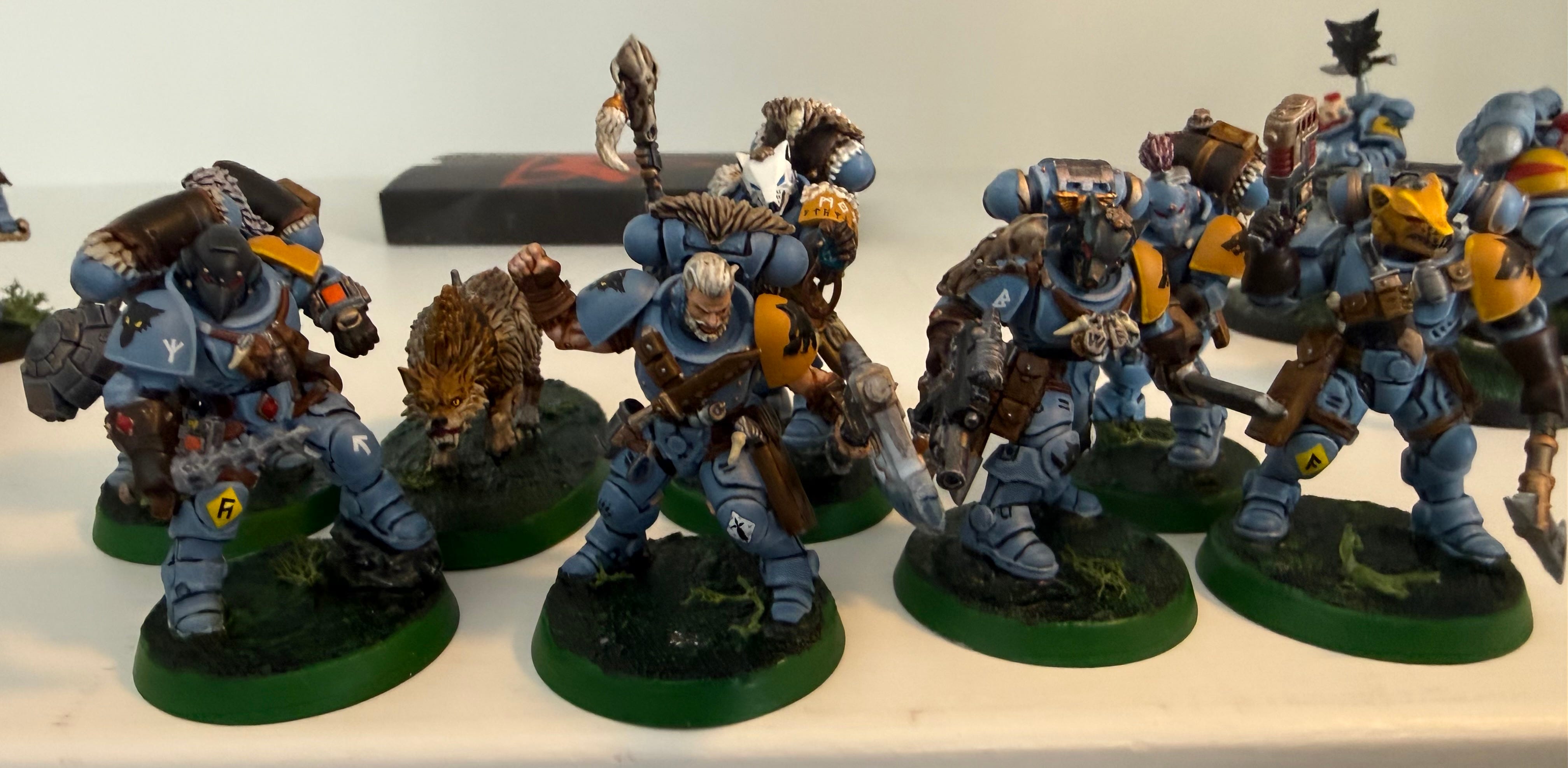
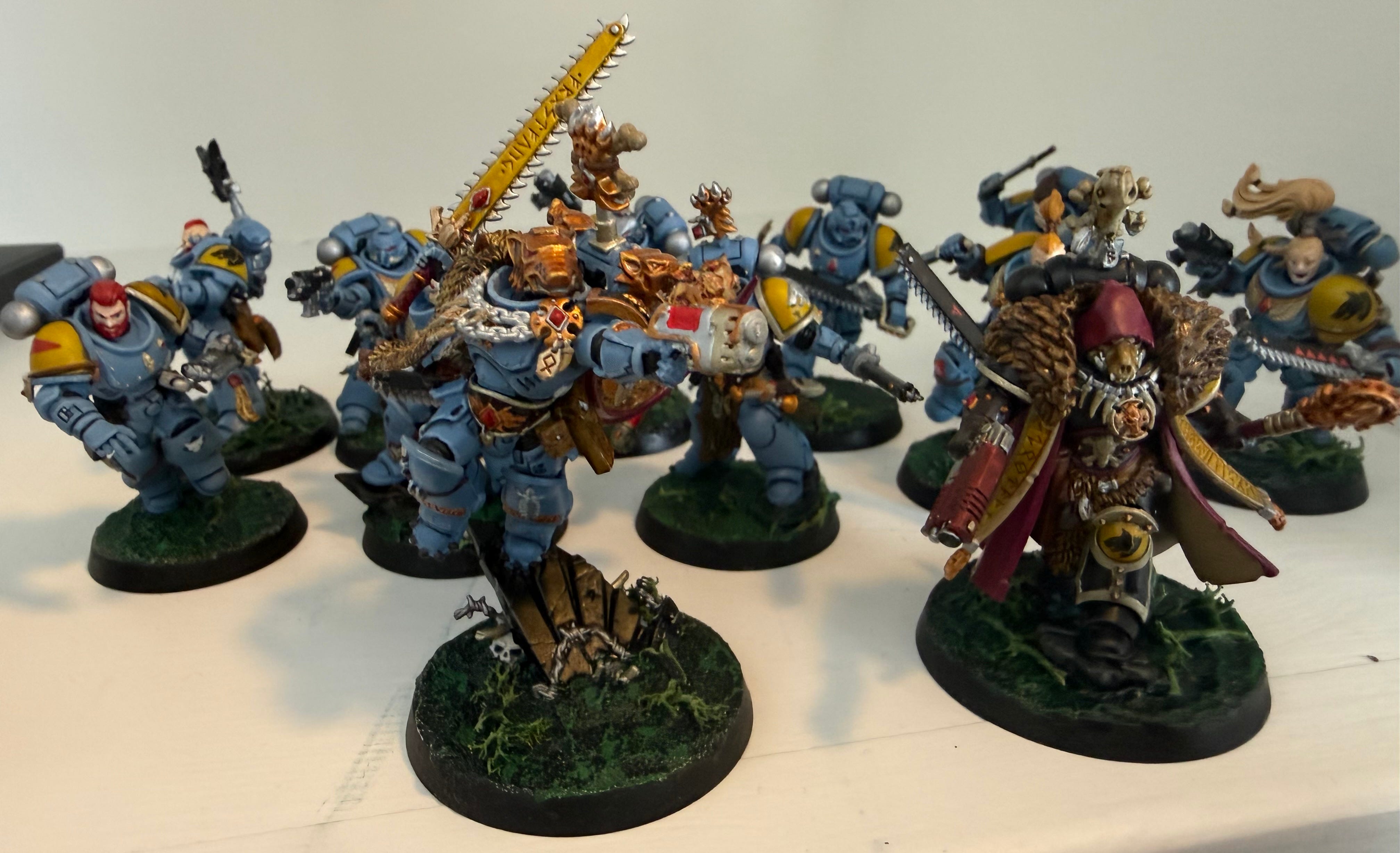
I also dabbled in Space Wolves when their refresh was released earlier this year. My father always loved Wolves the best. I was skeptical of their aesthetic for a long time, and several old kits lay unbuilt in my closet for over a decade. But I decided to finally make use of them and buy some Grey Hunters, just for fun.
Looking over those new Grey Hunters, I realized that they were some of the best sculpts I’d ever built. I loved painting them. So I got Blood Claws. And a few characters, to build out a custom Angels of Death kill team. And I read through Russ’ books in the Heresy.
It turns out, I actually do like the Space Wolves. Russ might even be my favorite Primarch.

My Wolves are, I think, my best-painted miniatures. Some of the highlights are too soft to make out, but Warpaints Fanatic’s Wolf Grey goes on smoothly despite my mishandling, and though it’s basic, I’m proud of the freehand pack markings on their shoulders and knees.

Maybe the first models I was ever proud of, before returning to repaint much of my Blood Angels, were my Tempestus Aquilons. I probably spent a hundred hours on this squad. It was an agonizing two weeks that drained every moment of my free time and idle thought. But I will always have these figures as proof of that time spent, no matter what the results objectively are:
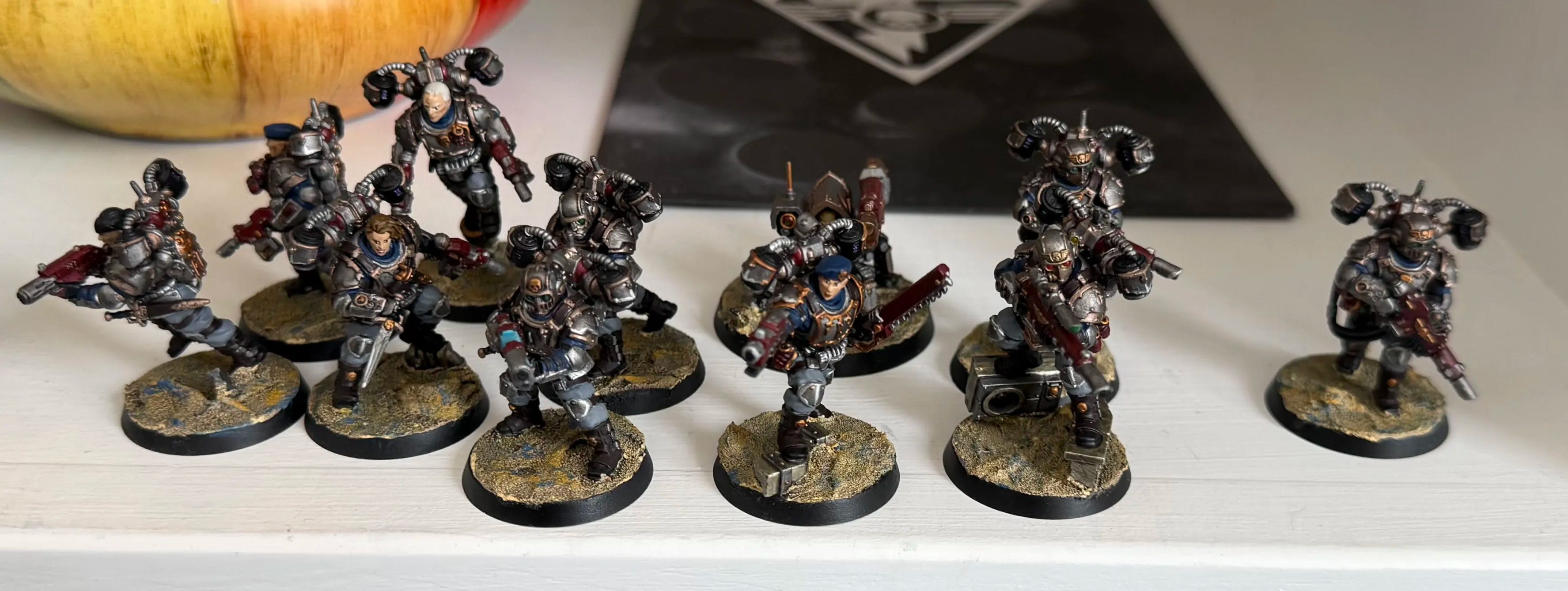
My final project for the year was the new Deathwatch squad. I do not enjoy painting black, but I repainted my entire Death Company in practice, then used what I’d learned. I challenged myself to finish one mini a night, every night, until the entire squad was done: no matter how good or bad that mini was, I could spend no more than one day on it.
The results were fantastic. I didn’t need more than six hours for any marine. Most took around four. The last two took significantly less. All of them look great, for my level of skill.
I still don’t like painting black.

My crowning achievement for the year must be Miao Ying. She’s my favorite lord in Total War: Warhammer III by far, and her new sculpt for The Old World is among the best GW has ever released—now officially voted the best of their non-40k models for the year. I had intended to start a Grand Cathay army, but I decided that I didn’t want to paint several hundred near-identical peasant levies.
Maybe someday.
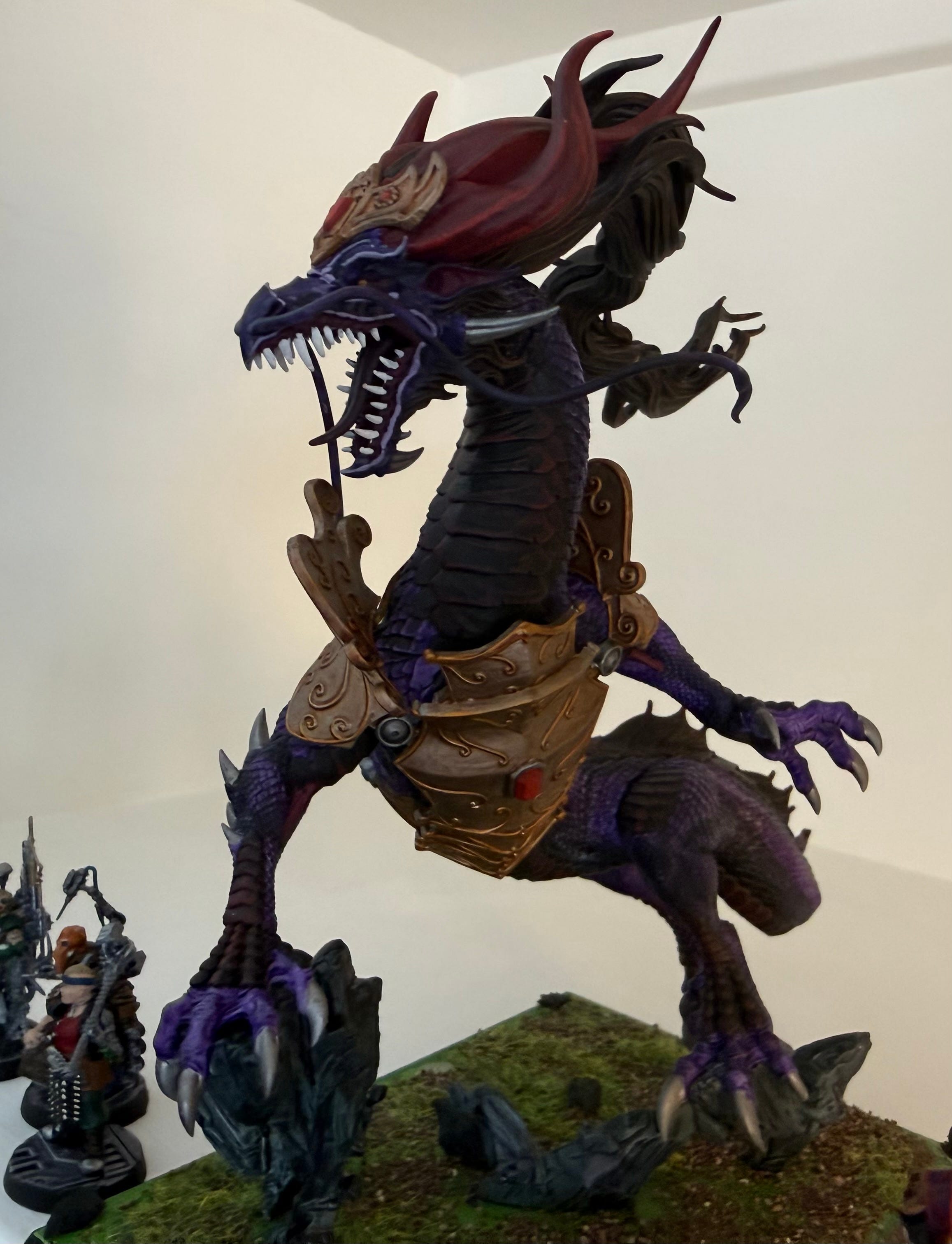
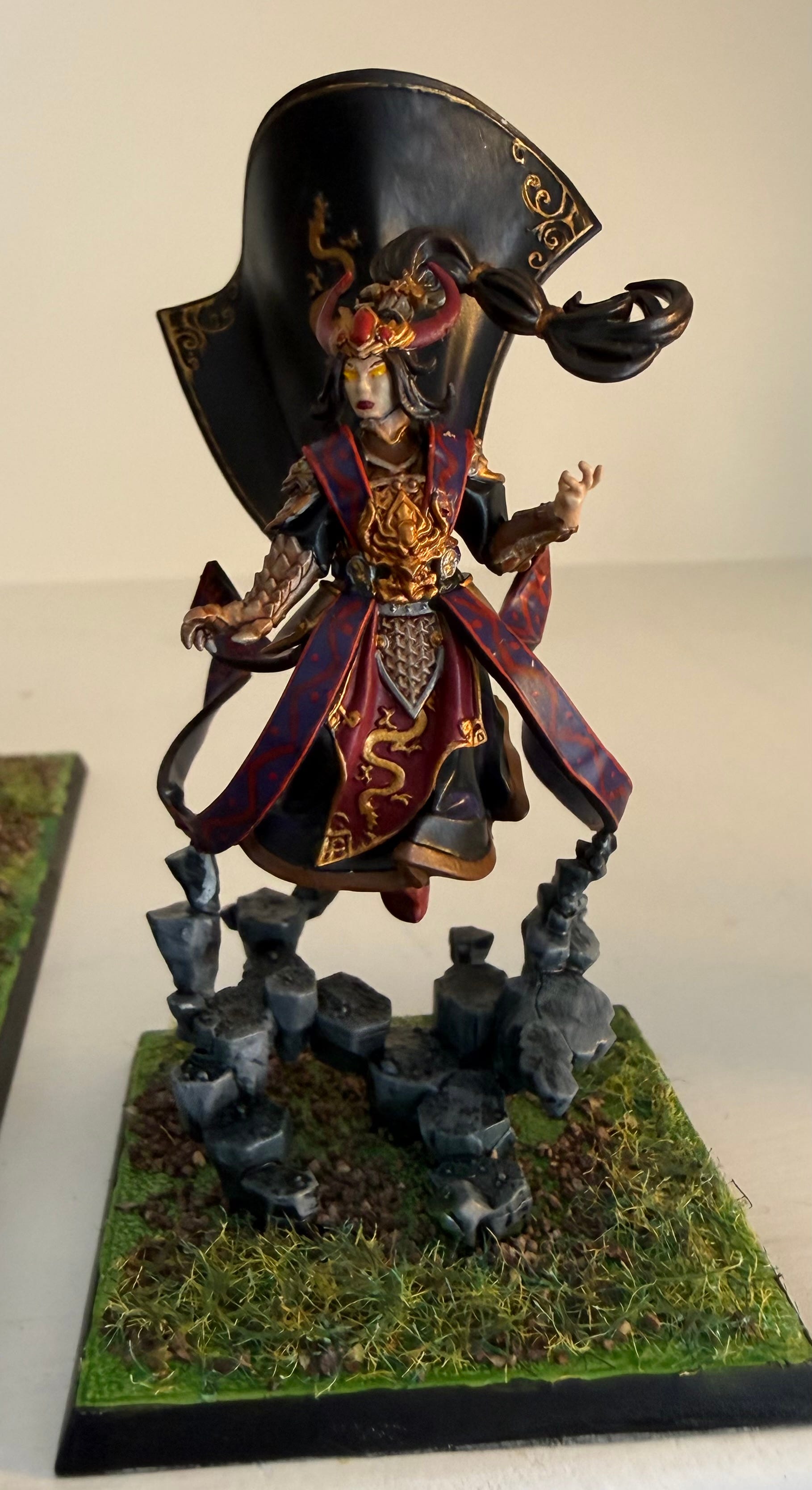
I don’t think she came out especially well. The freehand is messy, to say the least, and my drybrushing on the dragon’s scales looks awful. I had to hide it with a gallon of purple wash to salvage the paintjob. But she’s still a beautiful model, and she looks great on my shelf.
More than any other skill over the last fourteen months, I have been obsessed with learning how to paint faces. I have watched hundreds of hours of tutorials and scoured the Internet for blog posts explaining how to make model faces look right. Mostly I found the advice totally useless. It always centered around placing highlights, despite never saying where the highlights should go, and almost everyone said not to bother painting eyes or eyebrows—the two details that I quickly found made even the most poorly painted face look incredibly good.
I like unhelmeted heads. Faces give miniatures character. I wanted to be able to paint them well. But it was not easy.
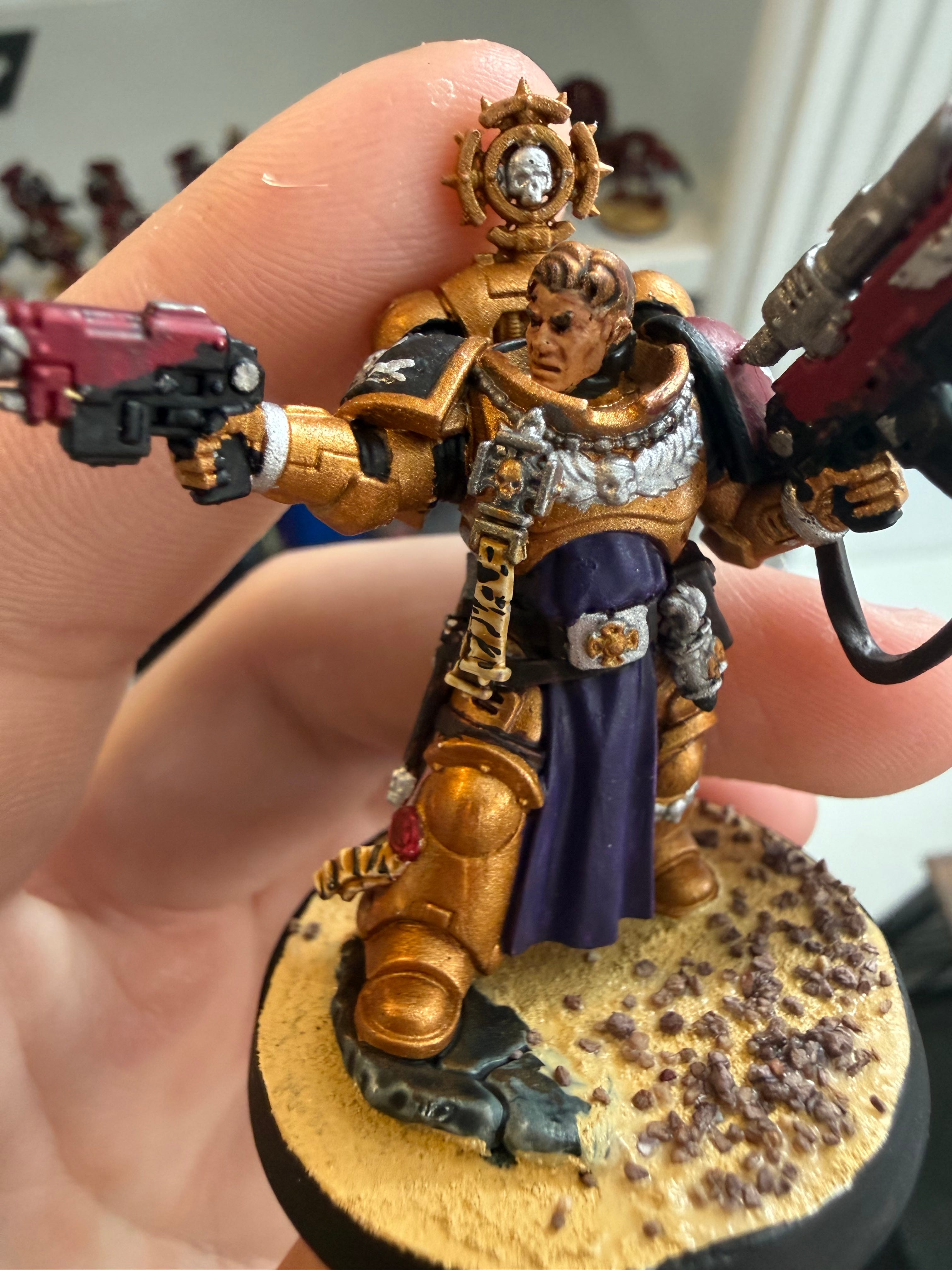
This is one of the first models I did, after sorting out the basics, and is one of the only in my army that I haven’t repainted. At the time I considered his face to be the best I was capable of. Just getting a smooth layer of flesh tone was challenging. I still often struggle with this. I added a wash into his eyes and small lines for the brow and dared to do no more.
If this were easily replicable, I would have stayed at this level for a long time. But I found that even this face had basically been a fluke. For the next six months I tried and failed to paint faces that were this good.
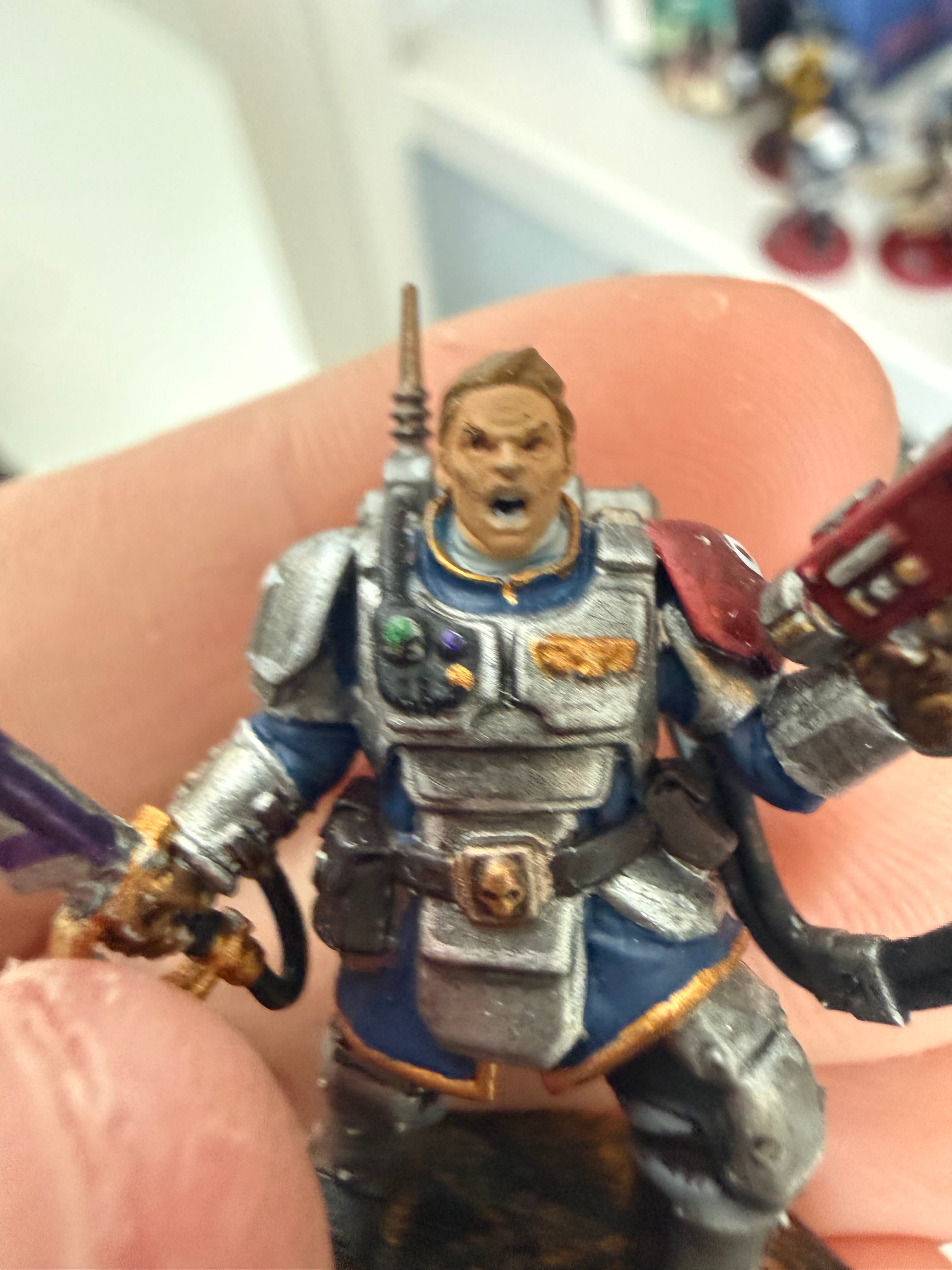
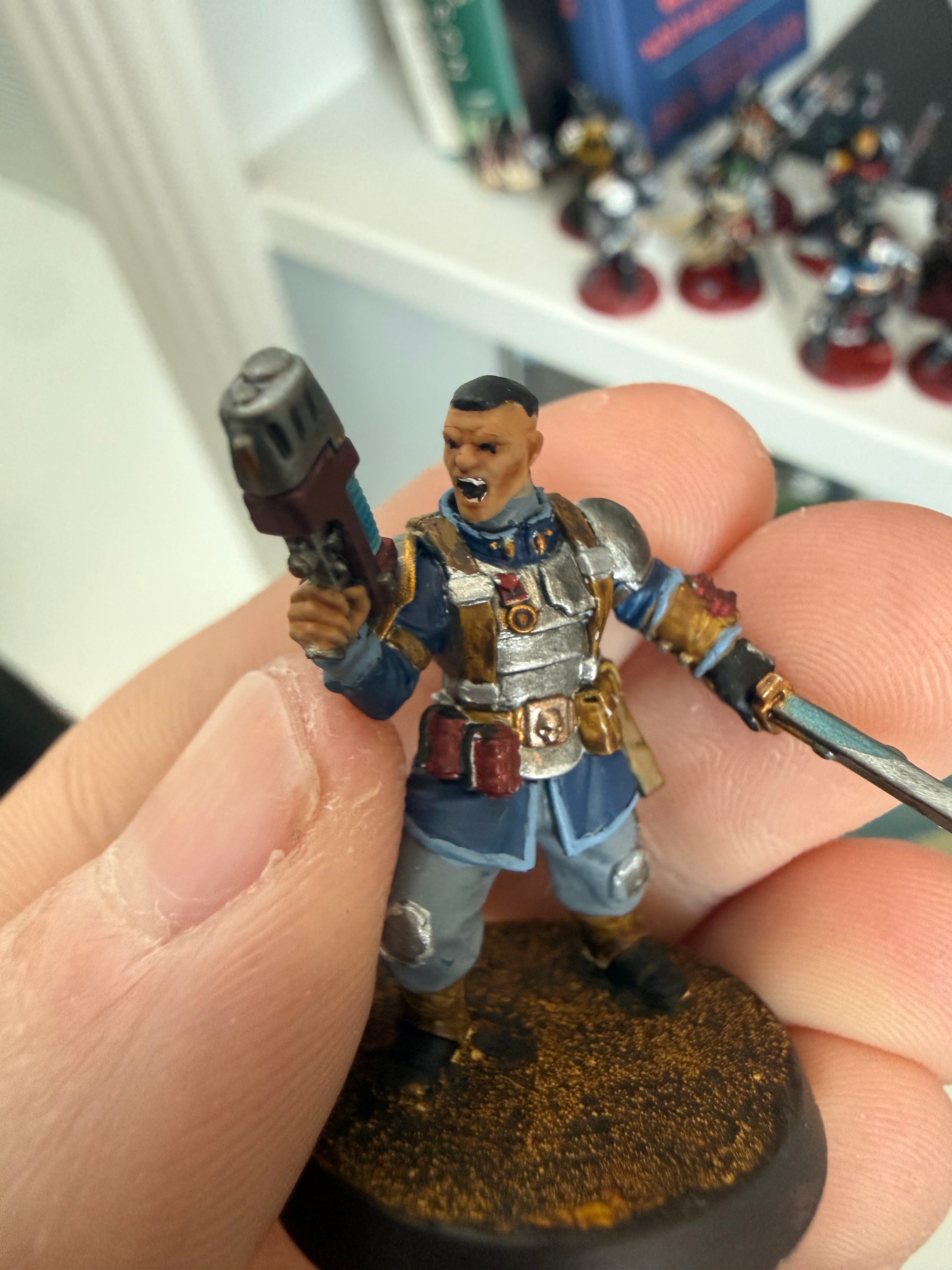
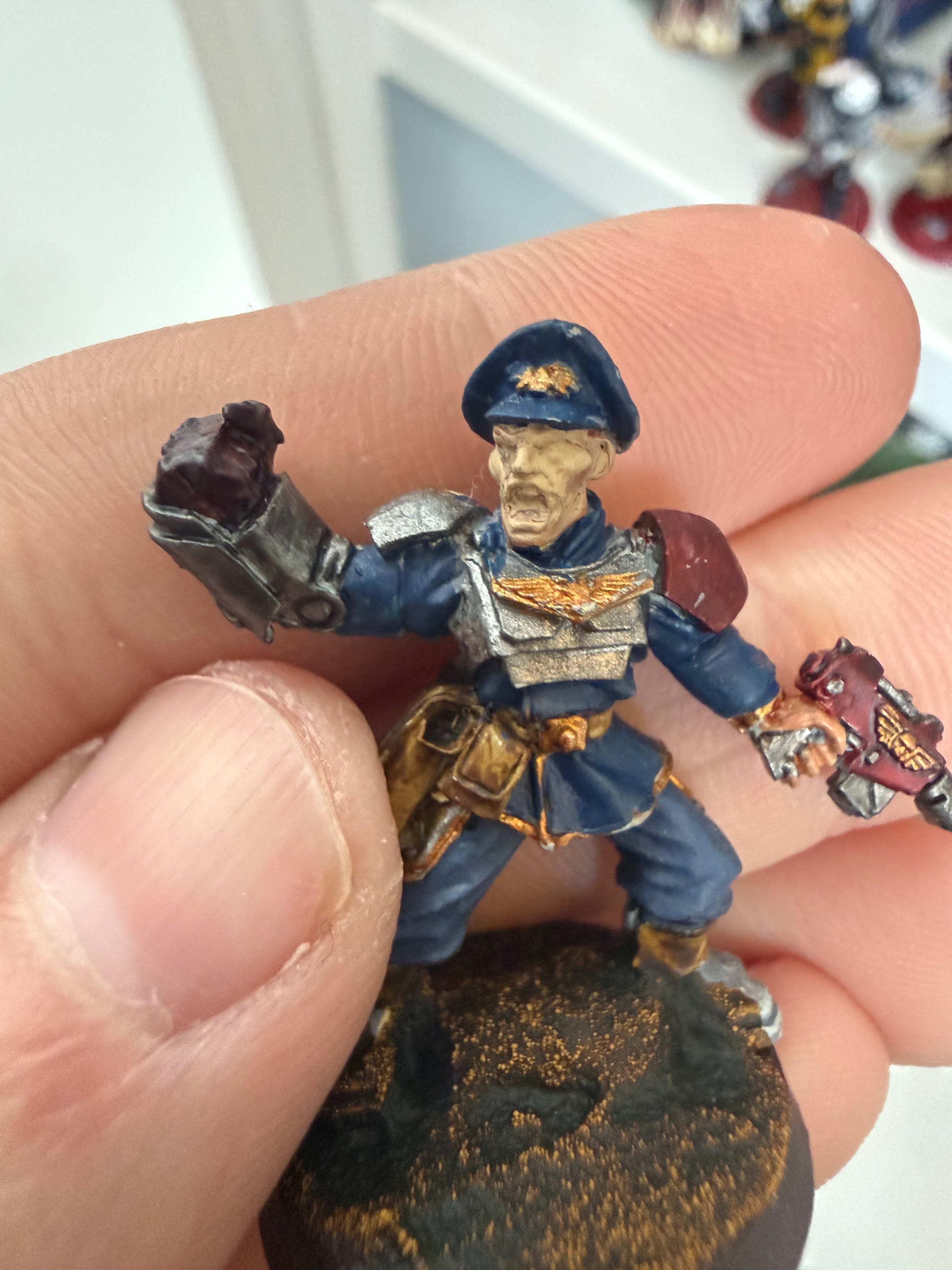
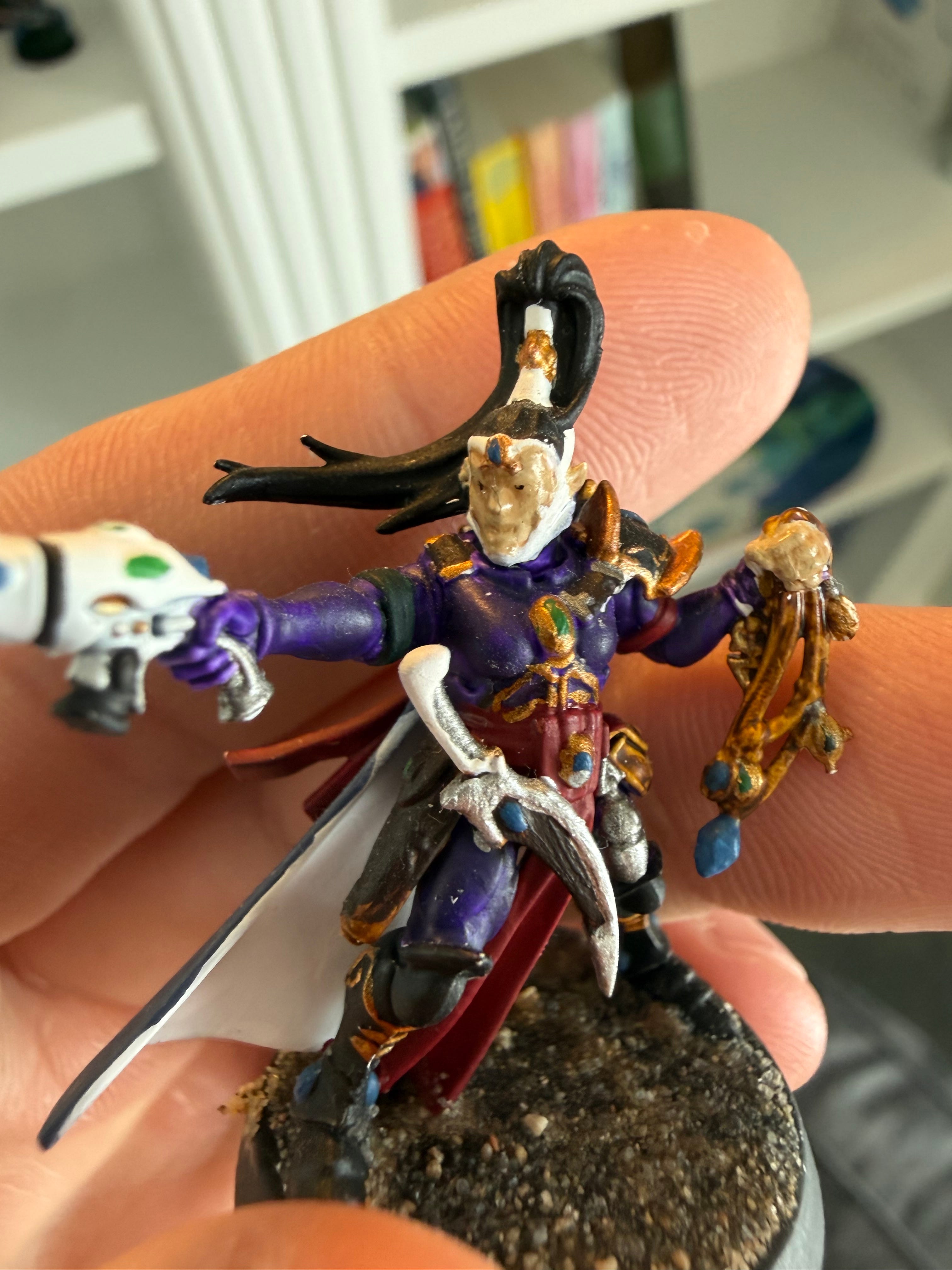
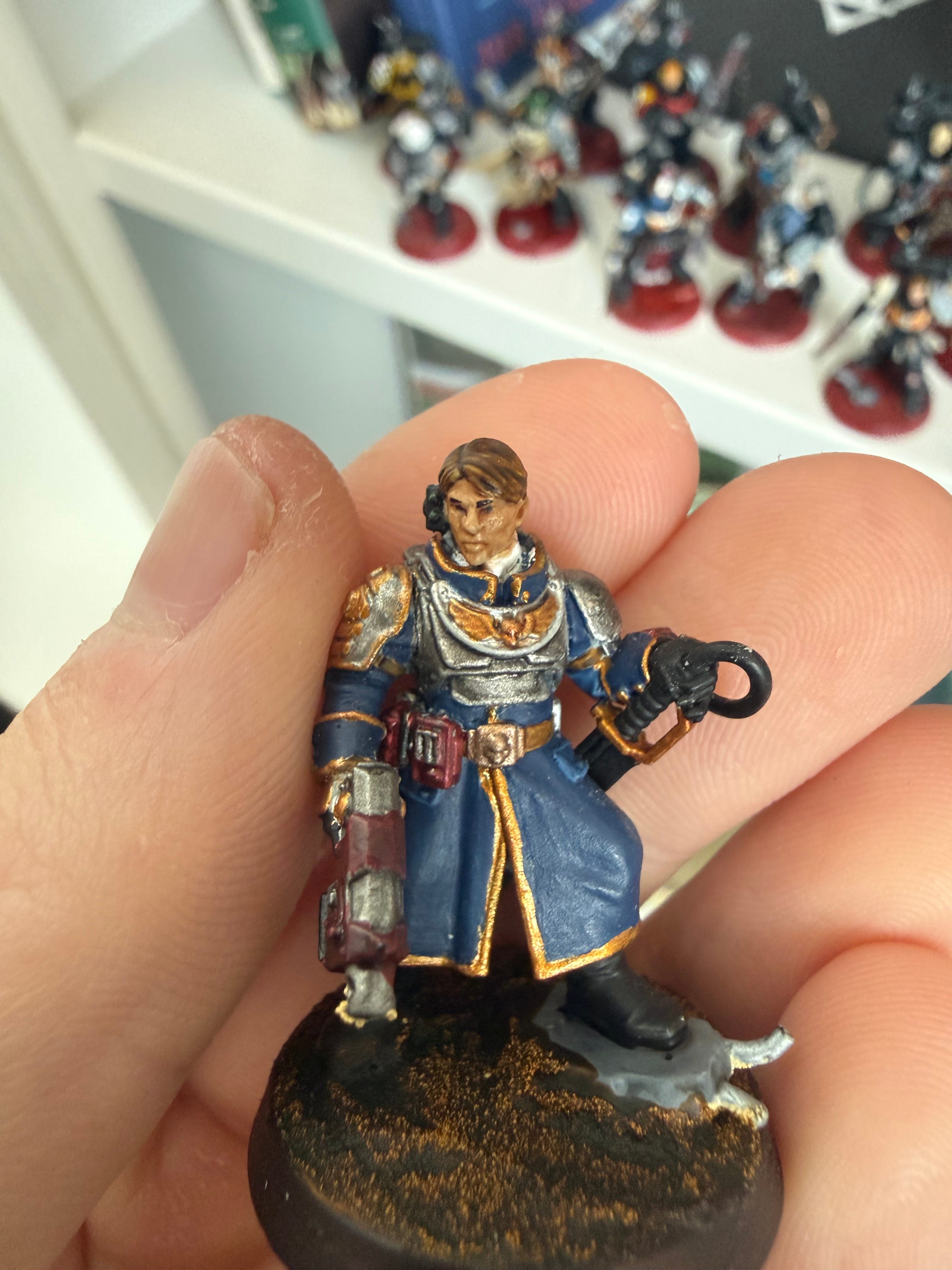
Though some came out better than others, nothing I read worked. The flesh tones people said to use always came out too dark. My highlights were always too harsh, creating too much contrast. Washes never looked right. I couldn’t layer detail back onto the faces correctly. My brush control wasn’t good enough to make the shading stand out.

This changed when I painted Saint Celestine to be my Sanguinor proxy. I kitbashed her as a custom warp entity called the “Bride of Sanguinius,” then followed a painting guide and simply added white to her eyes, instead of black or shade like I had before.
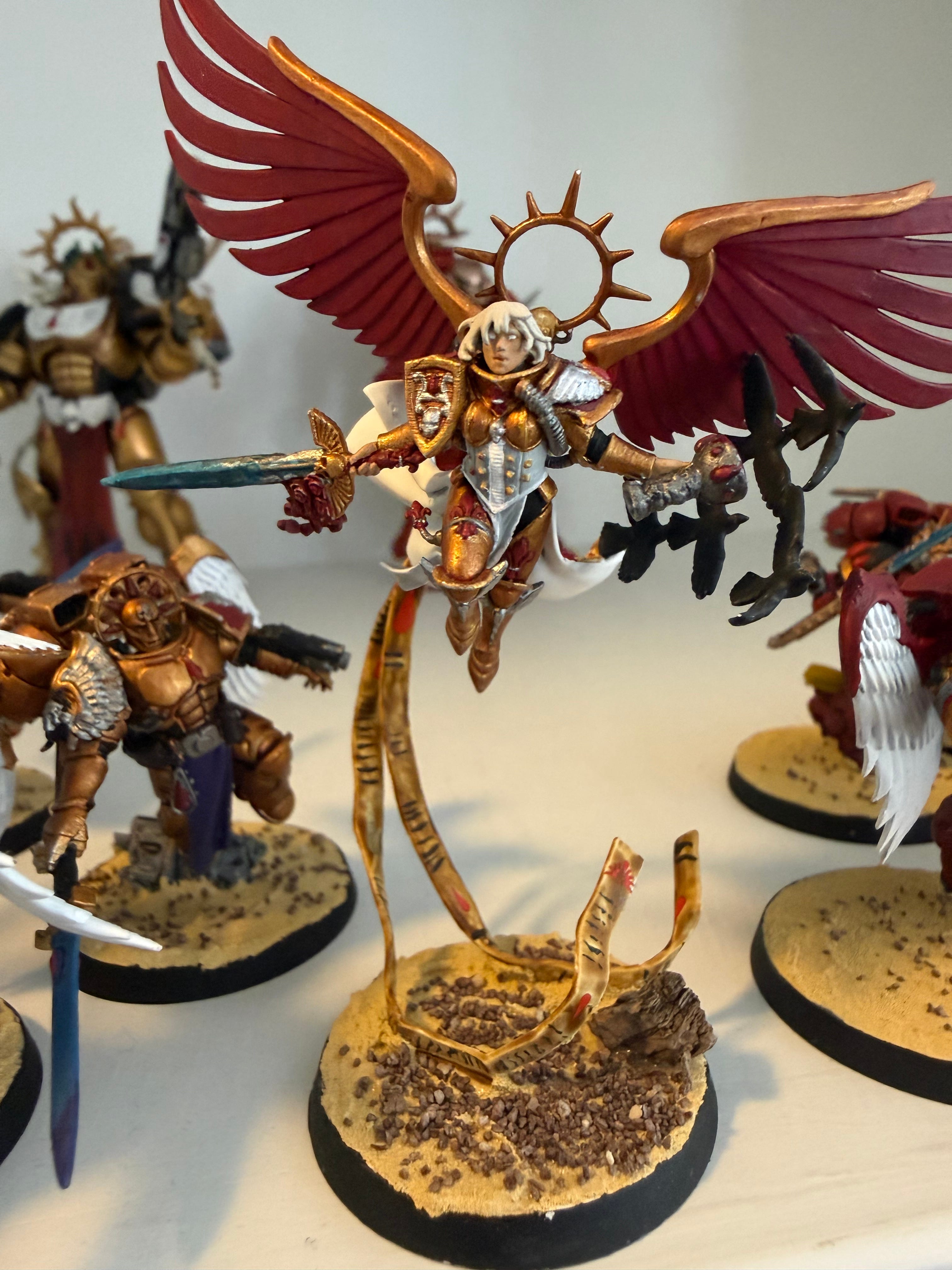
It was messy. It took three tries, stripping and repriming the head. But it wasn’t as hard as I expected it to be.
It looked good.
If I could paint the whites of the eyes, then I could surely add in dots of black?
For the rest of the year, this became my challenge. I practiced at every opportunity. It was extremely tedious. Constantly the paint wouldn’t flow from my brush when attempting to dot the pupils on my miniatures. I missed about 85% of the time. Success or failure came down to a fluke. When a face did turn out well, I had no idea why. One among a squad of five would look fantastic. The rest would look as bad as the day I’d started.
Imperial Guard gave me room to experiment.

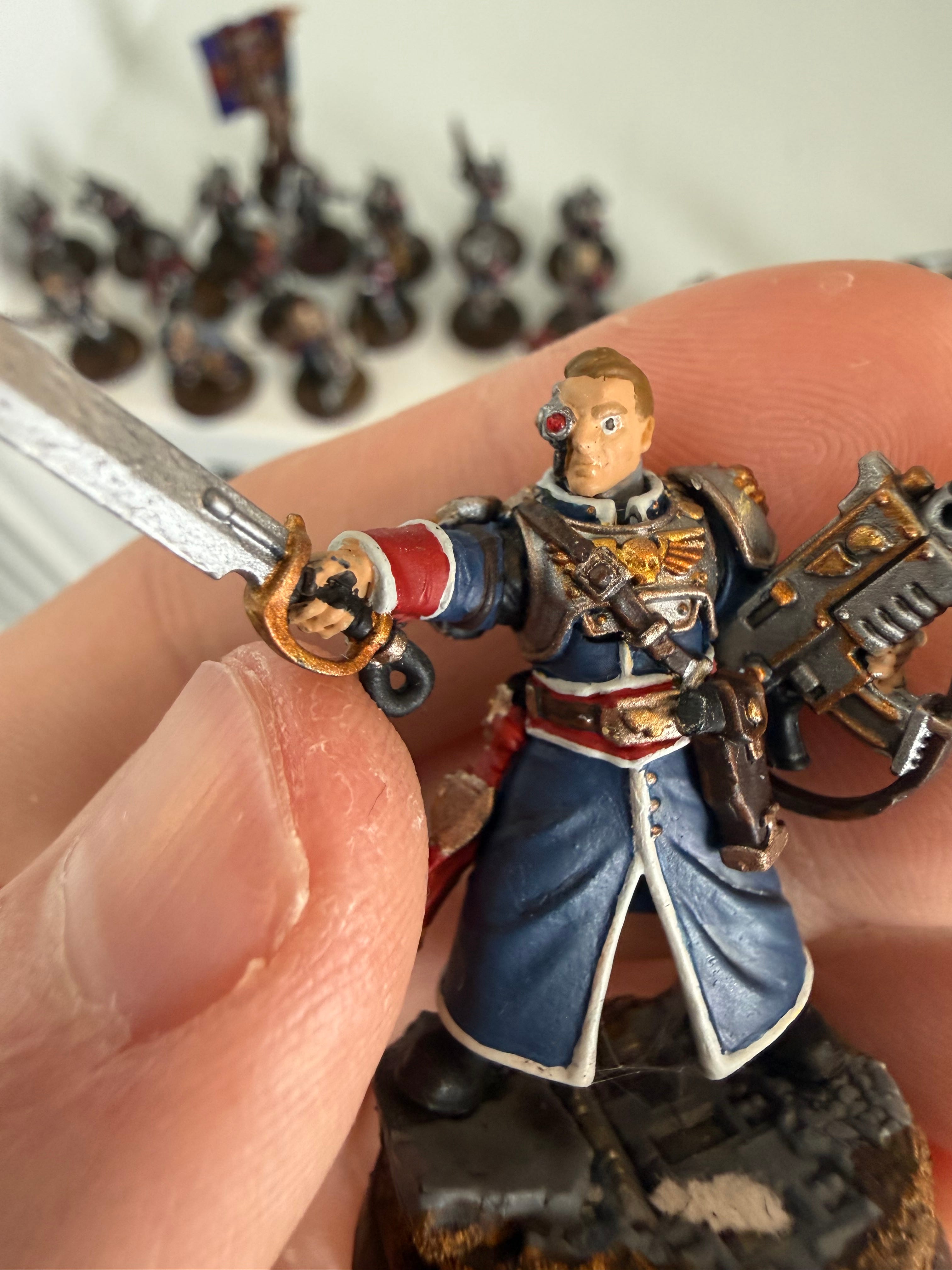
Then, with Space Wolves, I felt like I was making progress:

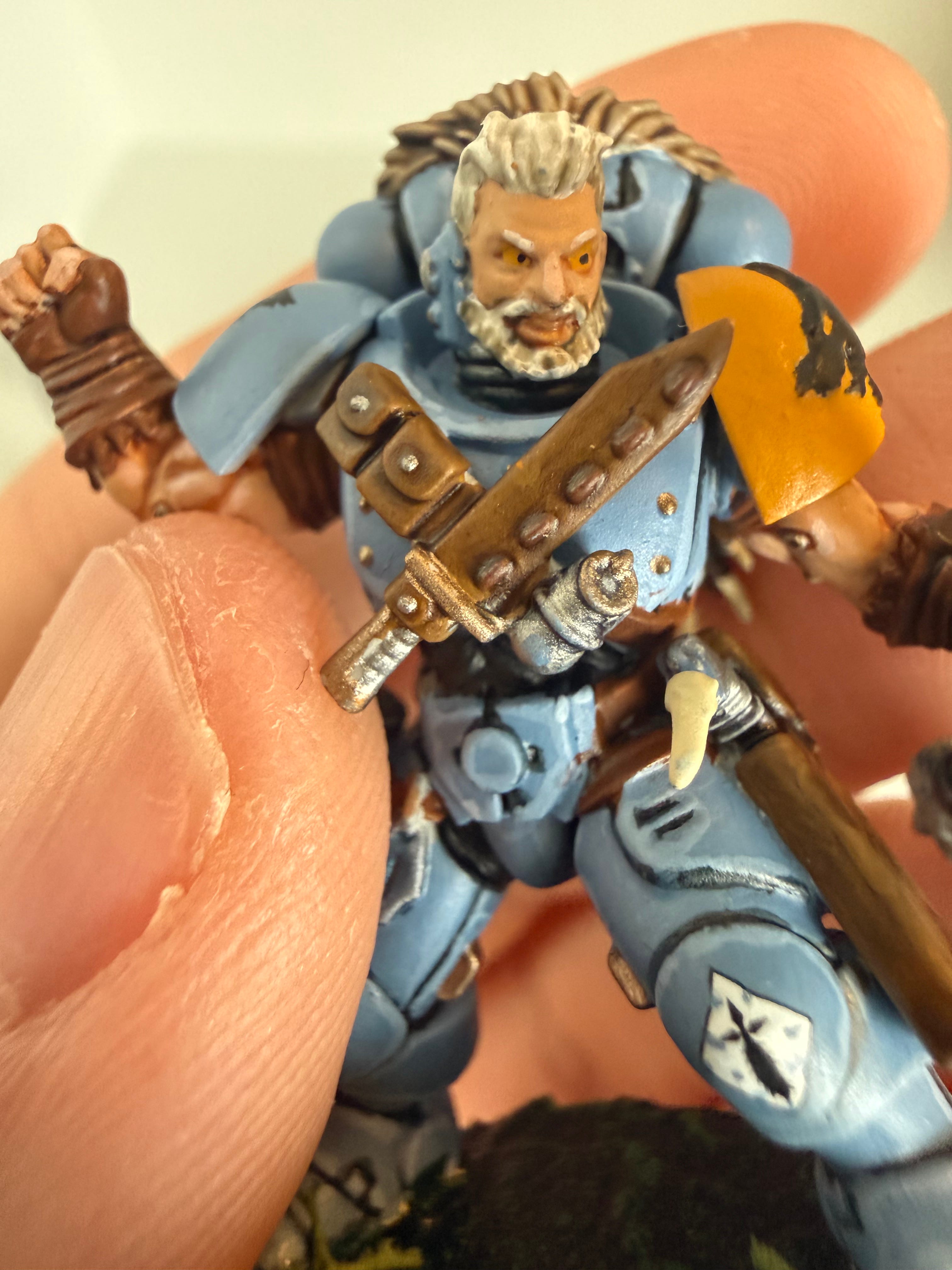
I decided to ditch black paint and get some .5 mm pens to use for eyes instead. This was the best decision I’d made in the hobby. It’s extremely easy to dot pupils using these pens. Combined with an increased understanding of shading, highlighting, and how to mix paints for a midtone, I’m no longer ashamed to show off the faces I’ve painted.
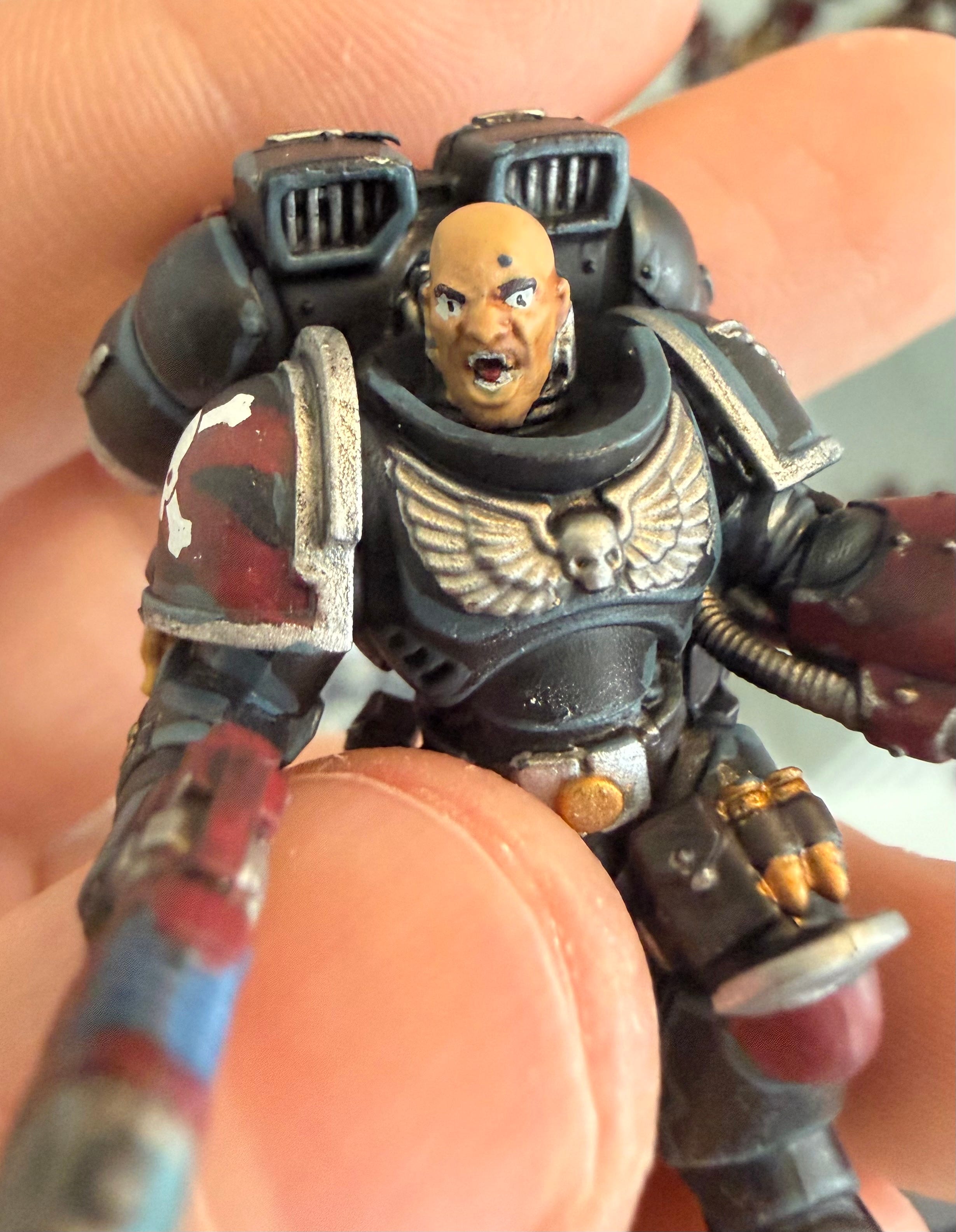
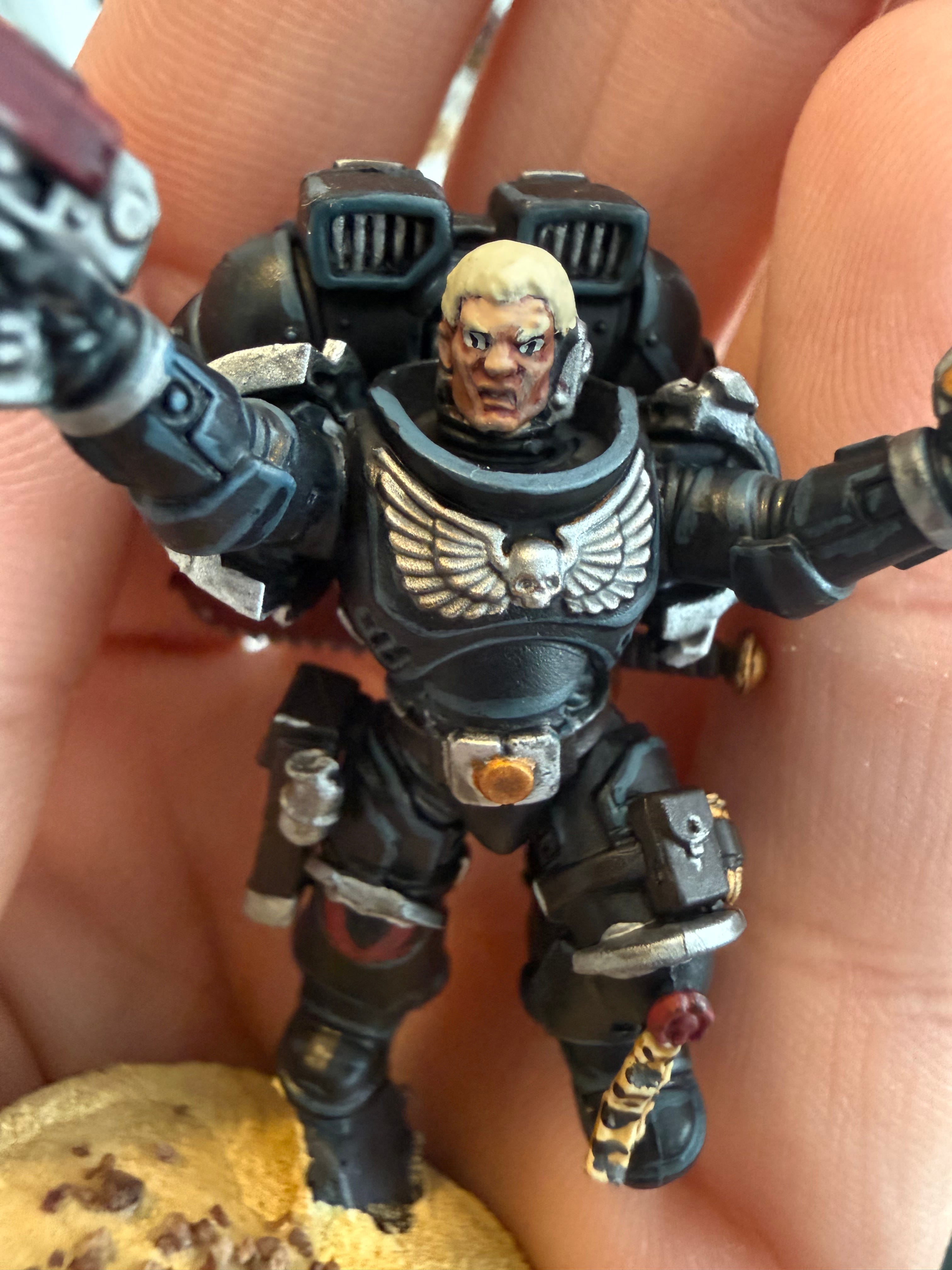
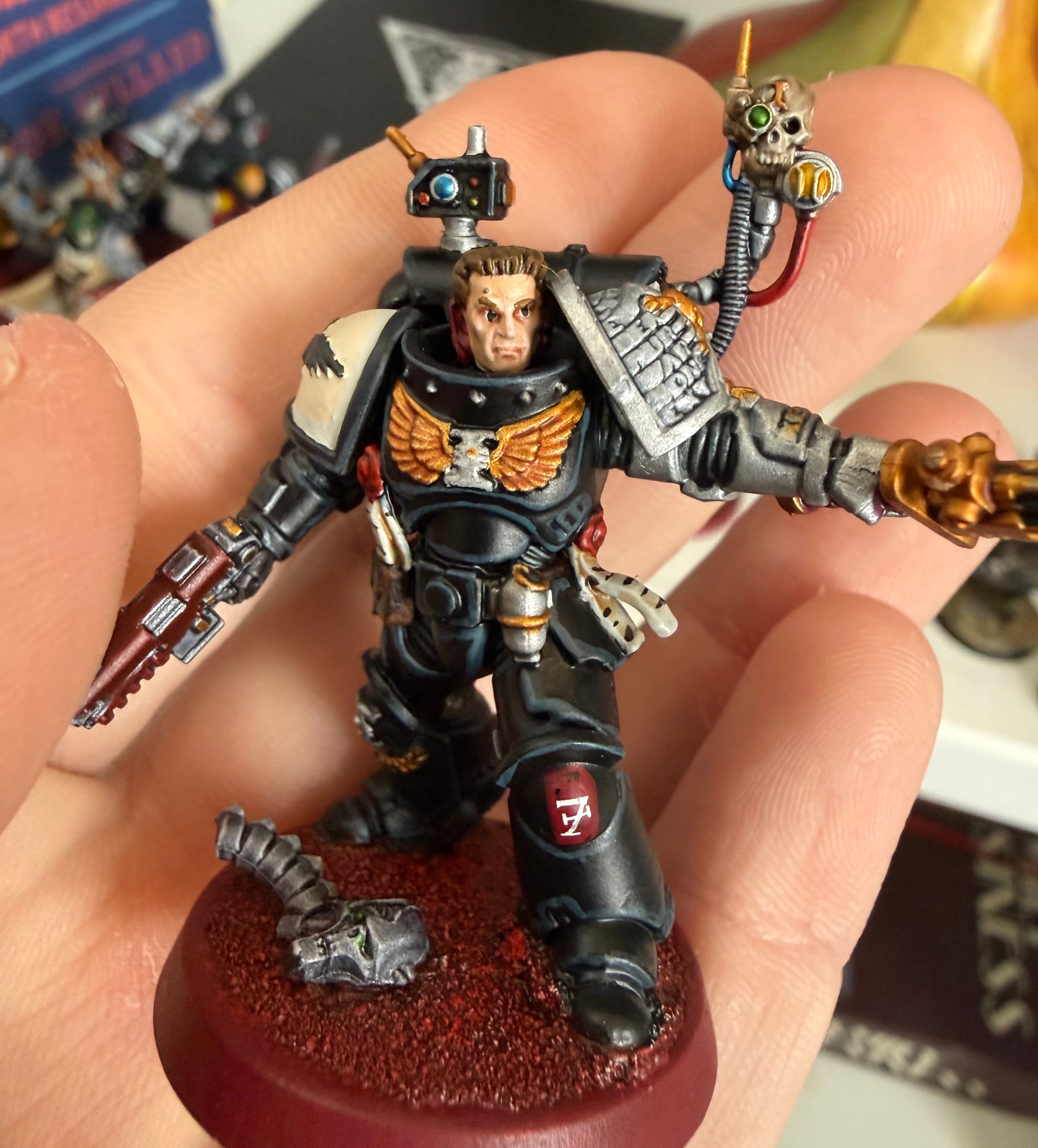
Almost any time someone online mentions painting faces, they will be given the advice to skip the eyes because it’s too hard. Well, man the fuck up, because if I can do it, you can, too. Get a micron pen or a sharp brush and some Black Legion contrast paint and dot those fucking eyes. It really does make a difference. Faces with eyes look so much better than ones without. They have an entire world more humanity to them.
Eyes are the auspex to the soul. Your Space Marines cannot have souls without them. And add on eyebrows, too.

I still often have no idea what I did to make one face look good and another look bad. I have no intuitive understanding of any of this. Painting does not come naturally to me at all. It is a foreign language, spoken in a foreign country. But it’s starting to feel more like home.
What’s Next?
I don’t plan on stopping. I’d like to learn the rules and play more games as we get ready for 11th Edition, though it’s challenging to find people where I currently am. I’m interested in 2nd Edition and working on a retro army, and I’d also like to step back from 40,000 and descend into the Horus Heresy. After having built a few kits of 30k marines, I’ve found that the more realistic proportions are much more appealing to me. I’m currently preparing to paint a small Isstvan III last stand force of Emperor’s Children. From there, I will go where the winds of my whims carry me.
I fear that I haven’t been improving much over the last several months. Now comfortably highlighting and shading my models, I’m not sure I’ll ever be able to move on to more advanced techniques. My brush control simply isn’t good enough to spend hours layering or glazing an armor panel, when there’s such a constant risk of mistakes. Painting in sub-assemblies could mitigate those fears, but building and kitbashing is my favorite part of the hobby. I’d rather not dilute it in that way.
Maybe improvement isn’t necessary. Low as it may be, in a single year I’ve achieved a level of skill I never thought I’d be able to reach. And that is only one year.
Warhammer is ridiculously expensive. It’s time-consuming. It kills my back. I will never be as good at it as most people who have invested the same amount of effort into it that I have. But compared to video games, movies, television, and really all of pop culture—well, I’d rather go paint some more minis. I don’t see that changing any time soon.
One Last Self-Indulgence
For the sake of logging my progress, at the end of 2025, these are my four favorite models in my collection. They aren’t necessarily the best painted. Just the ones I like the best.
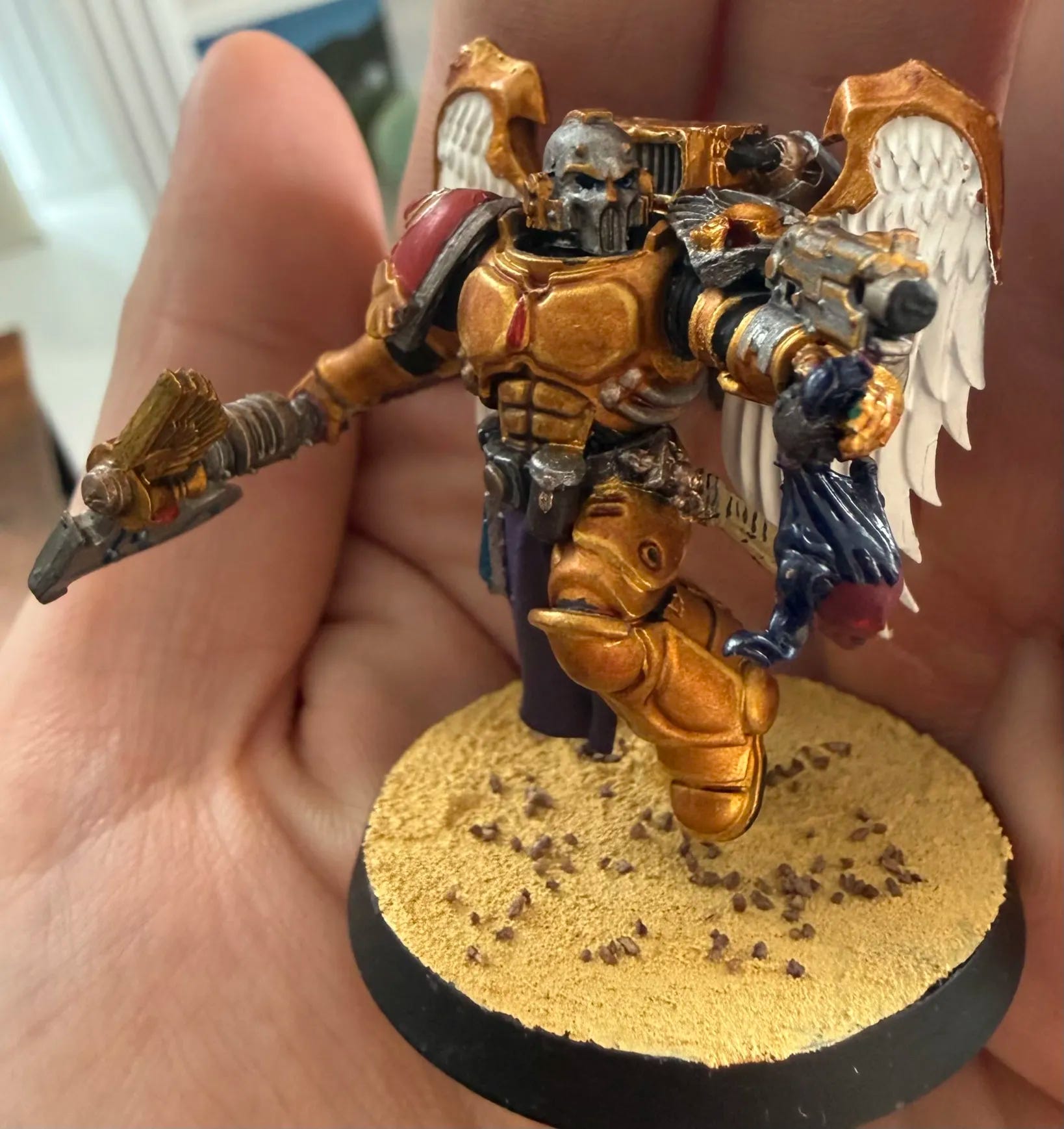
I wanted to create a squad of Sanguinary Guard that fit the true “Angel’s Tears” origins of my successor chapter. The best of their number was born from these obscenely expensive Heresy bits. I love the custom pose he has, wielding a severed head from an old Grey Knight. He looks like a ballerina performing a pirouette of death.
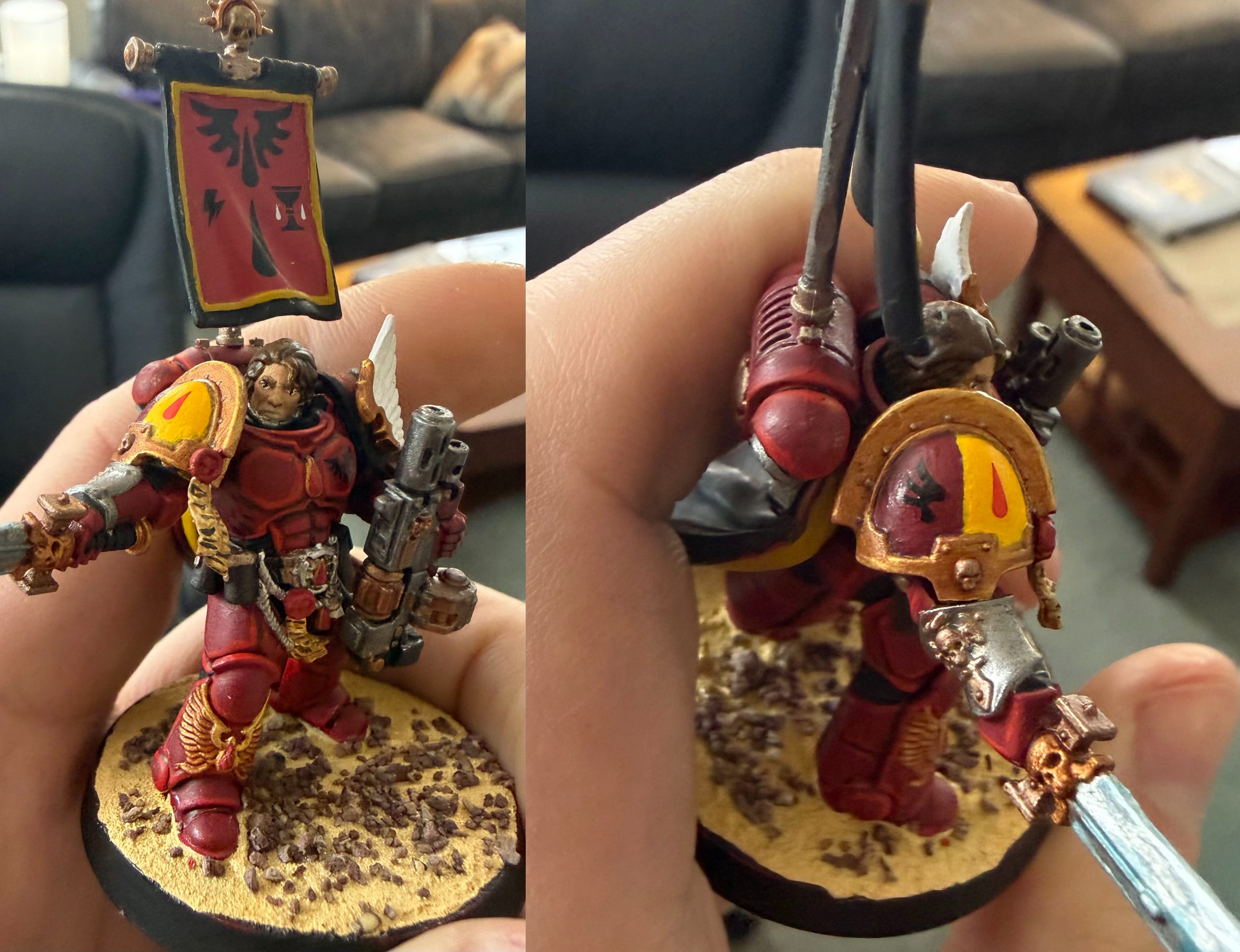
After finding myself with a second spare Blood Angels captain, I decided to turn one of them into an homage to the classic Tycho for my Fifth Company captain. This kitbash was the result. He was one of the first minis that ever received painted eyes, and although it’s extremely basic, I enjoyed the “freehand” of the retro-inspired heraldry I gave him. He’s completely unique. That’s what I find important.
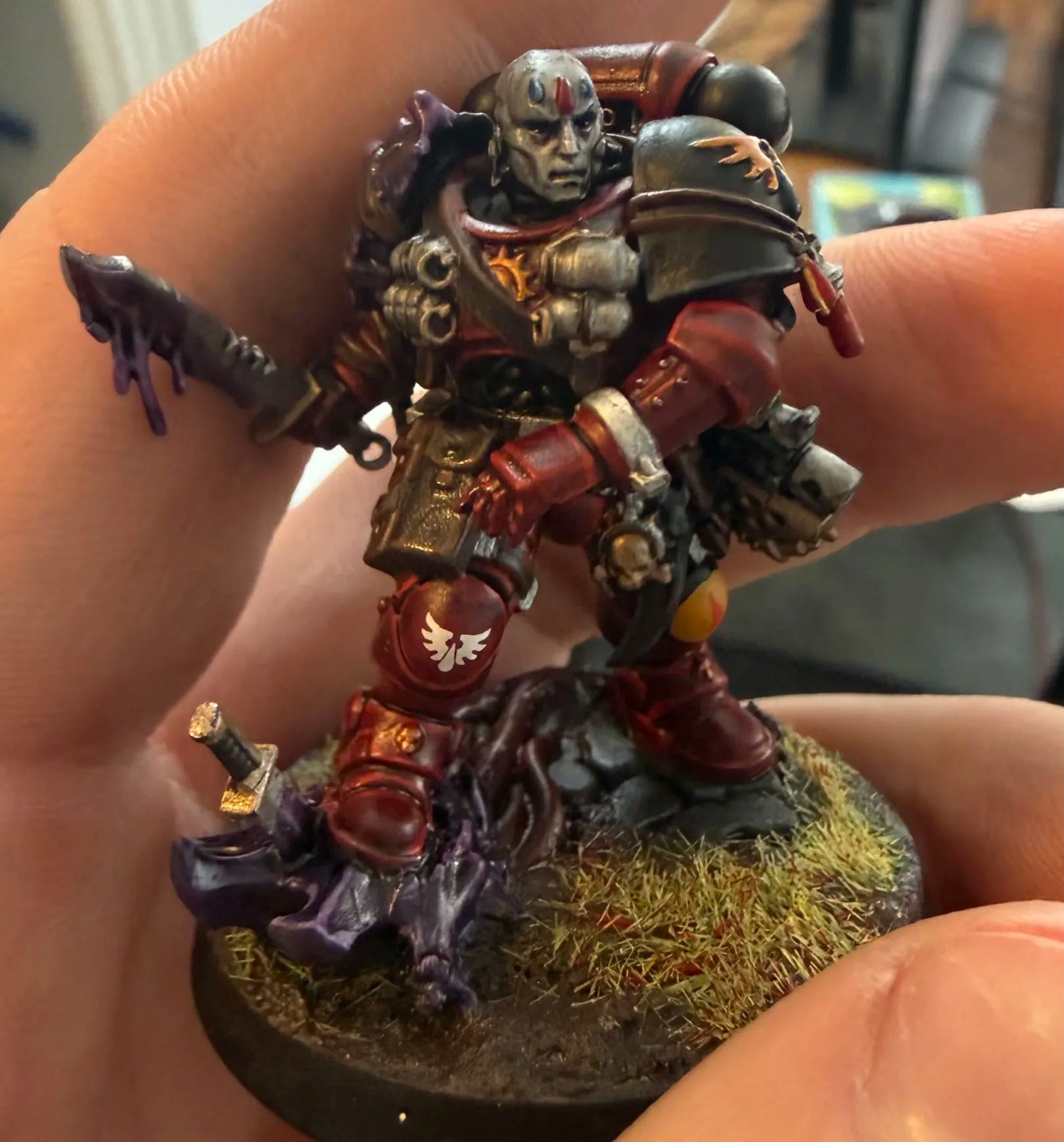
I’d been looking for a Combi-Lieutenant for a long time without luck. One day, at the local game store, there were two for sale.
This model had a rough coat of gray already established and came pre-based. Rather than stripping and starting over, I cut off his left arm and painted directly over what was there. The gray worked well as an undercoat for Khorne Red, and I finished him in a single sitting.
I don’t know why. But I’m extremely satisfied with the result. He just looks awesome.
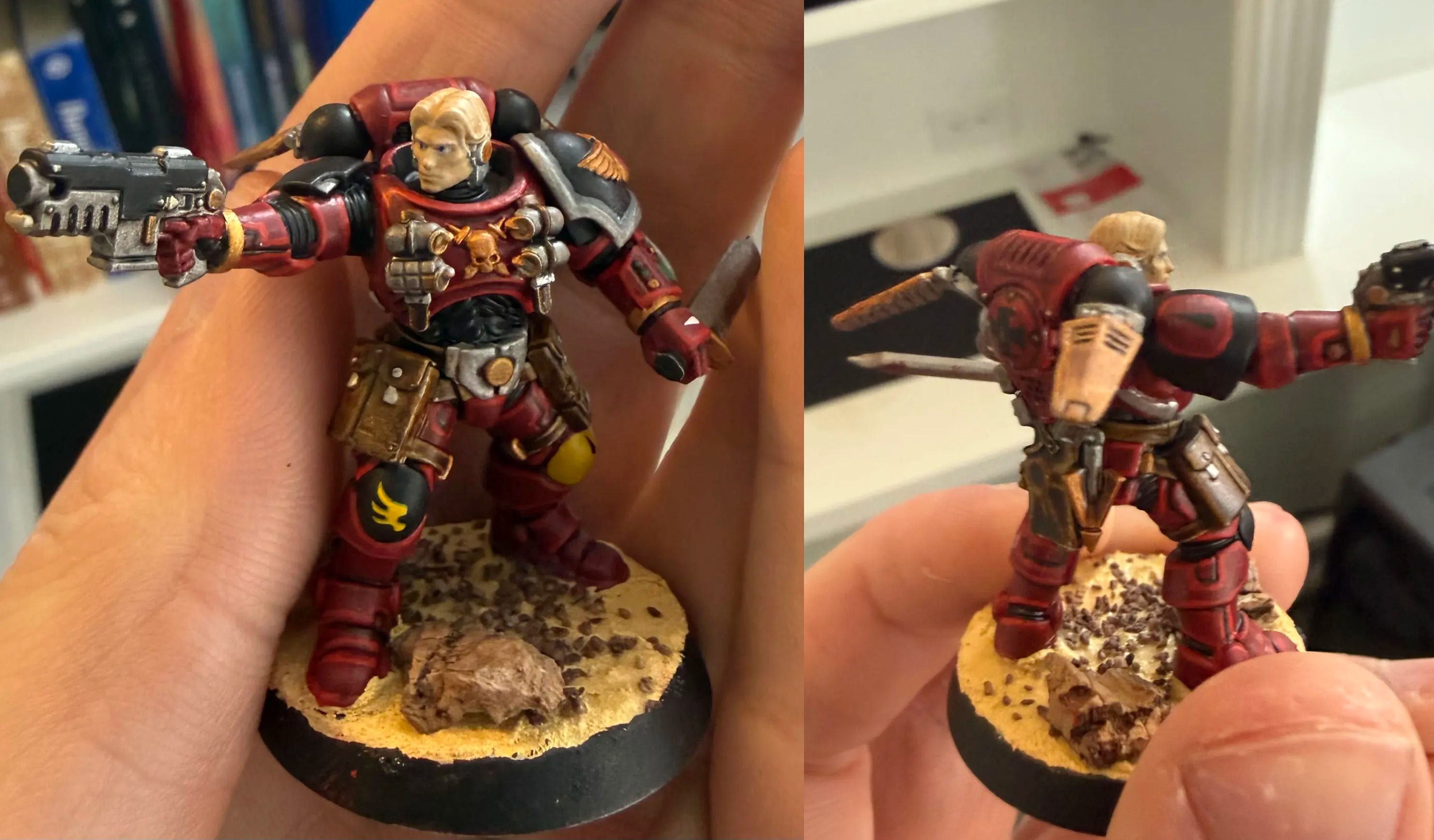
My favorite model of the year is this humble Reiver sergeant. The highlights on his armor turned out incredibly well. His face is smooth and angelic. The red looks fantastic and is as clean as I will ever be able to paint. But more than anything else, I’m proud of his right shoulderpad. There are no Tenth Company sergeant transfer decals. If I wanted him to look “right” with black pauldrons, I had to freehand my own.
So I did.
It doesn’t get much more basic than a red circle. For me, with my fine motor skill deficiencies, simply drawing that red circle was a tremendous challenge. It was far, far harder than perfectly dotting a thousand Guardsman pupils. And it’s still a little gnarly if you look too close.
I don’t care. I love it anyway. This is by far my favorite figure in my collection. My only hope is that by the end of next year, I’ll love someone new twice as much as him.
You are an incredible writer. Stumbled onto your substack after finding Starfield horrible, even though the reviews were quite good. I am happy you left this time-sucking world of video games and I hope you are finding greater fulfillment. Games are just too much time to spend in life with little enjoyment. But then again, so is social media. Anyway I want to paint now. Thanks! -ed